





 |
|
|||||||||||||||
 |
||||||||||||||||











 |
|||
 |
Nazareth Church (Basilica) of the Annunciation – History, Architecture & Significance 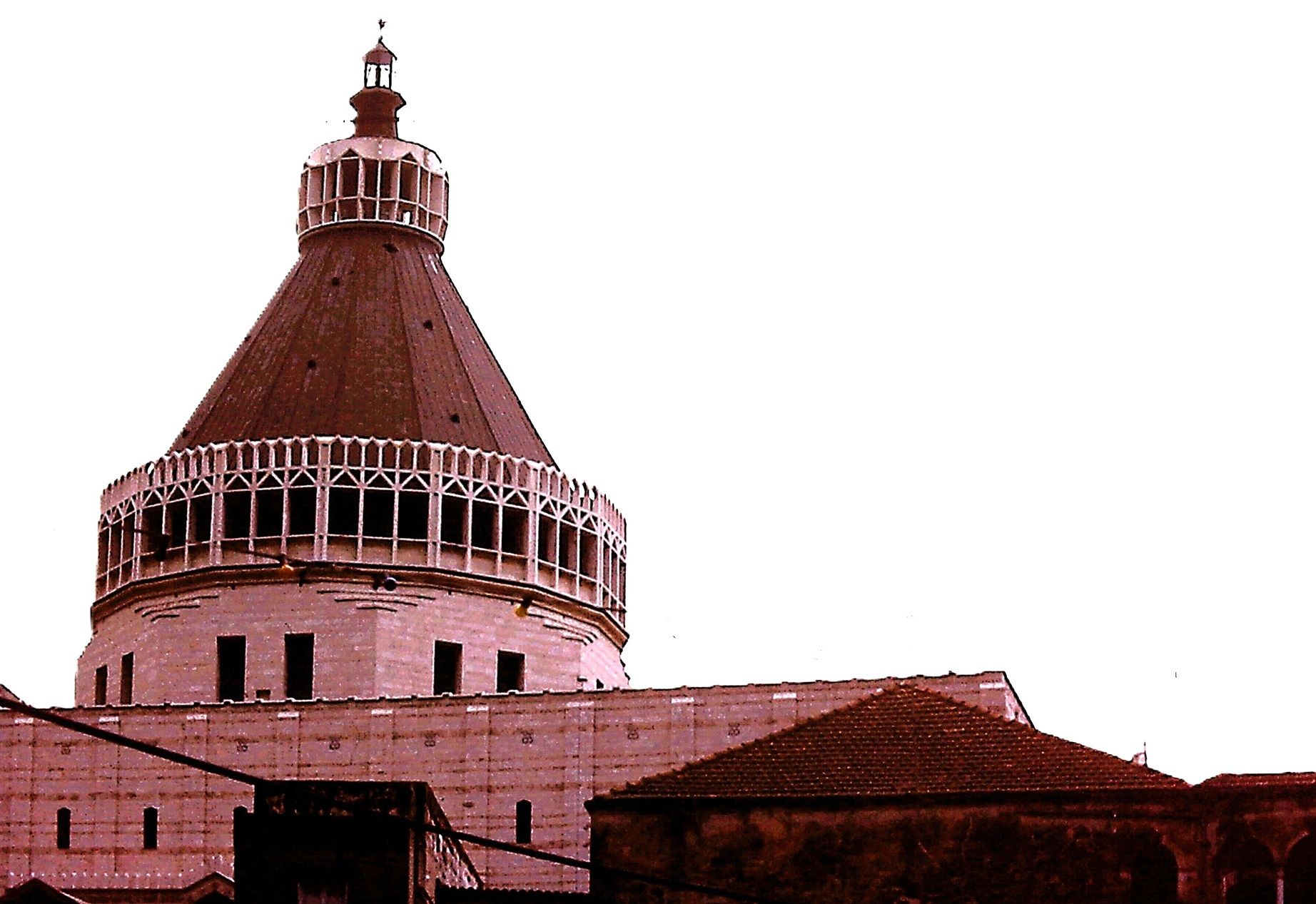
The Church of the Annunciation in Nazareth is built over what Catholic tradition identifies as Mary’s childhood home, and marks where the Archangel Gabriel announced to Mary that she would conceive Jesus, thus making it a focal point of global pilgrimage. The first shrine on the site is believed to have been commissioned under Emperor Constantine and his mother Helena, and was to established Nazareth as a key Christian centre. During the 12th century a larger Romanesque church was built by the Crusaders, although it was never fully completed and in 1260 it was destroyed by Mamluk forces. However, despite its destruction, Franciscan friars maintained a presence and devotion at the site. In 1730 following the Franciscans regaining limited rights, a modest church was built. The current basilica, designed by Giovanni and Giuseppe Muzio, is a monumental modern structure, that replaced the earlier buildings and incorporating their remains. This was completed in 1969. The exterior of the Basilica is considered one of the most distinctive modern church façades in the Middle East, combining reinforced‑concrete modernism with symbolic stone carving and a monumental vertical composition. Designed to incorporate 20th‑century modernist ecclesiastical architecture, blending concrete and stone. Its exterior is defined by cream‑colored limestone and reinforced concrete. The building rises in stacked tiers, culminating in the 55‑meter cupola, which dominates Nazareth’s skyline. The cupola’s form - an inverted lily - symbolizes Mary’s purity and visually “opens” toward heaven. The Main Entrance is located in the Western Façade and is carved with horizontal banding, inscriptions, and narrative reliefs that guide the visitor’s eye upward. It contains a Triple‑arched entrance depicting a traditional Christian motif signalling the Trinity and carved reliefs. The four evangelists - Matthew, Mark, Luke, and John - are carved above, linking the Incarnation to the Gospels. Bronze statue of Jesus - Positioned above the reliefs - symbolizing the Incarnation proclaimed below, and the Latin inscription: “The Word was made flesh, and dwelt among us” (John 1:14), carved across the façade, making the building itself a proclamation of the mystery it commemorates. 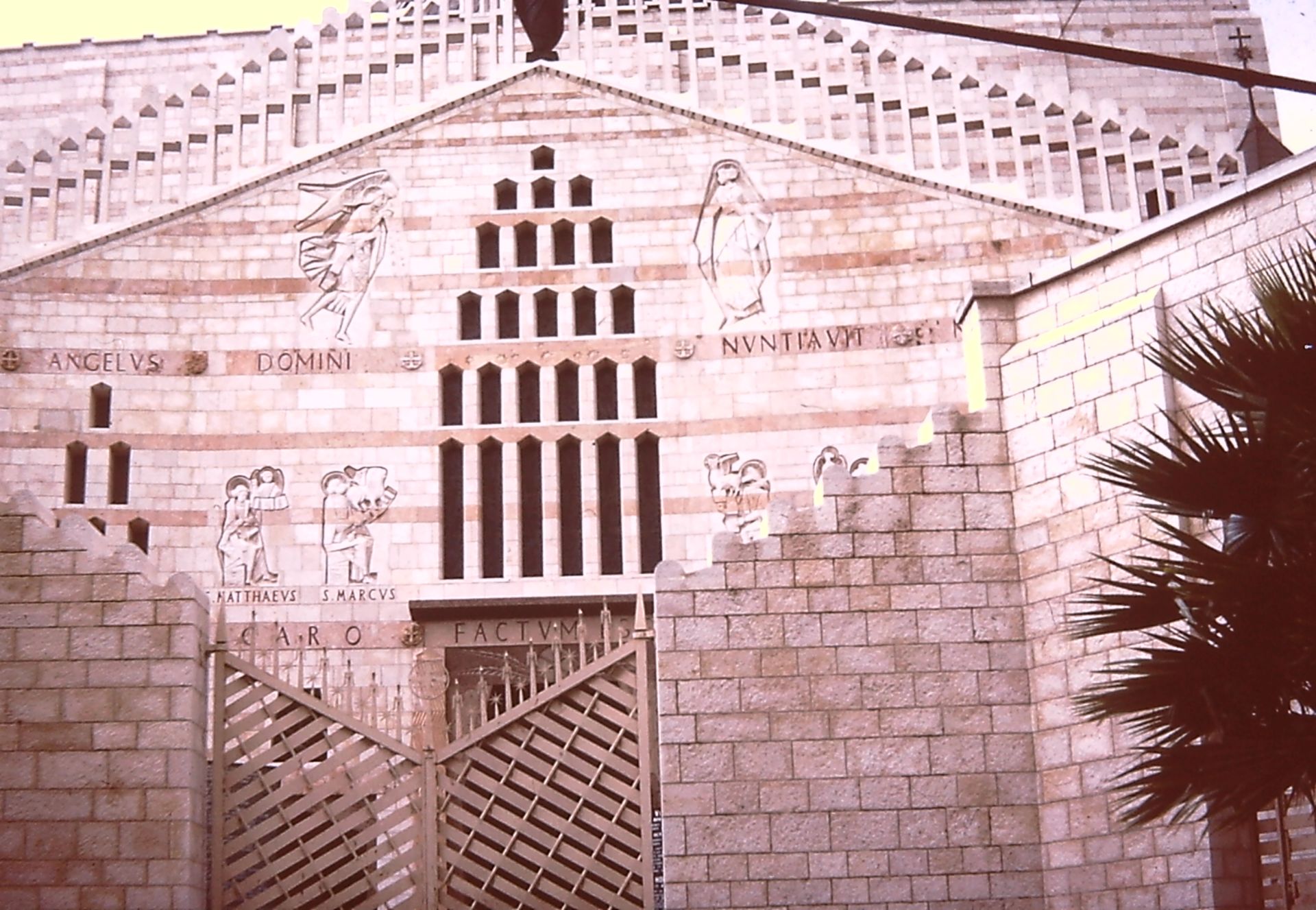 The main entrance is one of the most symbolically dense façades in modern sacred architecture. It functions as a visual proclamation of the Annunciation narrative, carved directly into stone and arranged in a tripartite, processional composition. The entrance sits on the western façade, the traditional direction of approach for pilgrims, and is the point where the theological message of the basilica becomes immediately legible. Mary and Gabriel appear in carved reliefs on either side of the central arch, anchoring the façade in the moment of the Incarnation. Above them are the symbols of the four evangelists - Matthew, Mark, Luke, and John - linking the event to the Gospel tradition. The Latin inscription across the façade reads: “Verbum caro factum est et habitavit in nobis” — The Word was made flesh and dwelt among us (John 1:14). This line is carved directly above the triple doorway and is one of the most defining features of the entrance. These inscriptions turn the façade into a theological statement: the building itself “announces” the Annunciation. The bronze doors beneath the arches are heavy, monumental, and deeply textured and decorated with bas‑relief scenes and inscriptions. 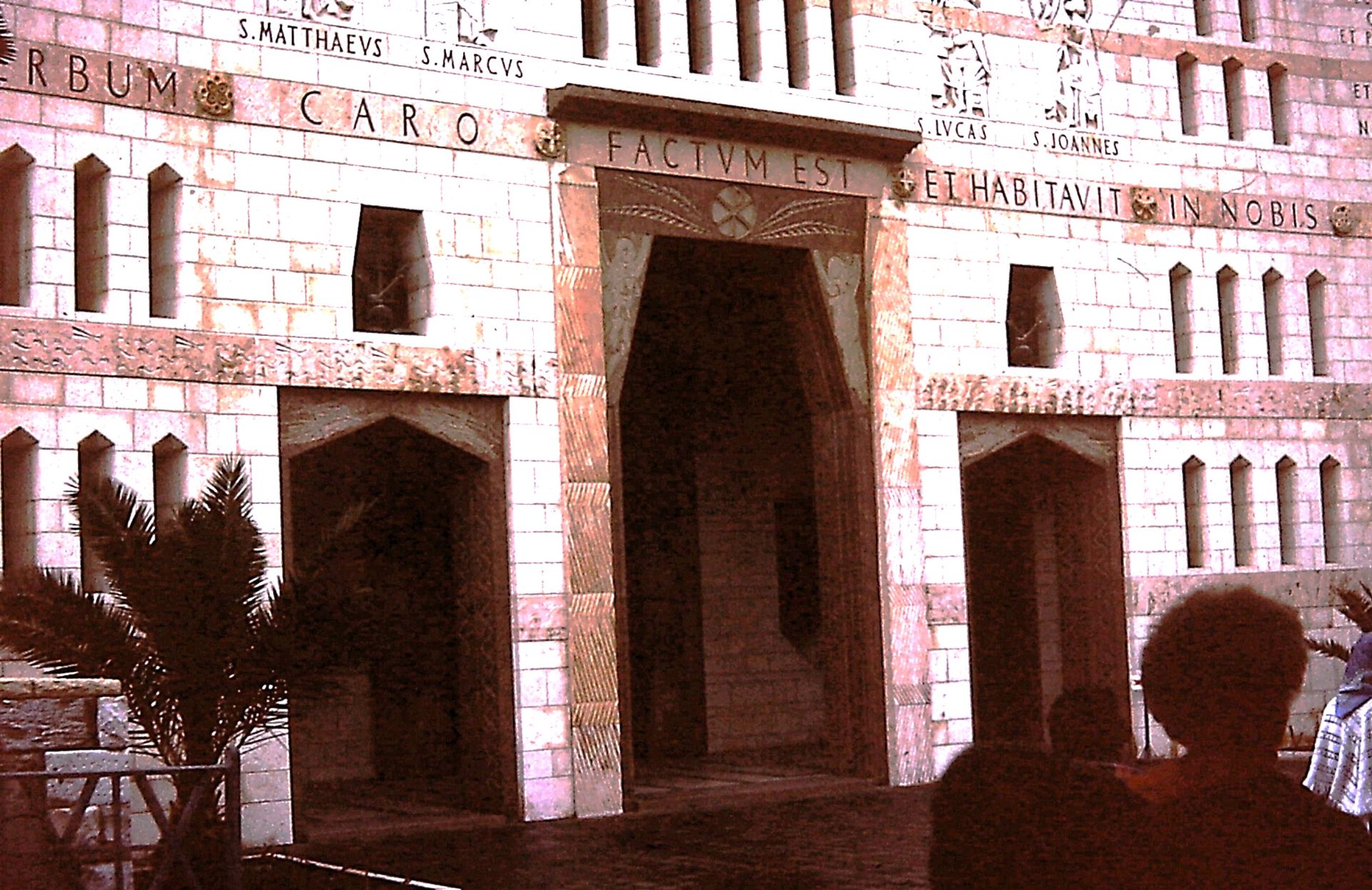 The interior of the Basilica consists of a two‑level sacred complex that unites archaeology, modern liturgical space, and the traditional site of Mary’s home. The Lower Basilica is the Grotto and Archaeological Core and is the spiritual heart of the basilica, preserving the earliest layers of devotion. The Grotto is a sunken, cave‑like chamber believed to be the remains of Mary’s childhood home. The central altar bears the inscription “Verbum Caro Hic Factum Est” — “Here the Word was made flesh” (John 1:14), marking the traditional location of the Annunciation. A fourth‑century pillar stands beside the altar, associated with the spot where Gabriel appeared to Mary. 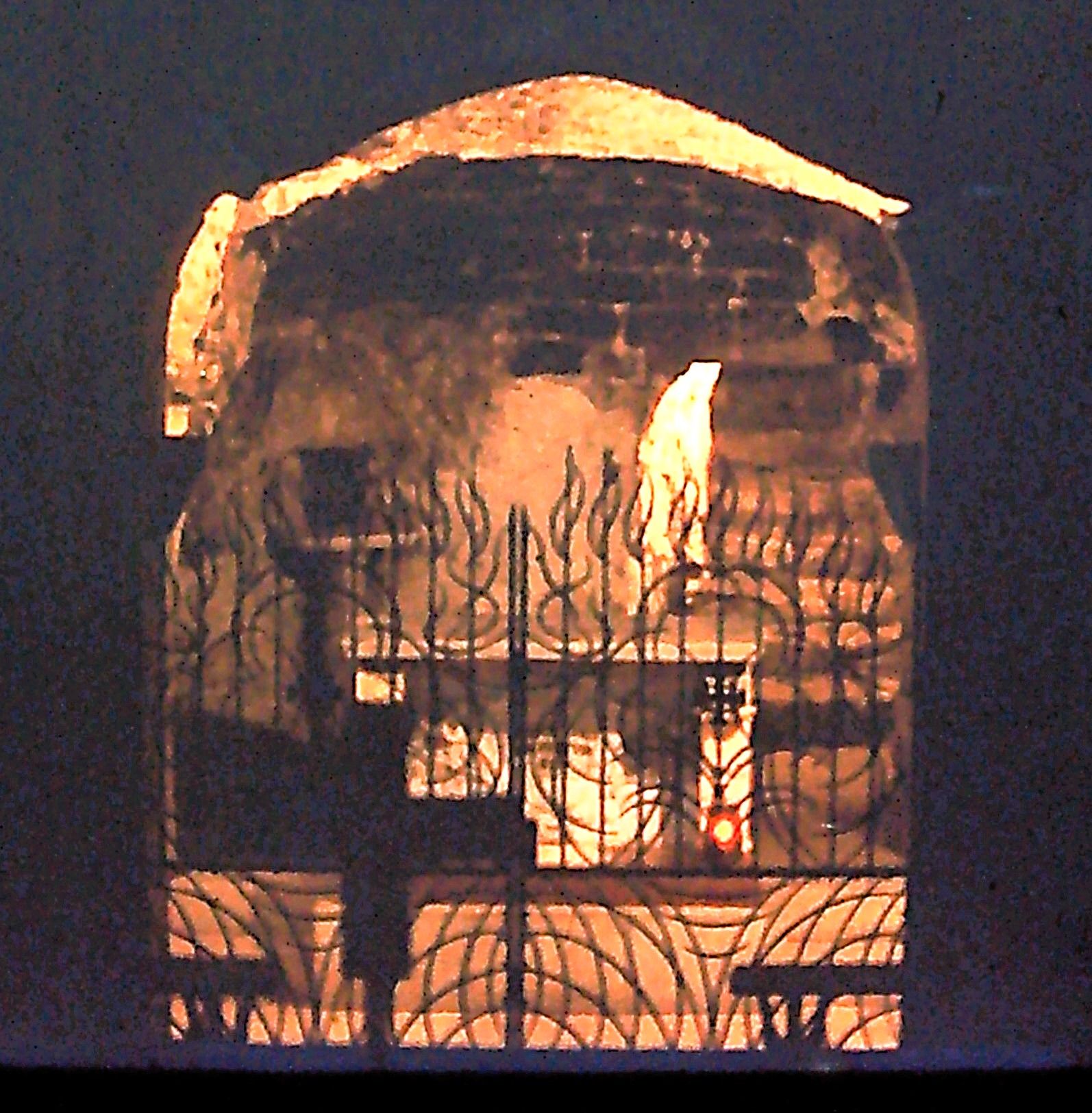 The dim lighting, rough stone, and the preserved cave walls create a sense of intimacy and historical depth. The space is designed for quiet prayer, with minimal ornamentation. Above the Grotto is the Upper Basilica which provides a tall space for worship with artworks such as mosaics and sculptures of Mary donated by countries from around the world, each in their own cultural style. The Upper Basilica is the Modern Worship Space and is a sharp contrast to the grotto as it is open and bright; it is used by the parish of Nazareth for regular liturgy making it a regular parish church. The main altar sits directly above the grotto, visually and symbolically linking the two levels. Light from the cupola filters down, creating a vertical axis from the grotto to the dome. The Basilica’s design expresses a vertical journey from the intimate grotto below to the soaring worship hall above. This two‑level structure is confirmed in contemporary descriptions, which note that the upper level serves the parish community while the lower level contains the cave and grotto believed to be Mary’s home. |
 |
|
 |
|||


All Photographs were taken by and are copyright of Ron Gatepain


| Site Map |