





 |
|
|||||||||||||||
 |
||||||||||||||||







 |
|||
 |
Jerusalem Church of All Nations (Basilica of the Agony) – History, Architecture & Significance 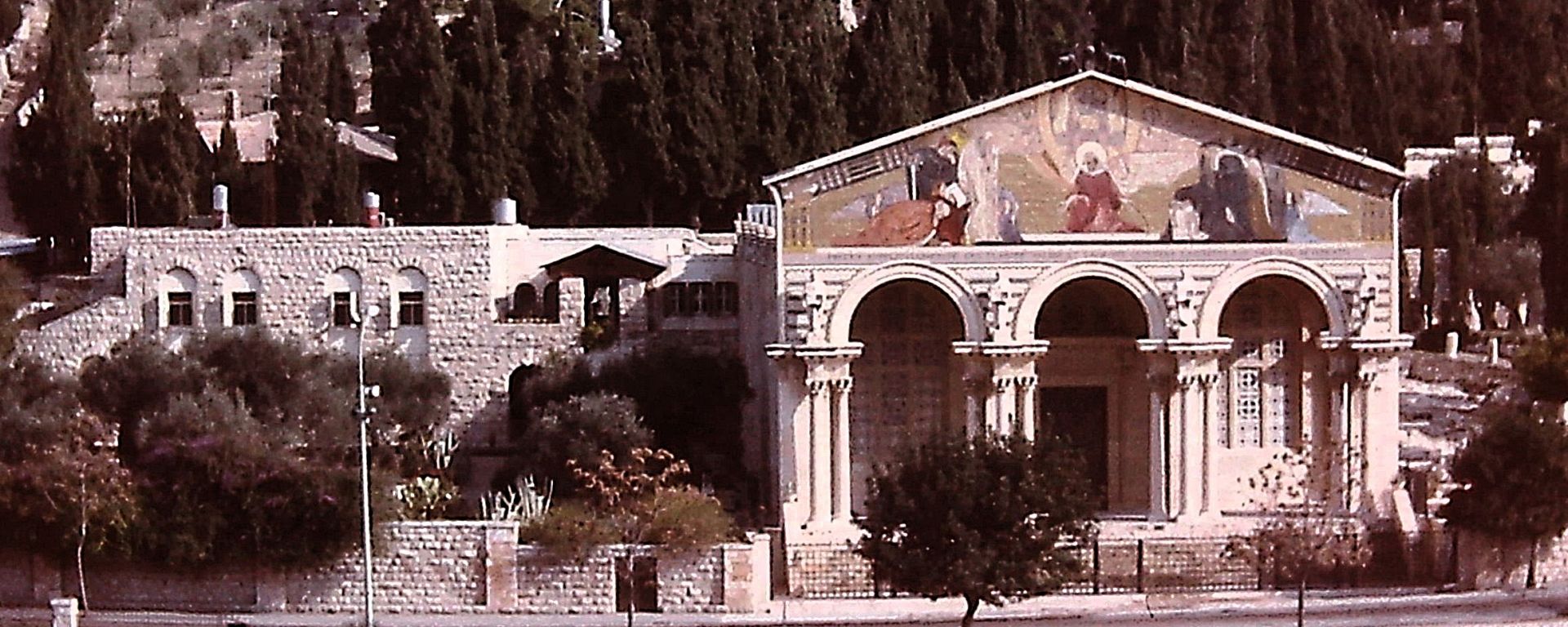
The Church of All Nations (Basilica of the Agony) is located at the foot of the Mount of Olives in Jerusalem, beside the Garden of Gethsemane, and is built directly over the rock where Jesus is traditionally believed to have prayed in anguish on the night of his arrest. The current basilica was completed in 1924 on top of the remains of two earlier churches. The first church was a 4th‑century Byzantine Basilica built over the Rock of Agony, constructed during the wave of Christian building that followed Emperor Constantine’s acceptance of Christianity. Its construction was part of the early Christian effort to mark Gospel sites with monumental churches. In 614 CE following the Persian invasion of Jerusalem there was widespread devastation of churches and monasteries, accompanied by mass killings of the Christian population. The monk Strategius - describe the Persians damaging or destroying major Christian buildings, and the Gethsemane Basilica is among the sites listed that did not survive the invasion. The Crusader chapel was the second church built over the Rock of Agony, following the destruction of the earlier 4th‑century Byzantine Basilica. In the 12th century, the Crusaders constructed a small medieval chapel which was part of the broader Crusader effort to restore and monumentalize Christian holy sites after their arrival in 1099. This was a modest, single‑space chapel, typical of Crusader memorial shrines which was built directly over the Rock of Agony, preserving the same sacred focal point as the earlier basilica. Foundations, a column base, and fragments of a mosaic floor were discovered beneath the modern church during excavations in the 1920s. These finds confirm that the Crusader chapel reused parts of the Byzantine footprint but at a reduced scale. The chapel was abandoned in 1345, during the decline of the Crusader presence in the region and a period of Political instability. There was also a reduced Christian control and by the mid‑14th century, many Crusader-era churches in Jerusalem fell into disuse or ruin. The Gethsemane chapel was no exception. Even though it was small and short‑lived compared to the Byzantine Basilica, the Crusader chapel played a crucial role in maintaining the continuity of devotion at Gethsemane. It ensured that the Rock of Agony remained a marked and venerated site during the medieval period. During the construction of the modern basilica a column from the Crusader chapel was found two meters beneath the floor and mosaic fragments from the medieval chapel were also uncovered. These discoveries resulted in the architect of the current church, Antonio Barluzzi, to redesign the foundations so the earlier layers could be preserved. Consequently, the Crusader chapel remains an archaeological layer beneath the present church. The current church was built between 1919 and 1924, and it was consecrated in June 1924. It was commissioned to replace the long‑ruined Byzantine and Crusader churches and to create a unified, international shrine over the Rock of Agony, the bedrock where Jesus is believed to have prayed before his arrest. In 1920, while preparing the foundations, workers discovered a column from the Crusader chapel and mosaic fragments. These finds were significant enough that architect Antonio Barluzzi halted the new foundations, excavated the earlier layers, and redesigned the plan to incorporate and preserve the archaeological remains. The church is called the Church of All Nations because many countries contributed financially to its construction, and the name reflects the international collaboration behind its construction. The national emblems of those countries who collaborated appear in the interior domes. Architecturally, it is in a Neo‑Byzantine style with a Roman basilica façade and is designed to evoke the sombre atmosphere of Gethsemane at night. The basilica is intentionally sombre, evoking the mood of Jesus’ agony in the garden. The mosaic fills the central tympanum, becoming the façade’s theological centrepiece. The external façade of the Church is structured like a classical Roman‑Byzantine hybrid with a broad portico supported by six Corinthian columns and three deep arches that frame the entrance and a large, luminous mosaic set within the central tympanum above the portico. This is not a painting but a modern mosaic, created by Professor Giulio Bargellini, an Italian artist known for monumental sacred imagery. It is designed with the same narrative clarity and symbolic density as a painted icon. The mosaic presents Jesus as the mediator between God and humanity - a theme that perfectly aligns with the church’s dedication to the Agony in Gethsemane. 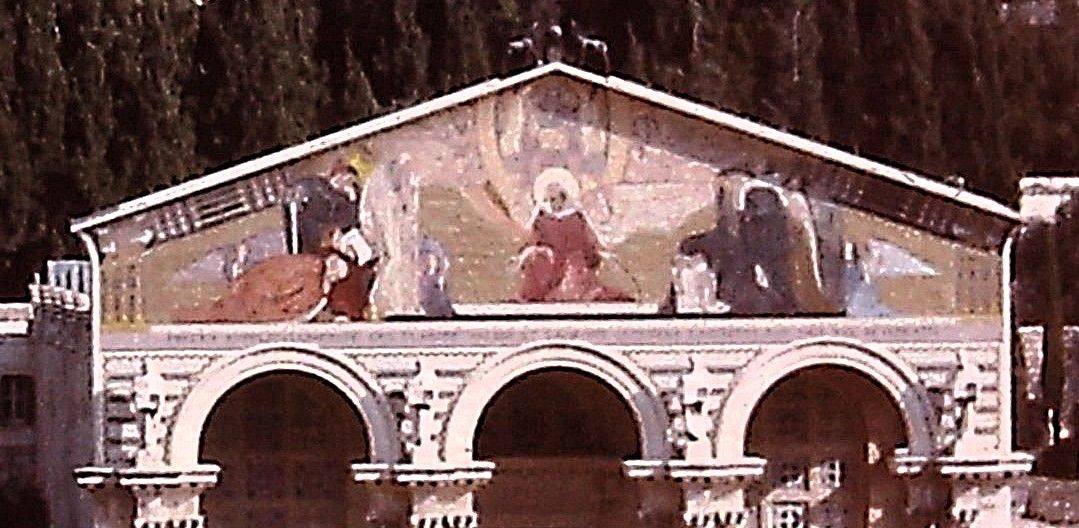 The mosaic depicts Christ enthroned or centrally elevated, acting as the bridge between heaven and earth. Figures representing humanity gathered below Him, often interpreted as the nations of the world - echoing the church’s name and multinational funding. A radiant gold background, typical of Byzantine‑inspired sacred art, symbolises divine presence. Internally it has twelve small domes, each decorated with a donor nation’s emblem and a ceiling painted as a starry night sky, framed by olive branches. Within the church are Violet‑blue alabaster windows that dim the interior light, creating a twilight effect. The altar of the basilica is not just a liturgical focal point, it is built directly over the Rock of Agony, the bedrock where Jesus is traditionally believed to have prayed on the night before his arrest. 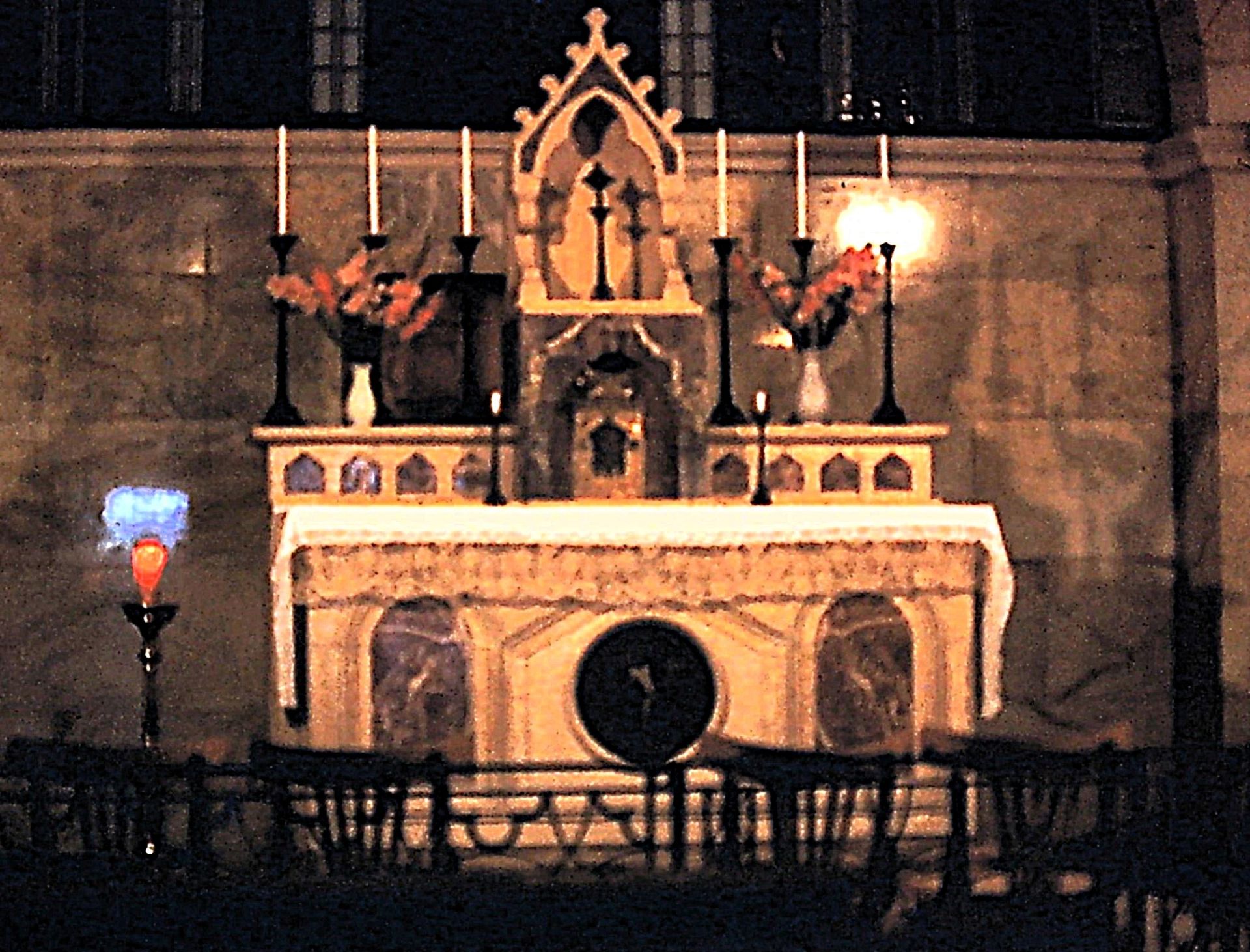 This rock is the emotional and theological heart of the entire church. The rock is fully visible beneath the altar, forming a physical and symbolic bridge between the Gospel narrative and the worship space. The Rock of Agony is a flat, exposed outcrop of natural bedrock sitting immediately in front of and beneath the high altar. Christian tradition identifies this as the place where Jesus “threw himself on the ground” in anguish (Matthew 26:39). The rock is surrounded by a wrought‑iron crown of thorns, donated by Australia. This direct visibility of the rock is intentional: the church is designed so that the altar does not overshadow the sacred stone but frames it. The altar stands at the centre of the sanctuary, directly above the rock, making it a memorial altar, marking the site of Jesus’ prayer, and a pilgrimage altar, where Mass is celebrated daily. It is a visual anchor, connecting the Passion narrative to the present. Behind and around the altar are three major mosaics: The Kiss of Judas; Christ in Agony consoled by an Angel and the Arrest of Jesus. These mosaics form a narrative arc around the altar, reinforcing the theme of the Passion. The entire area around the altar is designed to evoke a sense of contemplation and reverence, allowing visitors to reflect on the profound significance of the events that took place there.
|
 |
|
 |
|||


All Photographs were taken by and are copyright of Ron Gatepain


| Site Map |