





 |
|
|||||||||||||||
 |
||||||||||||||||











 |
|||
 |
Rhodes Church of Our Lady of Mercy (Latin Church of our Lady of Mercy) – History, Architecture & Significance 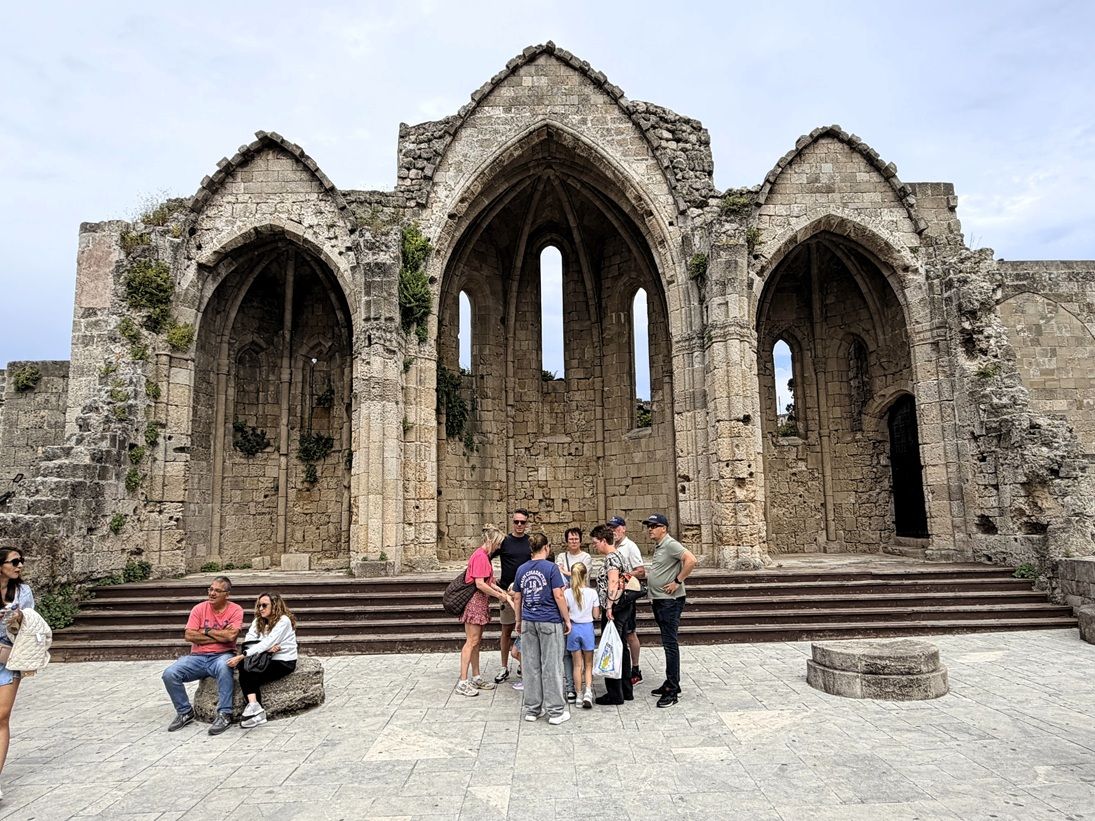
The Church of Our Lady of Mercy, known in Greek as Panagia tou Bourgou, stands in the Bourgou (civilian) quarter of the Medieval Town of Rhodes and is one of the most important surviving monuments of the Knights Hospitaller. Built in the early fourteenth century to serve the civilian population living outside the fortified Collachium (the fortified headquarters district of the Knights Hospitaller), it was the principal parish church of the district and one of the largest Gothic basilicas constructed by the Order on the island. Although commonly described today as a Latin church because it served the Catholic community of the Bourgou, its historical name never included that term. Despite its ruined state, the surviving arches and finely cut stonework still convey the scale and ambition of the original building. The church was designed as a three aisled Gothic Basilica aligned east–west, with a wide central nave flanked by narrower north and south aisles. The nave was separated from the aisles by arcades of pointed arches, and the eastern end terminated in a polygonal apse accompanied by smaller apsidal chapels. Over time, six side chapels were added along the aisles, reflecting the growing importance of the parish and the devotional needs of the surrounding community. The building was constructed in carefully dressed limestone, its ashlar masonry demonstrating the skill of the Hospitaller craftsmen who introduced Western architectural techniques to the Aegean. Although the west façade has largely disappeared, the most striking feature of the church survives at the eastern end, where three tall, pointed arches rise dramatically above the open square. These arches once supported the vaulting of the sanctuary and now form one of the most recognisable silhouettes in the Old Town. 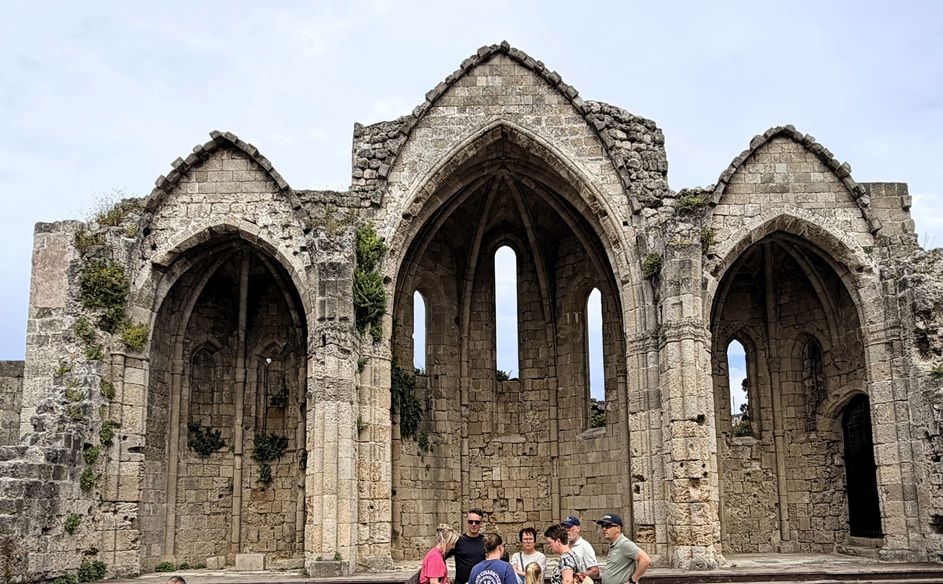 Inside the ruin, the springing points of the nave arcades remain visible, showing where the Gothic arches once rose to support the roof. The north wall contains seven arched tomb recesses, probably reserved for prominent members of the parish or the Order. The foundations and partial walls of the side chapels can still be traced, revealing their varied sizes and arrangements. Visitors stand in the central open space of the church, framed by the surviving walls of the north and south aisles. The tall ashlar stone walls are the original 14th century Gothic masonry of the Knights Hospitaller. The large, pointed arch openings in the walls are the remains of the arcades that once separated the nave from the side aisles. 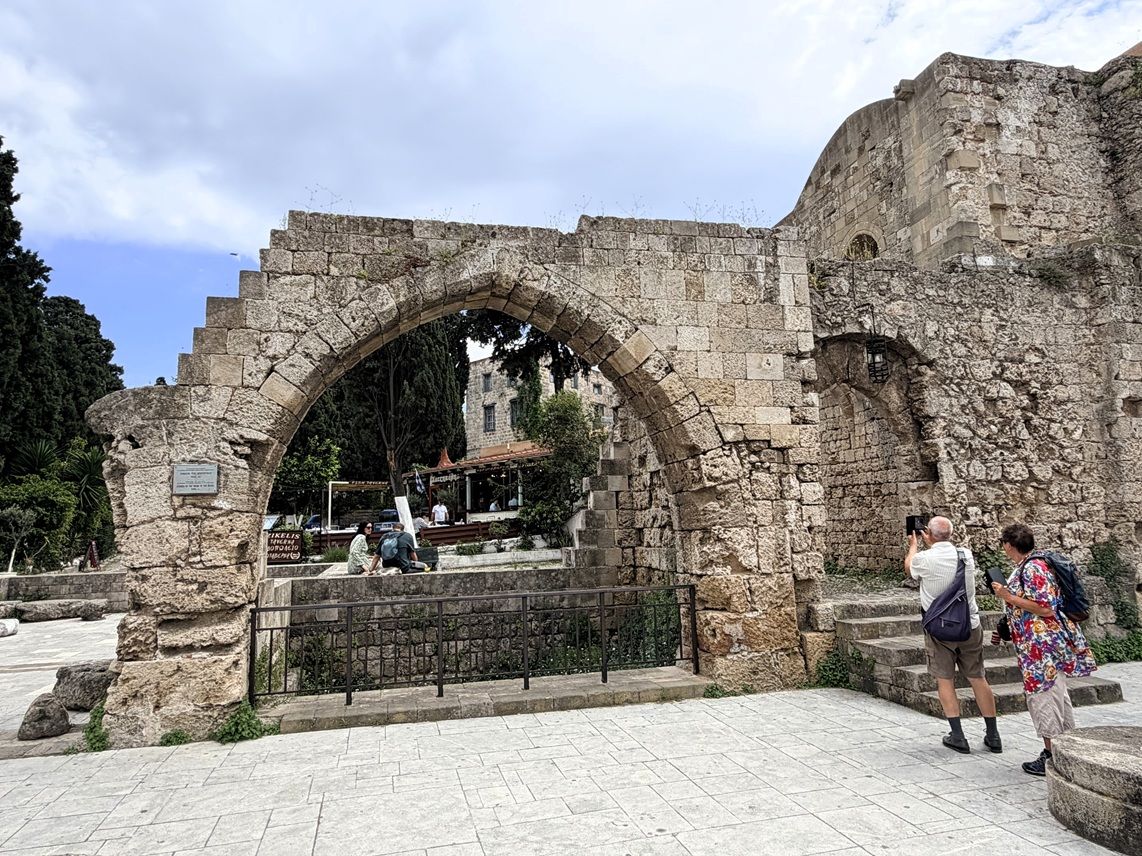 The single column in the centre of the space is one of the few surviving vertical supports from the medieval structure. 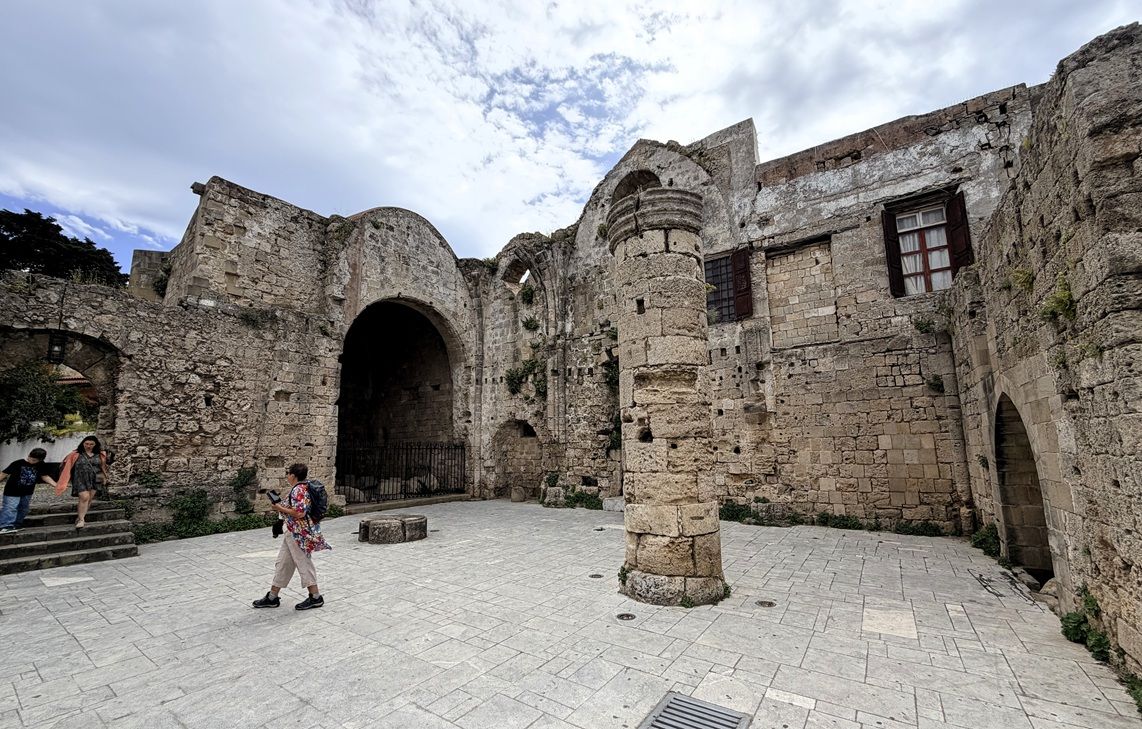 The paved floor is modern, laid during conservation works to stabilise the site and allow visitors to walk through the ruin. The church remained in use until the Ottoman siege of 1522, during which much of the Bourgou quarter was destroyed. After the Knights surrendered Rhodes, the building was abandoned and gradually fell into ruin. Its footprint, however, was never built over, allowing the plan of the medieval structure to remain clearly legible. Today the church stands as an open architectural shell, its dramatic arches and spacious interior making it a popular venue for concerts, theatrical performances, and cultural events, particularly during the summer months when the ruins are illuminated at night. Despite its ruined condition, the Church of Our Lady of Mercy remains a significant monument for understanding the medieval history of Rhodes. It illustrates the introduction of Western Gothic architecture into the eastern Mediterranean, provides insight into the religious life of the civilian population outside the Knights’ citadel, and forms one of the most atmospheric and evocative medieval sites in the Old Town. Its surviving arches continue to dominate the square, preserving the memory of a once impressive parish church at the heart of the Bourgou community. References and Additional Informtion https://whc.unesco.org/en/list/493/ https://en.wikipedia.org/wiki/Rhodes https://www.greeka.com/dodecanese/rhodes/sightseeing/panagia-bourgou/ https://wearerhodes.com/listing/church-of-panagia-tou-bourgou/
|
 |
|
 |
|||


All Photographs were taken by and are copyright of Ron Gatepain


| Site Map |