





 |
|
|||||||||||||||
 |
||||||||||||||||











 |
|||
 |
Poconchile Church of San Jerónimo – History, Architecture & Significance 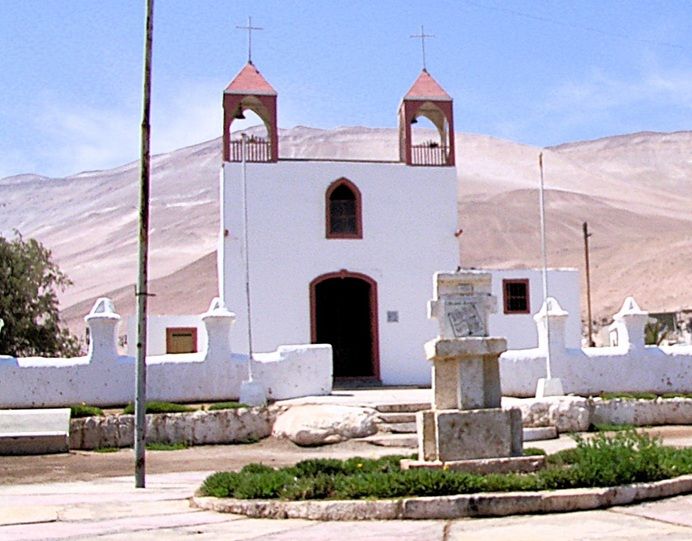
The Church of San Jerónimo, (spelled locally as San Geronimo) located in the Lluta Valley in the pre‑Inca village of Poconchile, approximately 23 miles (37 km) from Arica, is one of the most important early colonial churches in northern Chile. Traditionally dated to 1605, though the current structure dates from the late‑19th‑century following its reconstruction after the earthquakes of 1868 and 1877. It blends Spanish mission design with Indigenous construction methods. It is constructed using at least 60% traditional Andean materials, the primary wall material is that of Adobe (earth + straw) and Stone masonry set in mud mortar. Its finish is of Barro (a mud plaster) something that is also used for interior walls. The roof structure and bell towers are constructed in locally obtained wood. Animal‑hide lashings are used to tie the roof beams (a distinctive Andean technique). The roof is covered in layers of Paja brava, (which is also known as Peruvian feathergrass or Jarava ichu, a grass species native to the Americas) and mud layers. The exterior walls are whitewashed. Adjacent to the church is the cemetery which is enclosed by a low adobe perimeter wall. Its proximity reflects the Andean tradition of keeping ancestors within the living community’s sacred centre. The graves are marked by hand‑made wooden or metal crosses. Small niches or above‑ground tombs built in adobe or stone can also be seen. 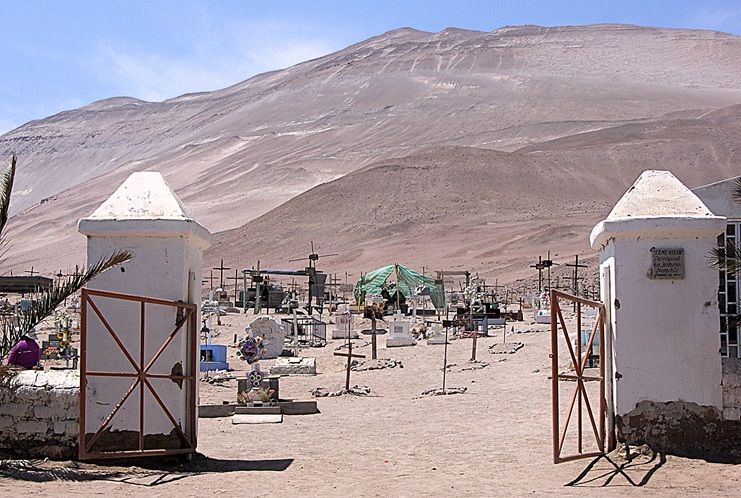 Positioned directly in front of the church is the Calvario, an outdoor crucifix shrine made of stone that forms part of the traditional Andean Catholic ceremonial landscape. It represents Calvary, the hill of Christ’s crucifixion, and serves as a processional station during Holy Week, funerals, and saint‑day rituals, and marks the threshold between the secular world and the sacred precinct. On passing the Calvario visitors enter the Atrio, the walled forecourt in front of the church. This is an open, sacred space that acts as the threshold between the everyday world and the holy interior. The interior of the church consists of a single‑nave, rectangular in plan with whitewashed adobe walls with rows of wooden benches providing the pews. Visible from the nave is the trapezoidal wooden roof structure. 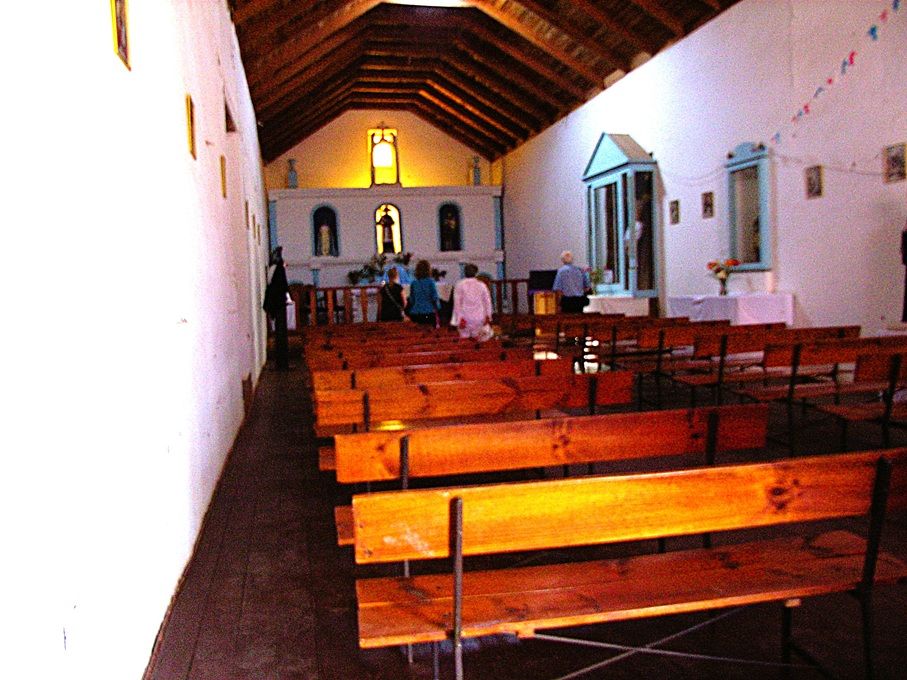 At the far end is the altar with its retablo (altar screen) made of timber and painted or gilded. Also at the end of the church are niches containing statues of the Virgin Mary, San José (St. Joseph) the patron of families and agriculture whose feast (19 March) is celebrated in Poconchile, and San Jerónimo (the churches patron). San Jerónimo (347 - 420 CE) was a Christian scholar, monk, and translator and one of the most influential figures in early Christianity. He is best known for producing the Vulgate, the first authoritative Latin translation of the Bible, which shaped Western Christianity for more than a thousand years. The Interior Crucifix is carved in a style consistent with 19th century local workshops, notable due to the church’s reconstruction after the 1868 and 1877 earthquakes. It shows Christ wearing a crown of thorns and a plaque with “INRI” above the cross. This is an abbreviation of the Latin phrase: Iesus Nazarenus Rex Iudaeorum, “Jesus of Nazareth, King of the Jews.” It was the inscription that according to the New Testament, the Roman governor Pontius Pilate ordered to be placed above Jesus during the crucifixion. 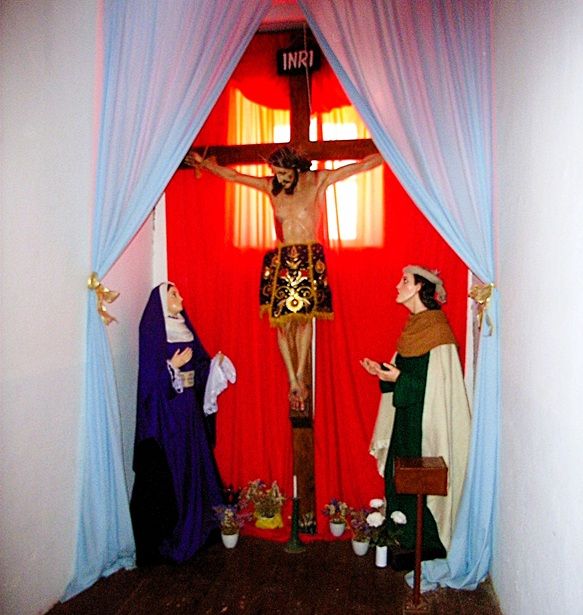 At the back is a red cloth, symbolizing both martyrdom and ritual intensity. Below the crucifix are statues of Mary and San Jerónimo. The Church of San Jerónimo is part of the Iglesias del Altiplano, a group of Andean churches recognized on Chile’s tentative UNESCO list for their cultural and architectural significance. In 2015 it was officially declared a Monumento Histórico (National Historic Monument of Chile) in recognition for its cultural, historical, architectural, and artistic value. This designation protects the church, its atrio, cemetery, and associated structures as part of Chile’s most important cultural heritage. Consequently, any restoration, alteration, or intervention must be approved by the Consejo de Monumentos Nacionales.
|
 |
|
 |
|||


All Photographs were taken by and are copyright of Ron Gatepain


| Site Map |