





 |
|
|||||||||||||||
 |
||||||||||||||||











 |
|||
 |
Athens Church of the Virgin Mary of the Golden Cave (Panagia Chrysospiliotissa) – History, Architecture & Significance 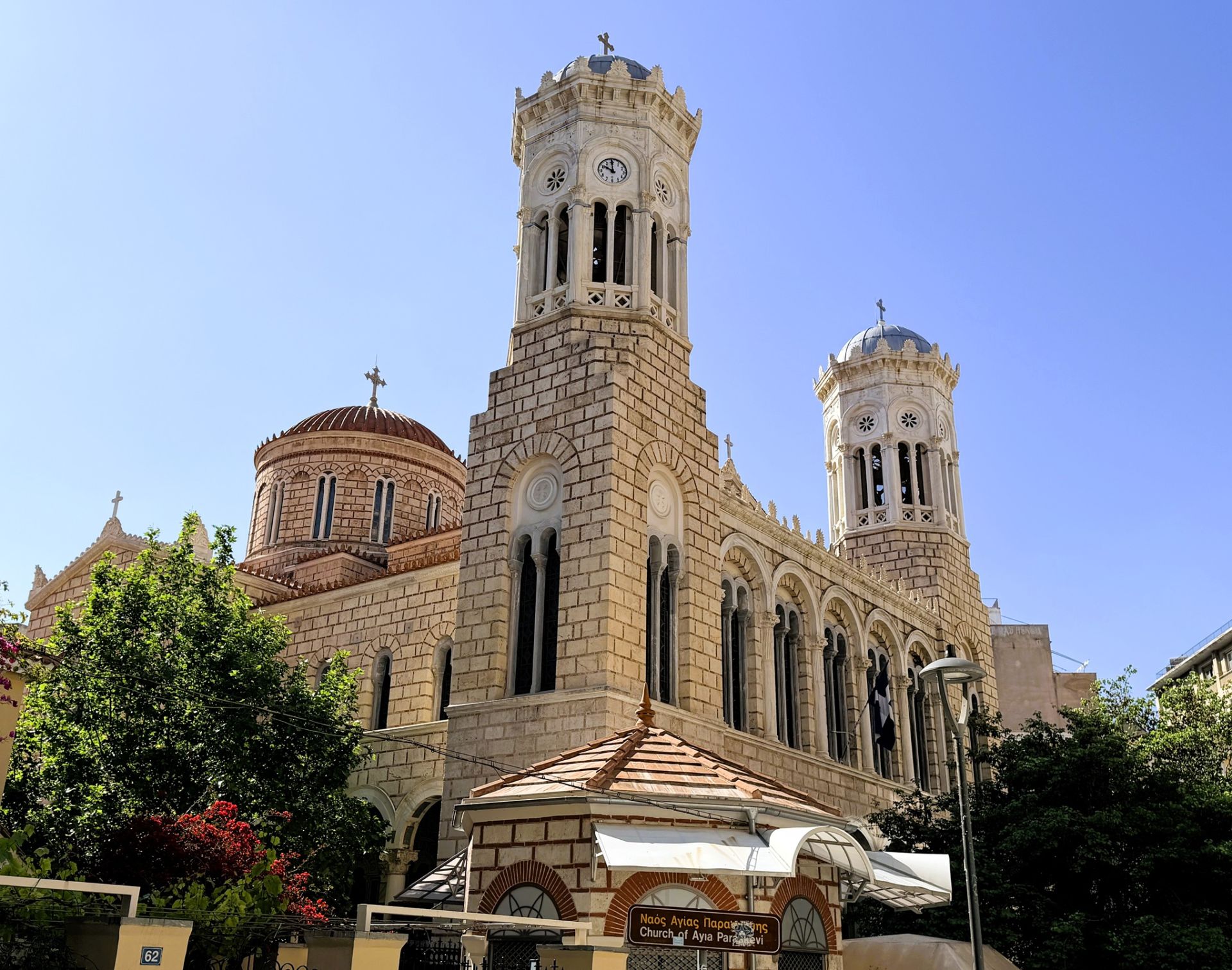
The Church of the Virgin Mary of the Golden Cave (Church of Panagia Chrysospiliotissa) stands prominently on Aiolou Street in the commercial heart of Athens and is one of the most architecturally ambitious parish churches of the nineteenth century. Its scale, design, and richly decorated interior reflect the transformation of Athens from an Ottoman provincial town into the capital of the modern Greek state. Although the present structure was completed in 1892, the site has a much longer history of Christian worship, with a church recorded here since the early eighteenth century . A small basilica was first built on the site in 1705 during Ottoman rule, serving the Christian population of the district until it was destroyed during the siege of Athens in 1826–1827 carried out by Ottoman forces during the Greek War of Independence. A modest replacement erected in 1832 soon proved inadequate for the needs of the rapidly expanding capital. As the commercial district around Aiolou Street developed, in 1846, the parish acquired adjoining plots with the intention of constructing a far larger and more imposing building. Work on the new church began in 1863 under the architect Dimitrios Zezos, one of the earliest proponents of a Greek Byzantine Revival style. After his death the project passed to Panagis Kalkos, and later to Ernst Ziller, who is widely believed to have designed the church’s elaborate marble iconostasis. Financial constraints slowed progress, but the building was finally completed in 1892 with significant support from the Monastery of Mega Spileo in the Peloponnese. This association gave rise to the epithet “Chrysospiliotissa,” meaning “of the Golden Cave,” a reference to the famed cave monastery and its revered icon of the Virgin. The exterior features cloisonné brickwork, arched and bifora windows, a window divided into two narrow arches, separated by a small column or pillar, and framed by one larger outer arch, carved stone frames, and classical cornices. The western end of the church, facing Aiolou Street, forms its principal entrance and is one of its most architecturally expressive elements. 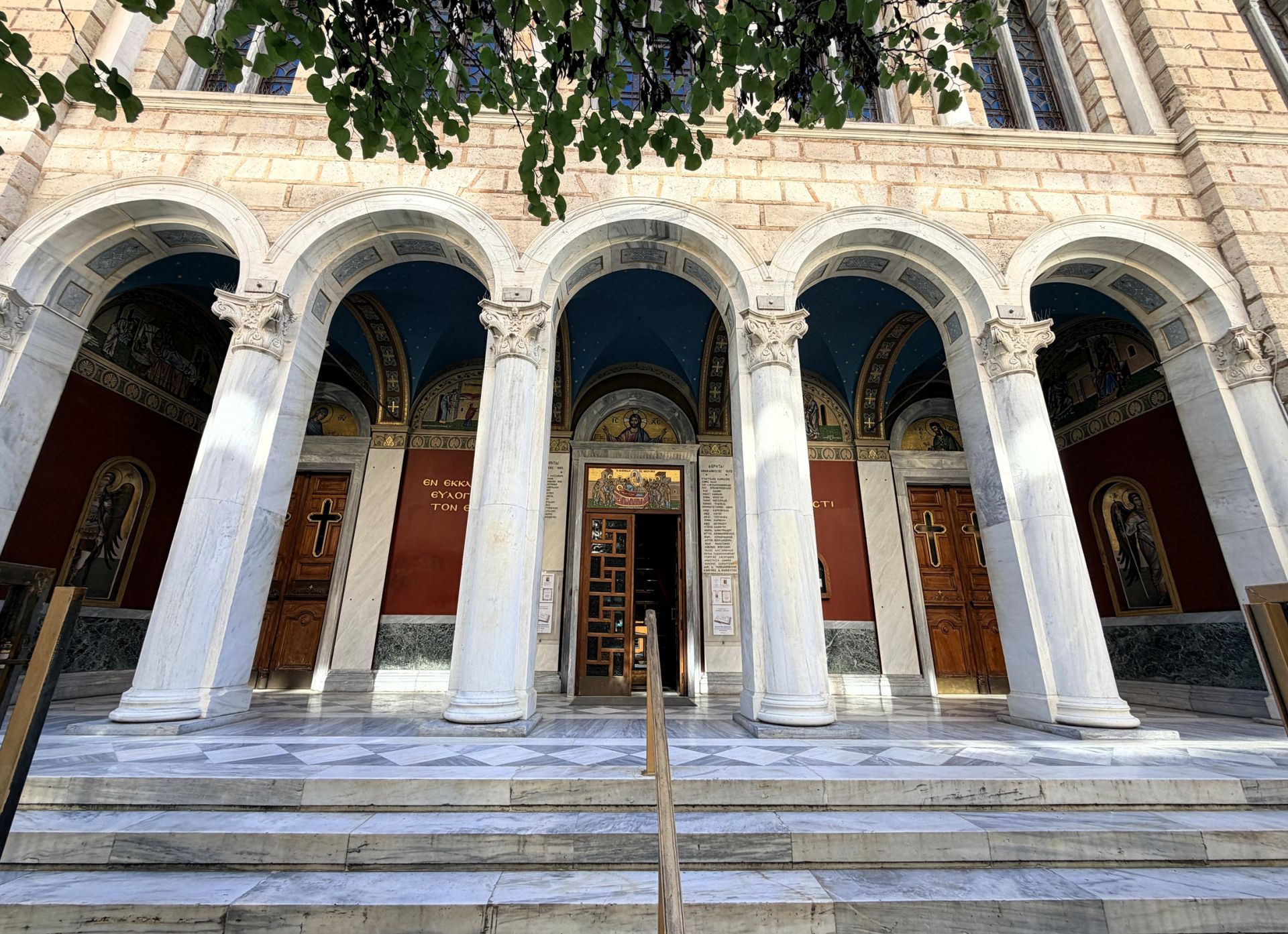 The façade combines Byzantine Revival masonry with Neoclassical symmetry, creating a monumental yet harmonious frontage within the dense urban setting. A broad marble staircase elevates the entrance above street level, forming a transitional space between the bustle of Aiolou Street and the sacred interior. The staircase leads directly to the narthex (entrance hall or lobby area), entered through imposing timber doors framed by carved stonework. The entrance doors are constructed of heavy, dark stained timber reinforced with decorative metalwork. Their geometric panels, carved crosses, and floral motifs reflect the nineteenth century taste for blending Byzantine forms with Western craftsmanship. The doors sit within a triple arched porch, the central arch being the largest, flanked by two smaller openings that echo the rhythm of the nave arcades. Above them, marble framed bifora windows with slender colonnettes admit light into the narthex. The surrounding cloisonné brickwork recalls Middle Byzantine churches such as Kapnikarea and the Little Metropolis, deliberately rooting the new church in Athens’ medieval architectural heritage. The façade is crowned by the bases of the two octagonal marble bell towers, whose height of over 20 metres and crisp detailing frame the entrance and give the west front a strong upward thrust. 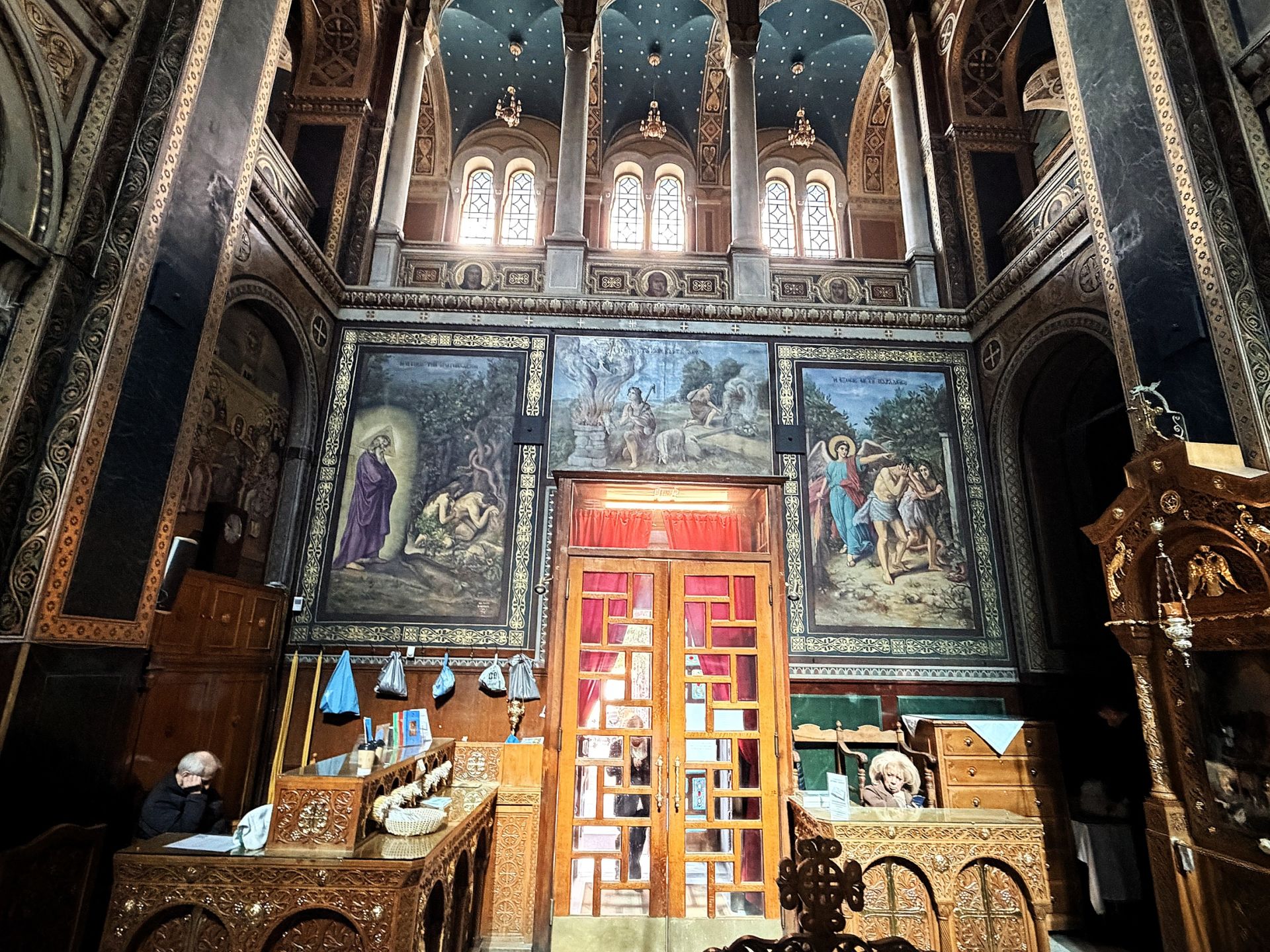 The doors appear as a dark, weighty presence, their heavy timber construction contrasting with the lighter tones of the marble columns and frescoes. Above them, the triple arched narthex opening creates a series of receding planes, drawing the eye upward toward the bifora windows that admit soft, diffused light. The cloisonné brickwork around the upper windows can be glimpsed through the arches, visually linking the interior to the Byzantine Revival exterior. Light from the dome and upper windows creates a strong contrast between light and shadow, with the sanctuary glowing in colour and gold while the entrance recedes into shadow.  In the middle of the church, rising high above the nave, supported by arches and columns, is the central dome. This is the main source of natural light inside and helps create a feeling of height and openness. Light entering through the windows around the dome spreads softly across the interior, brightening the frescoes and giving the space a calm, uplifting atmosphere. The dome marks the centre of the church both architecturally and spiritually, drawing the eye upward and emphasising the vertical focus of the building. 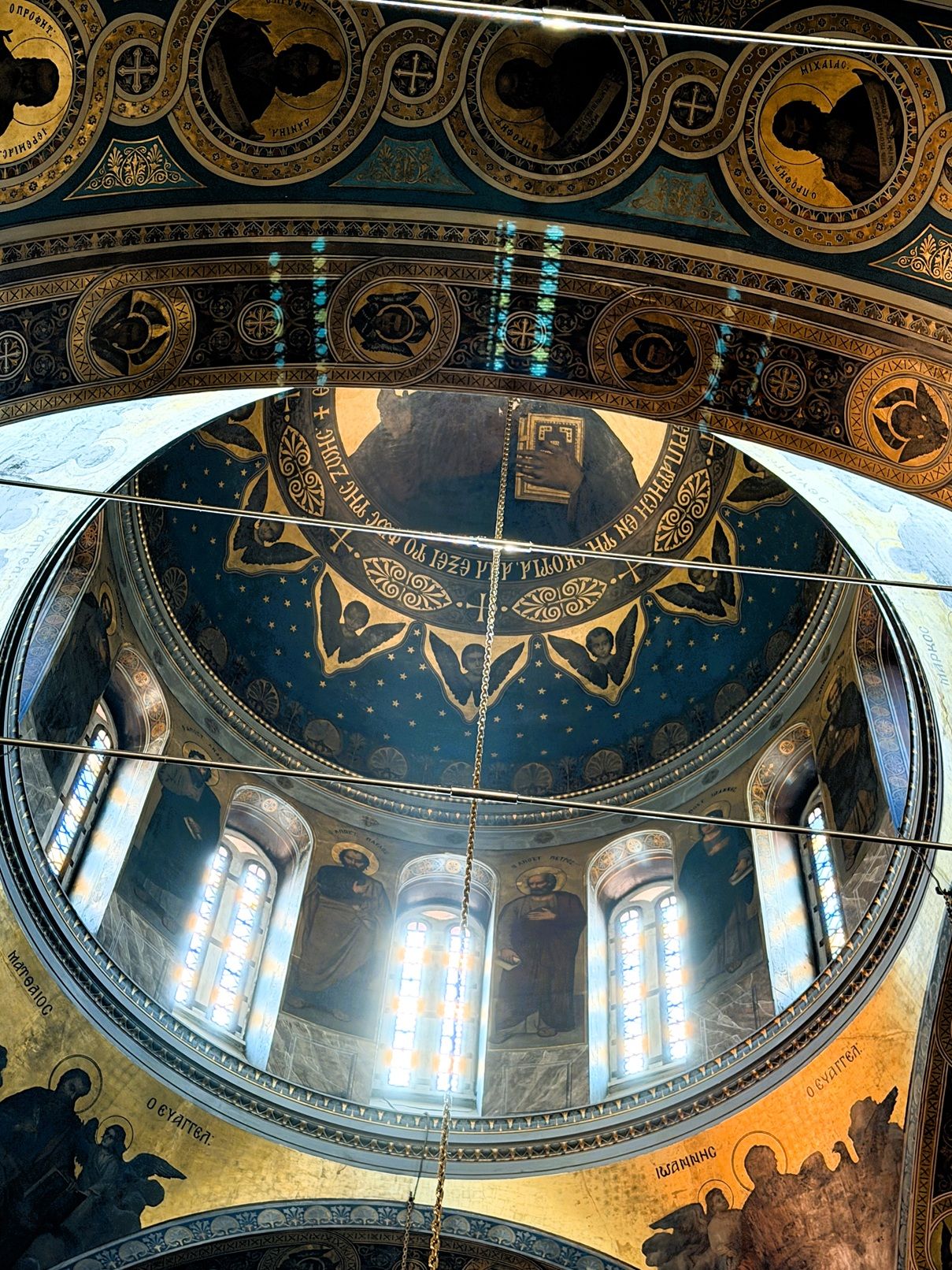 The paintings displayed are one of the church’s most distinctive features. The walls, vaults, and arches are covered with frescoes that follow traditional Byzantine themes but incorporate stylistic elements drawn from Western European academic painting. The figures are more naturalistically modelled than in strict Byzantine iconography, the drapery is softer, and the compositions make greater use of perspective and atmospheric colour. These show richly painted vaults, narrative scenes along the aisles, and decorative borders combining floral and geometric motifs, creating a continuous visual scheme integrated with the architecture.  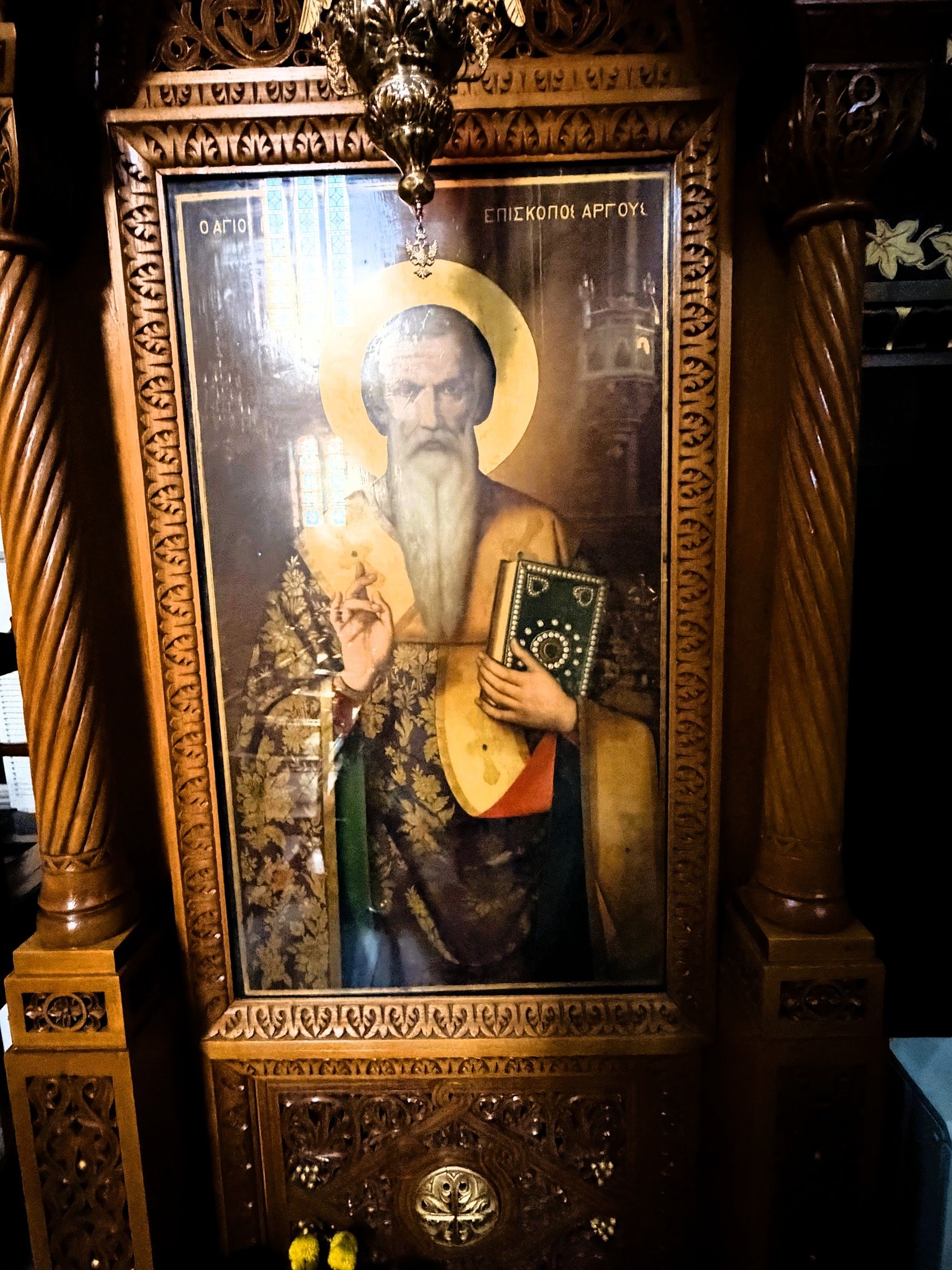 The iconostasis is one of the most distinguished liturgical furnishings in the church and a key element in understanding its artistic ambition. Widely attributed to Ernst Ziller, it reflects the synthesis of Byzantine tradition and nineteenth century classicism that characterises the building. Constructed primarily of white Pentelic marble, it is classical in composition yet fully Byzantine in function. 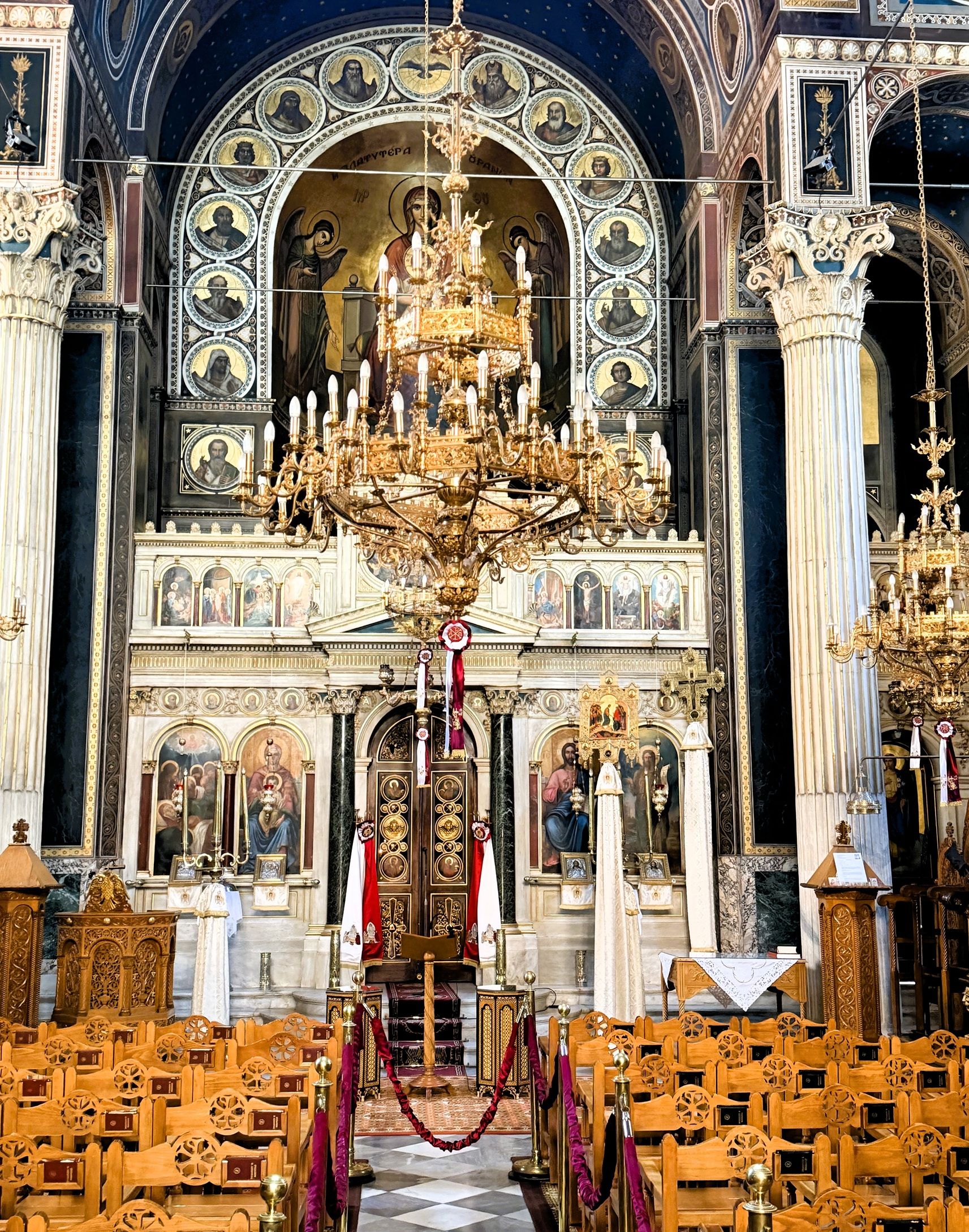 The high altar occupies the focal point of the eastern end of the church, set within the curved apse behind the iconostasis. The altar table is constructed of solid white marble, its simple, rectilinear form emphasising purity and permanence. Beneath it lies the customary cavity for relics, linking the modern church to ancient liturgical practice. Behind the altar rises the apse conch, decorated with the image of the Virgin Mary holding the Christ Child in the Platytera type. In fact there are several images of the Virgin and Child. The surrounding sanctuary walls contain additional frescoes of angels, hierarchs, and liturgical motifs. The interplay between the sculptural clarity of the iconostasis and the painted depth of the apse creates a layered composition that draws the eye toward the altar, reinforcing its central liturgical role. 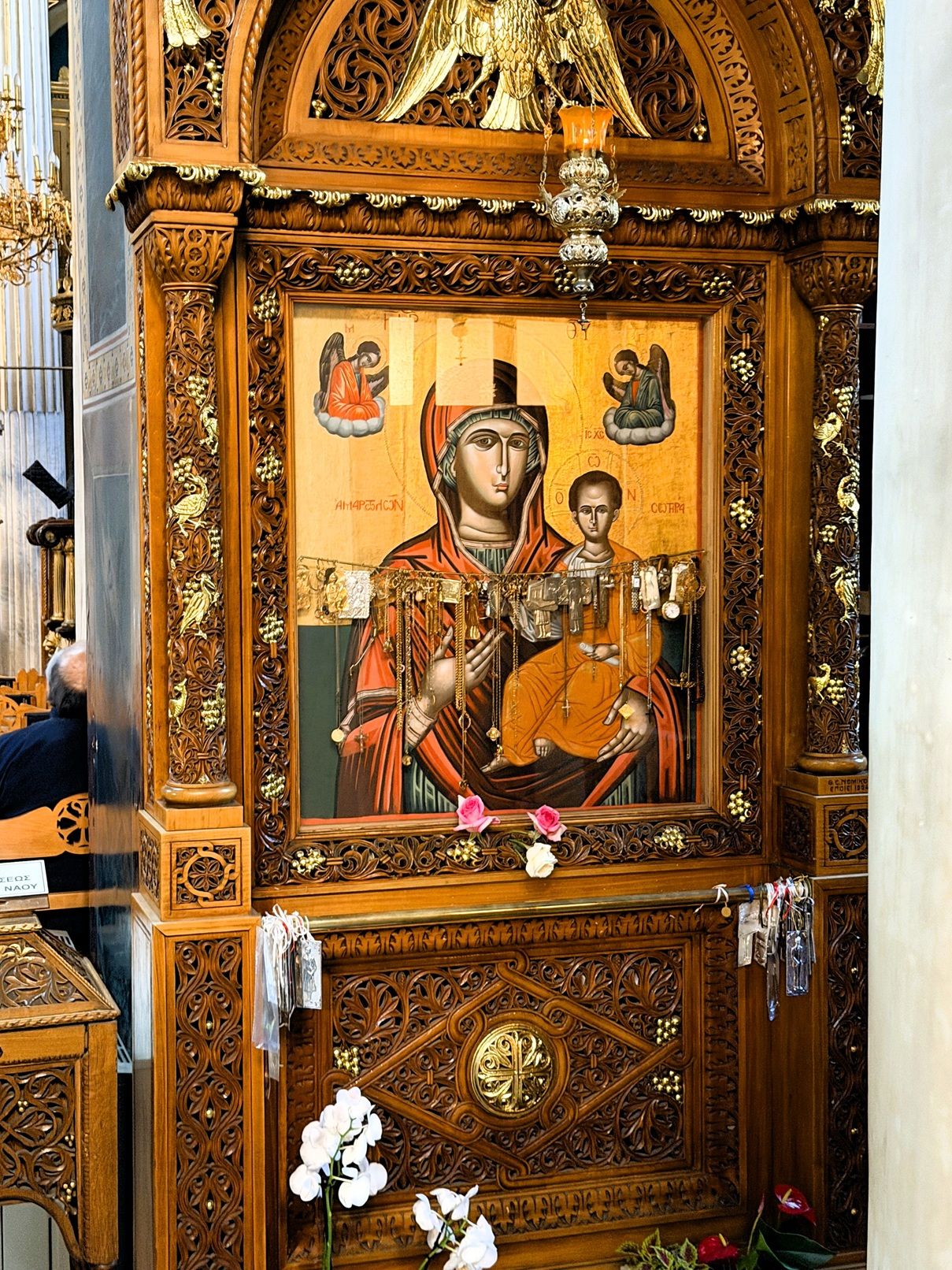 Positioned on the north side of the nave, is the pulpit, one of the church’s most refined liturgical furnishings. Supported on a robust marble base, it is crafted from carved marble and painted wood, articulated with classical pilasters, moulded cornices, and decorative panels echoing the iconostasis. Its front panels contain painted or gilded ornamentation, including floral motifs, geometric borders, and medallions of saints. Above it is a sounding canopy, typically decorated with a painted dove symbolising the Holy Spirit. The pulpit reflects the period’s concern for acoustics, visual coherence, and architectural refinement. 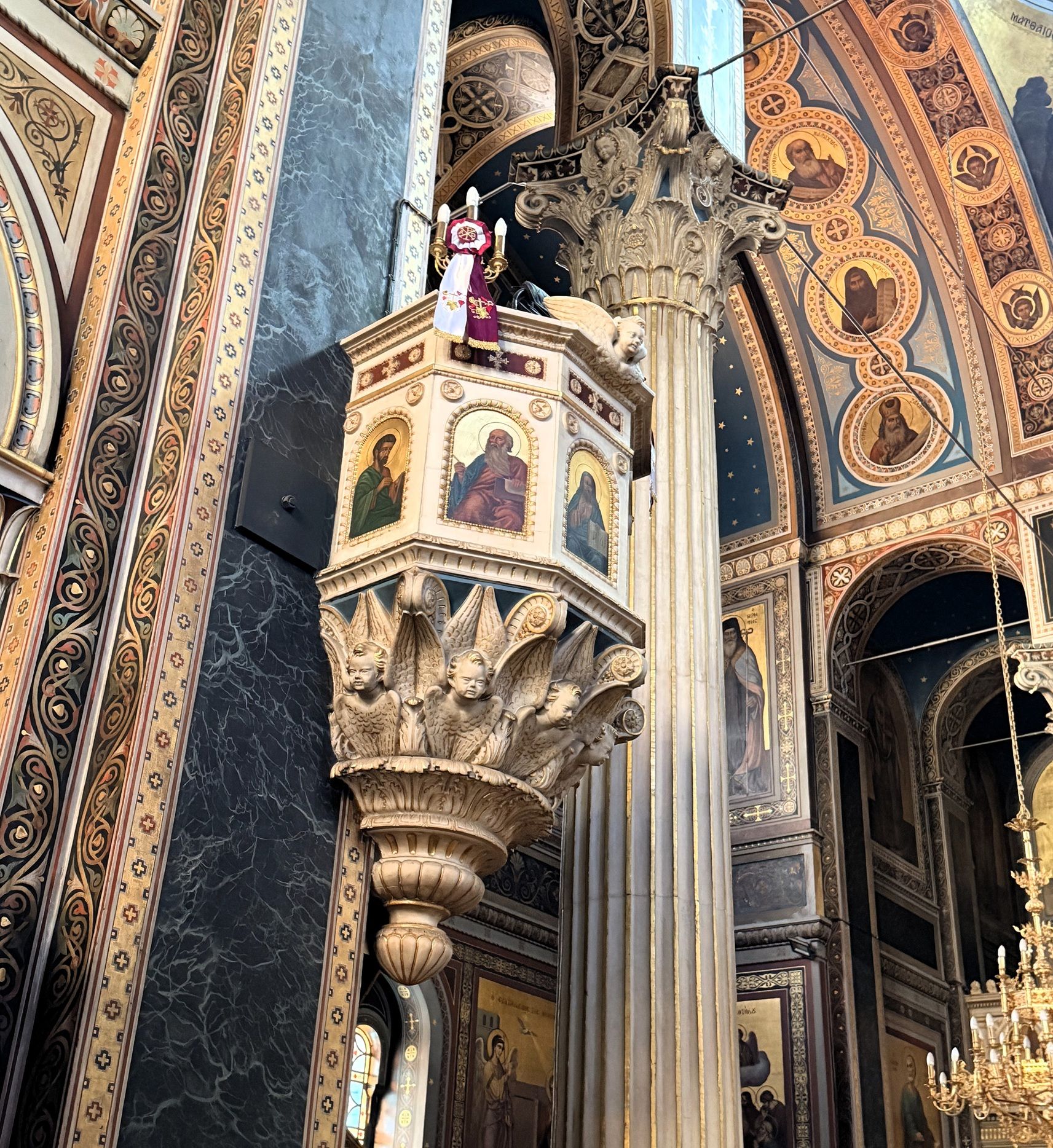 The Church of the Virgin Mary of the Golden Cave is dedicated to the Dormition of the Virgin Mary, celebrated on 15 August. Its long history, devotional associations, and prominent position at 60 Aiolou Street make it an important landmark in the commercial centre of Athens. The building’s monumental scale and richly detailed façade stand out amid surrounding neoclassical and modern structures, offering visitors an excellent example of the architectural experimentation that shaped the early modern Greek capital. Today, the church remains an active and vibrant parish church, its architecture and decoration reflecting both the city’s historical continuity and its nineteenth century aspirations. https://athensattica.com/point/holy-monastery-of-panagia-chrysospiliotissa-the-dormition-of-the-virgin-mary/ https://aroundus.com/p/7350802-panagia-chrysospiliotissa https://web.pinsteps.com/place/2213abd1?l=en
|
 |
|
 |
|||


All Photographs were taken by and are copyright of Ron Gatepain


| Site Map |