





 |
|
|||||||||||||||
 |
||||||||||||||||











 |
|||
 |
California San Francisco Golden Gate Bridge – History, Architecture & Significance 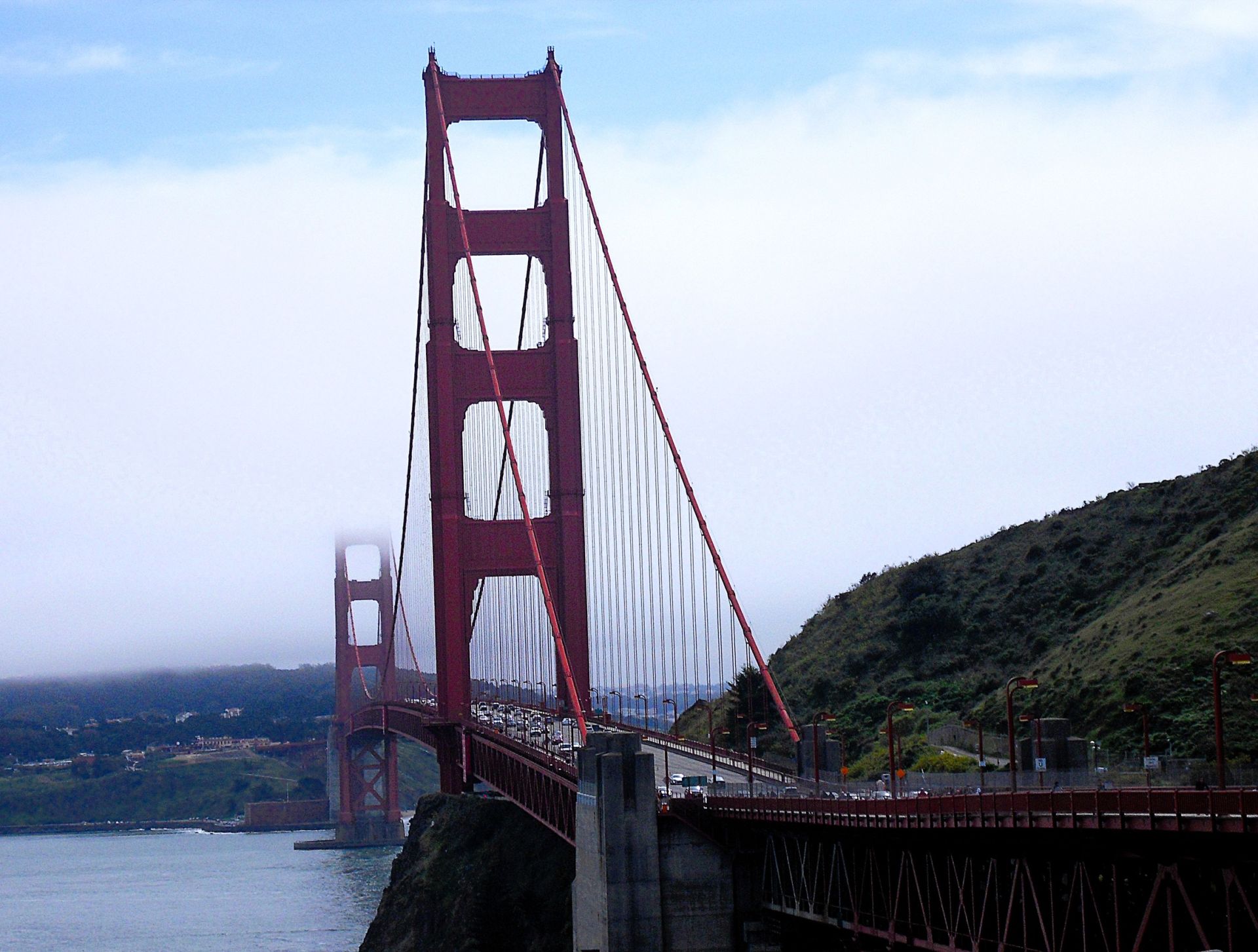
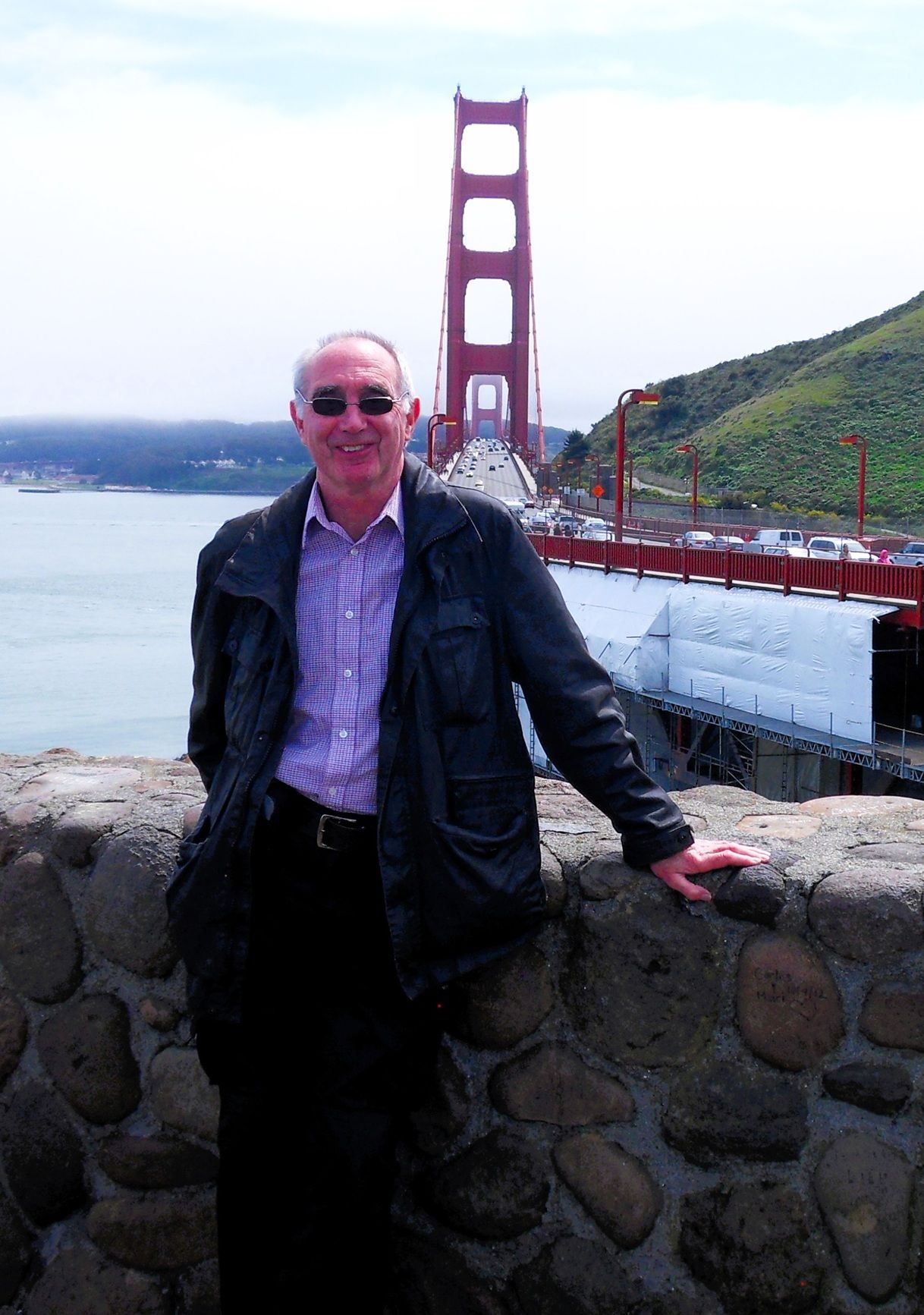
The Golden Gate Bridge linking San Francisco to Marin County across the Golden Gate Strait is one of the most recognizable landmarks in the world. The sweeping red‑orange suspension bridge was completed in 1937 after four years of construction, and was, at the time, the world’s tallest and longest suspension bridge. The idea of a bridge was first suggested in the 1870s although the technology and finance was not available until 1919 when the search for a designer began. Joseph Strauss, known for drawbridges, came up with some ideas that were feasible. Putting together a team of collaborators which included Leon Moisseiff, who refined the suspension design: Charles Ellis, who carried out much of the mathematical engineering calculations and Irving Morrow, the architect who shaped the bridge’s Art Deco style and chose its now‑iconic colour for visibility in fog and harmony with the landscape. By the late 1920s, the design had become a modern suspension bridge which was to be longer and taller than any previously built. Work began on January 5, 1933, and was carried out during the Great Depression providing many needed jobs. This resulted in a diverse source of labour and resulted in people from many backgrounds such as former farmers, clerks, taxicab drivers, cowboys, lumberjacks, and stevedores all becoming ironworkers. The workforce consisted of several hundred men at any given time, although seasonal weather affected how many men could work safely. The construction of the bridge resulted in 11 workers being killed during the construction process but a revolutionary safety net beneath the work area, introduced by Strauss, saved 19 men from falls, these men were later known as the “Halfway to Hell Club.” Operations were made even more unpredictable due to the strait’s tides, fog and storms, although despite all the problems it was to open ahead of schedule and $1.3 million under budget. One of the main sources of challenges was the foundations. These were required for the bridges two towers and needed to anchor the towers against wind and earthquake forces and also to be able to withstand constant saltwater corrosion. The south tower, near the shore on the San Francisco side, is built on solid bedrock. In order to do this, engineers excavated down to stable rock and then constructed a massive concrete pier. The north tower on the Marin side, sits in open water directly in the Golden Gate Strait where tides can reach 7+ knots. In order to place these foundations required the construction of a large steel-and-timber caisson - which is essentially a watertight box - this was then lowered into place and that enabled workers inside the caisson, to blast rock to reach a stable foundation layer. Resting on the foundations are the towers. 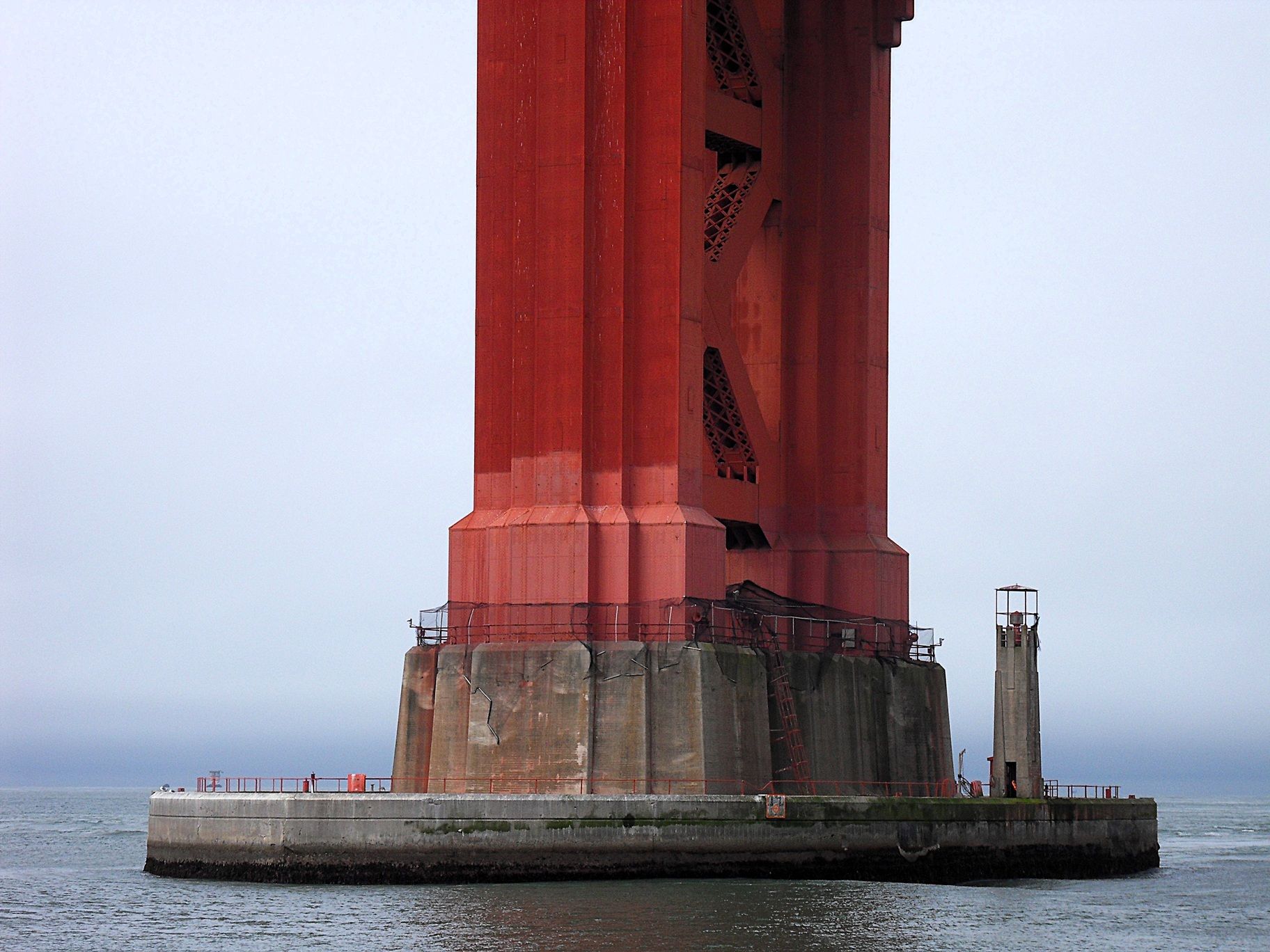 These are Steel lattice construction columns, which stand 746 feet (227 m) tall above the water they are designed to flex and carry the downward pull of the cables and transfer the force into the foundations. 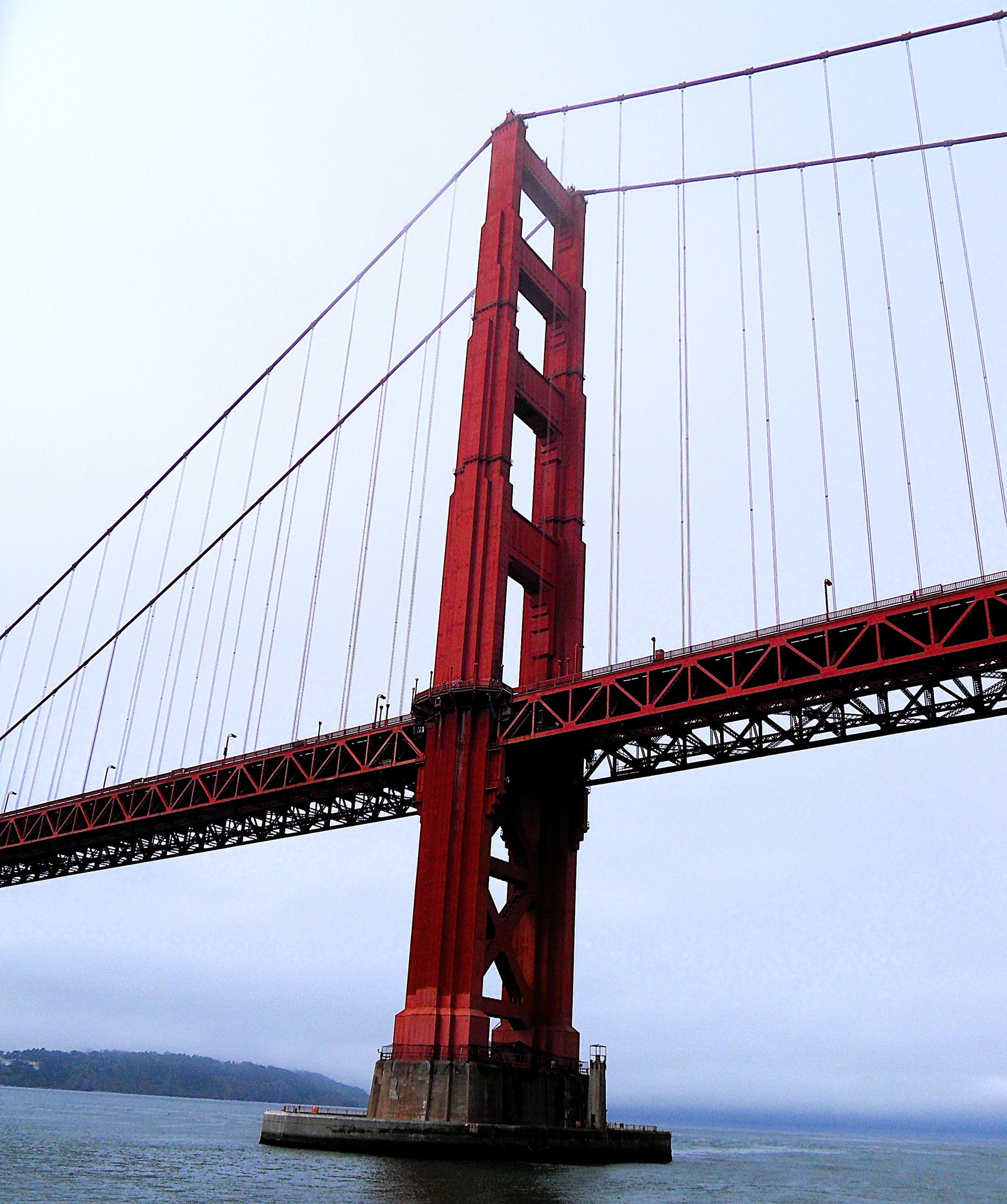 Structurally, each tower is a steel lattice made of riveted plates and cross‑bracing – which make them strong, flexible, and built to move with wind and earthquakes. Art Deco in design they have vertical fluting to emphasise height with stepped shoulders at the top. The towers were constructed of prefabricated steel sections which were shipped by barge and hoisted into place in stages from the foundations upward. Workers climbed the rising skeleton, riveting thousands of steel plates together. The towers are not rigid structures but are designed to move so that in strong winds, each tower can sway several feet. During an earthquake, the steel lattice flexes to absorb energy. Main Suspension Cables are supported by the towers and consist of two cables, each 36 inches (0.91 m) in diameter and made of 27,572 pencil‑thin wires, each wire being 0.192 inches thick - about the width of a pencil lead. The total wire length, if stretched out, would circle the Earth three times. These pull downward on the towers and outward toward the anchorages carrying the entire weight of the roadway. The cables weren’t prefabricated: They were spun on-site, above the strait. In order to do this a small pilot line was carried across the strait by boat, then pulled up to the towers. A spinning wheel - called a traveller - ran back and forth between the towers laying down a single wire with each pass. This required thousands of passes to build up a bundle, which were compacted into the final cable. This was then wrapped in a protective steel sheath and painted. The cables allow for the expansion and contraction with temperature which can be quite significant. On hot days, the deck can sag up to 16 feet lower than on cold days. In strong winds, the cables and deck sway gently, this movement is intentional as it prevents structural failure. These cables carry the entire weight of the roadway, traffic, and their own mass and transfer that load into the towers and then into the anchorages. They support the vertical suspender ropes that hold the roadway and allow the bridge to flex in wind, temperature changes, and earthquakes. Hanging from the cables are Hundreds of vertical steel ropes connecting the main cables to the roadway. It is these that transfer weight of the deck and the load it carries upward into the cables. They allow the deck to move independently during wind or seismic events and keep the roadway level. The deck or roadway is about 90 feet wide and carries six lanes of traffic in its 4,200‑foot main span. The roadway made of a lightweight orthotropic steel originally had a concrete deck, but the decking was replaced in the 1980s with a topping of a thin epoxy‑asphalt surface. This change reduced the bridge’s overall weight by 12,300 tons, improving wind stability and seismic performance. 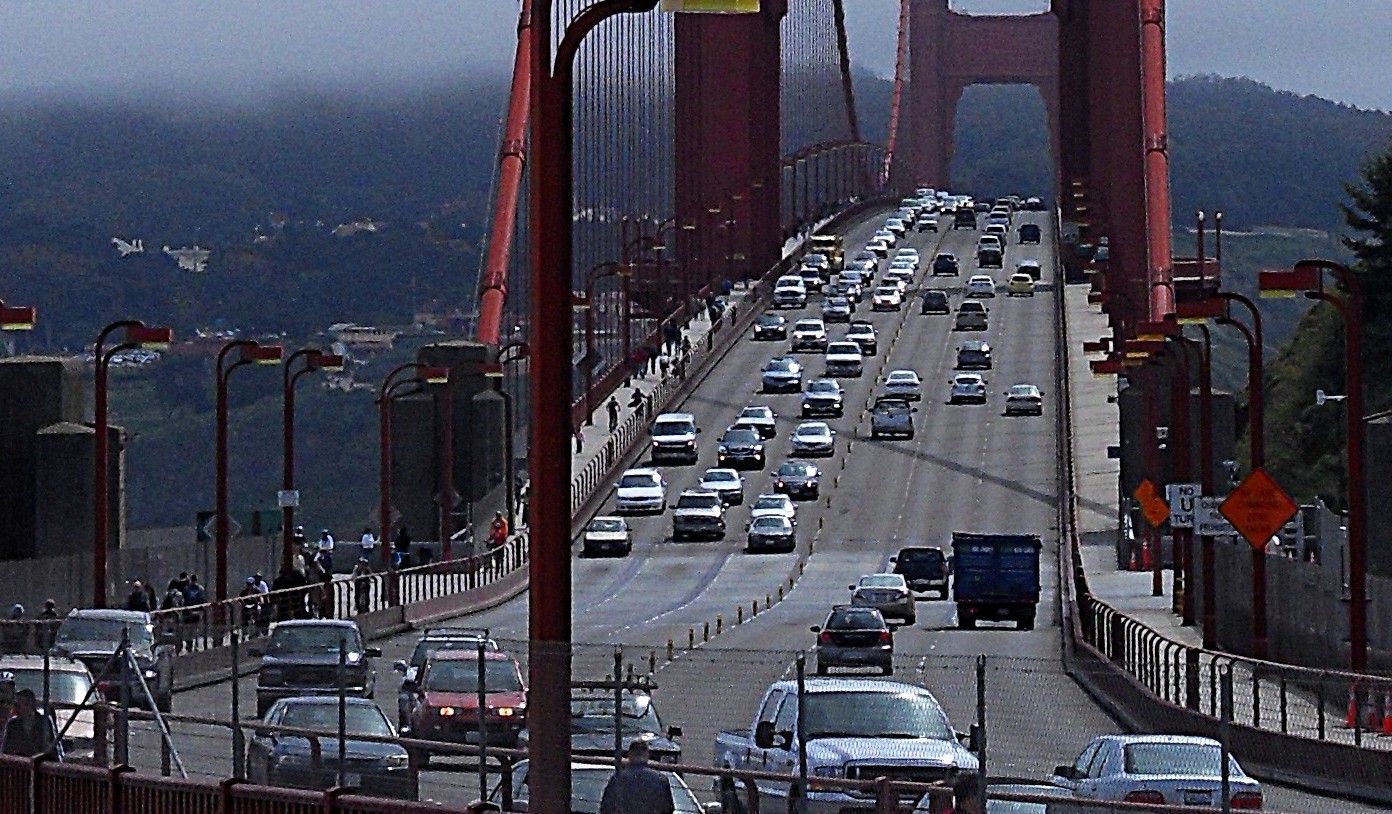 It is made of a lightweight steel truss which gives it its flexibility, something that is required due to it constantly moving. It is designed to survive wind, earthquakes, traffic loads, and the harsh marine environment. 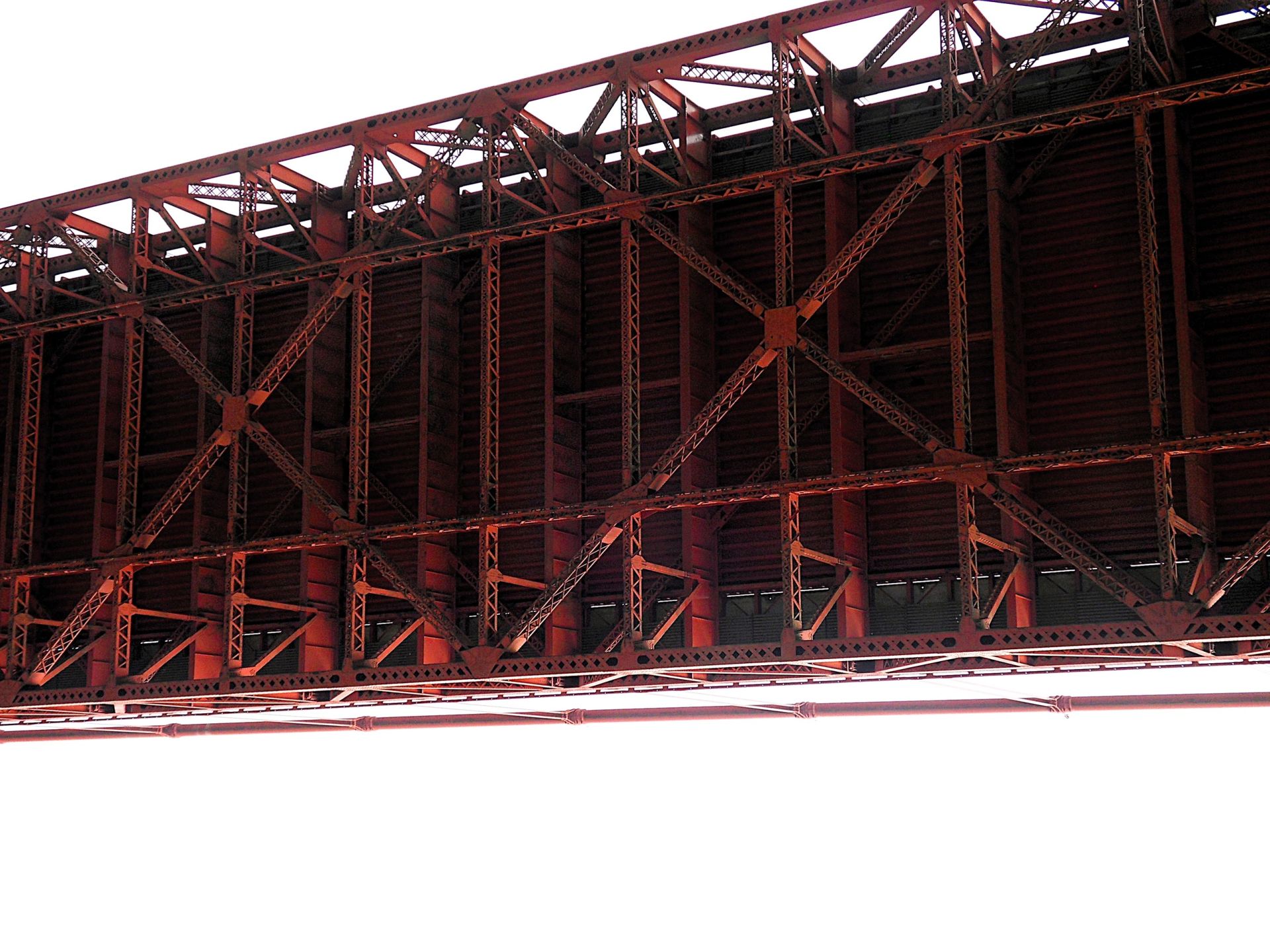 Apart from increasing flexibility the truss system reduces weight and allows wind to pass through the elements which prevents the risk of oscillation. The sway in fact, can be several feet sideways in strong winds with a rise or fall of up to 16 feet depending on temperature. In an earthquake it flexes so the energy is absorbed rather than resisted as a rigid deck would crack or fail. Something else relating to the roadway that is seen at the San Francisco side is a steel truss viaduct made of repeating triangular steel frames. Unlike the main span, which hangs from cables, this section is supported by piers driven into the seabed near the shore. These are rigid, not flexible like the suspended span. Their purpose is to lift the roadway to the correct elevation before the cables take over. This is required as the suspended span cannot begin at the shoreline and a roadway already at the correct height is required; the approach truss viaduct provides this by allowing the bridge to transition from ground-supported to cable-supported by carrying the roadway out over shallow water. It also provides a rigid platform before the suspended deck begins. 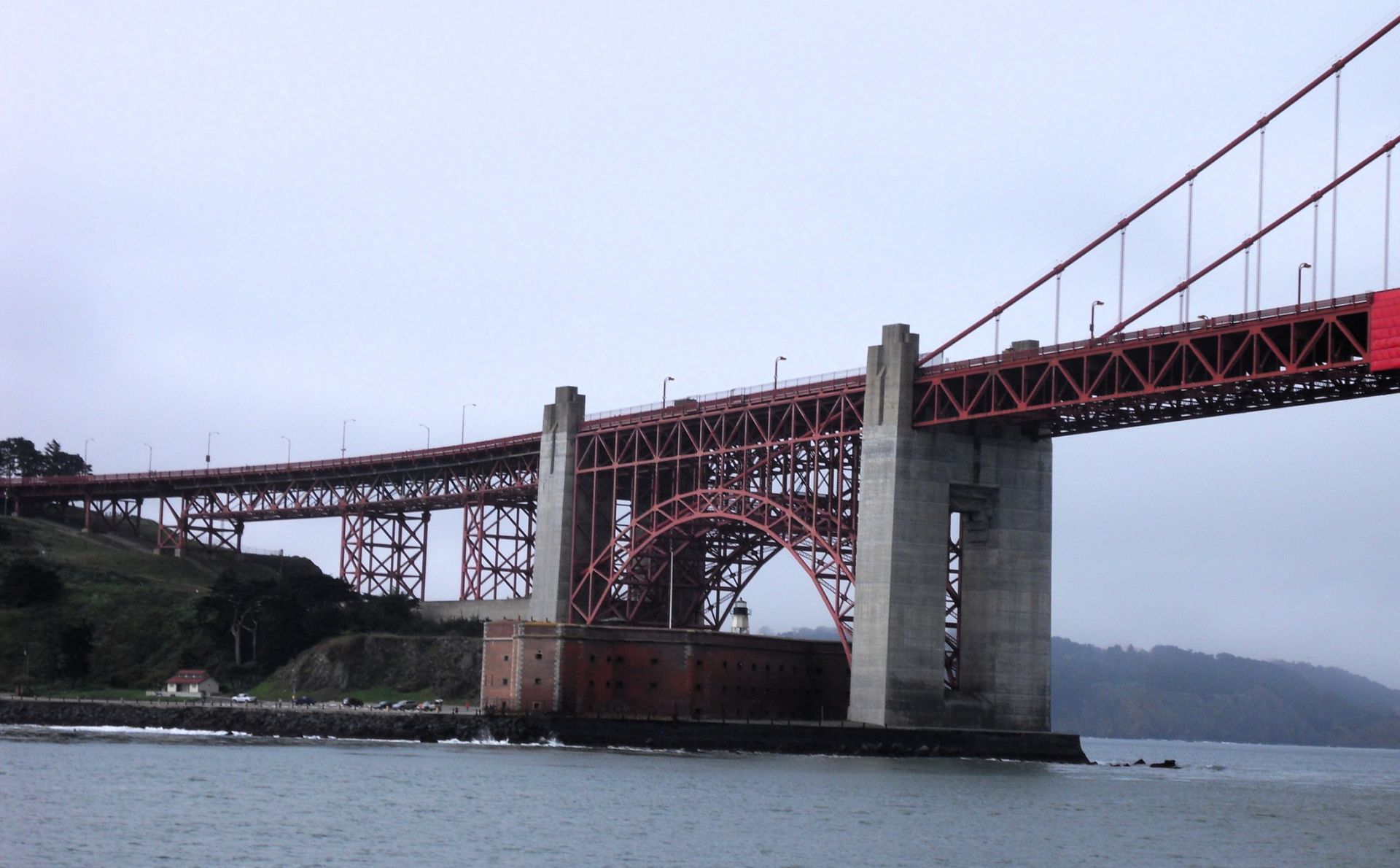 The final item of the bridge are the anchors which are massive reinforced concrete blocks weighing over 60,000 tons built directly into the bedrock of the hills at each end of the bridge. Their purpose is to hold the ends of the main cables and resist the horizontal pull of the entire system. Inside each anchorage is a chamber where the cable ends are secured. The main cable enters the anchorage where it spreads out into hundreds of individual strands. Each strand is looped around a steel eyebar which are embedded in the concrete mass. The concrete absorbs the tension and transfers it into the ground. The anchorages are the only part of the bridge that does not move. These are not open to visitors. Located near the parking area at Vista Point on the Marin side is the statue of the Lone Sailor, this is not a specific person, but a symbolic figure. It is a young sailor standing with his seabag facing the bridge and the Pacific beyond capturing the moment before departure, or the moment of return. It honours all who served in the U.S. Navy; the Merchant Marine and Coast Guard, especially those who sailed under the Golden Gate on their way to war. Dedicated on April 14, 2002, this statue is one of several replicas of the original Lone Sailor sculpture created by Stanley Bleifeld for the U.S. Navy Memorial. It is life-size and is made of textured bronze, giving it a weathered, sea‑worn feel. Due to the harsh marine environment the statue requires periodic conservation work. 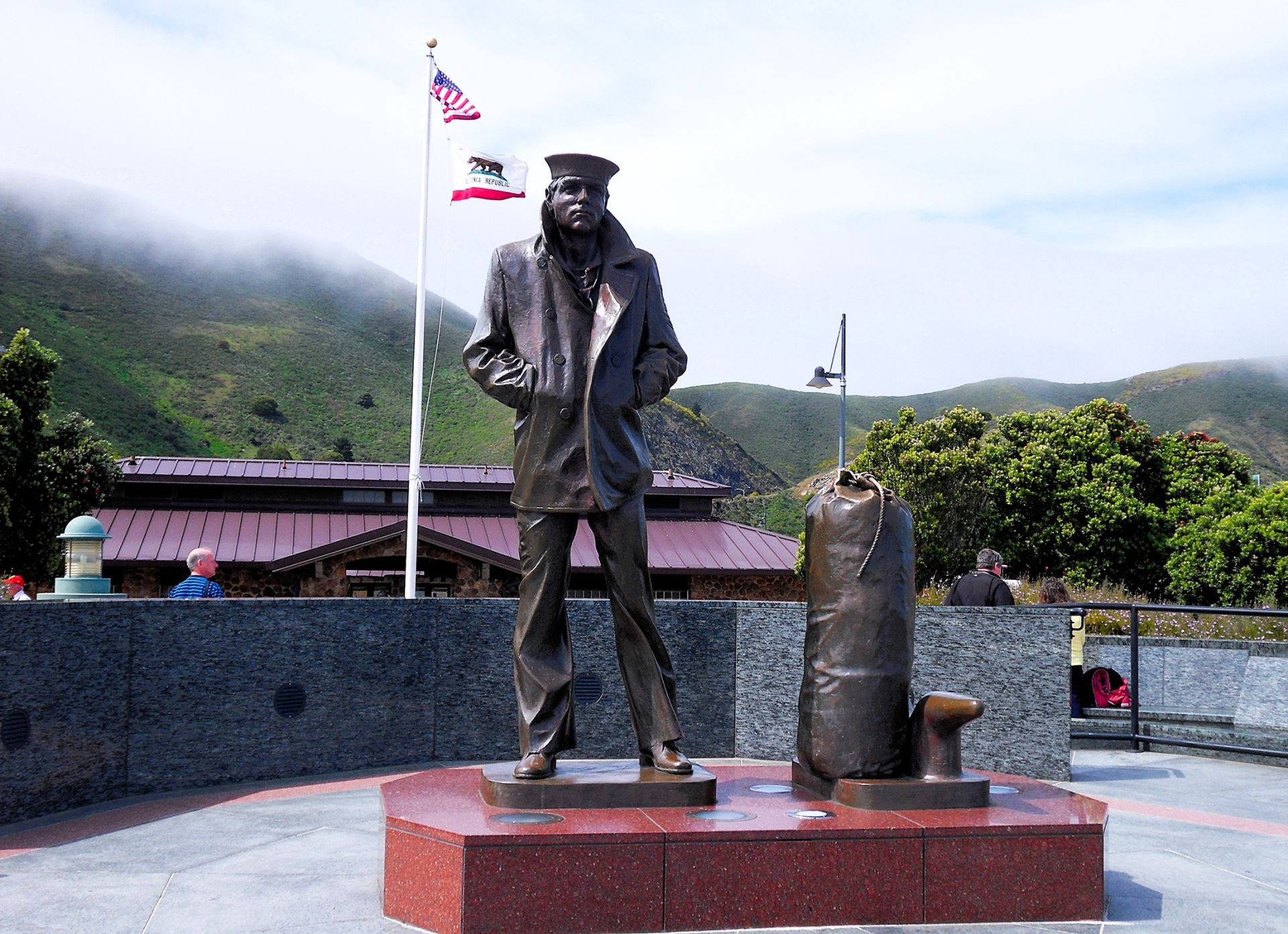 |
 |
|
 |
|||


All Photographs were taken by and are copyright of Ron Gatepain


| Site Map |