Grand Palace – History, Architecture & Significance
Summary
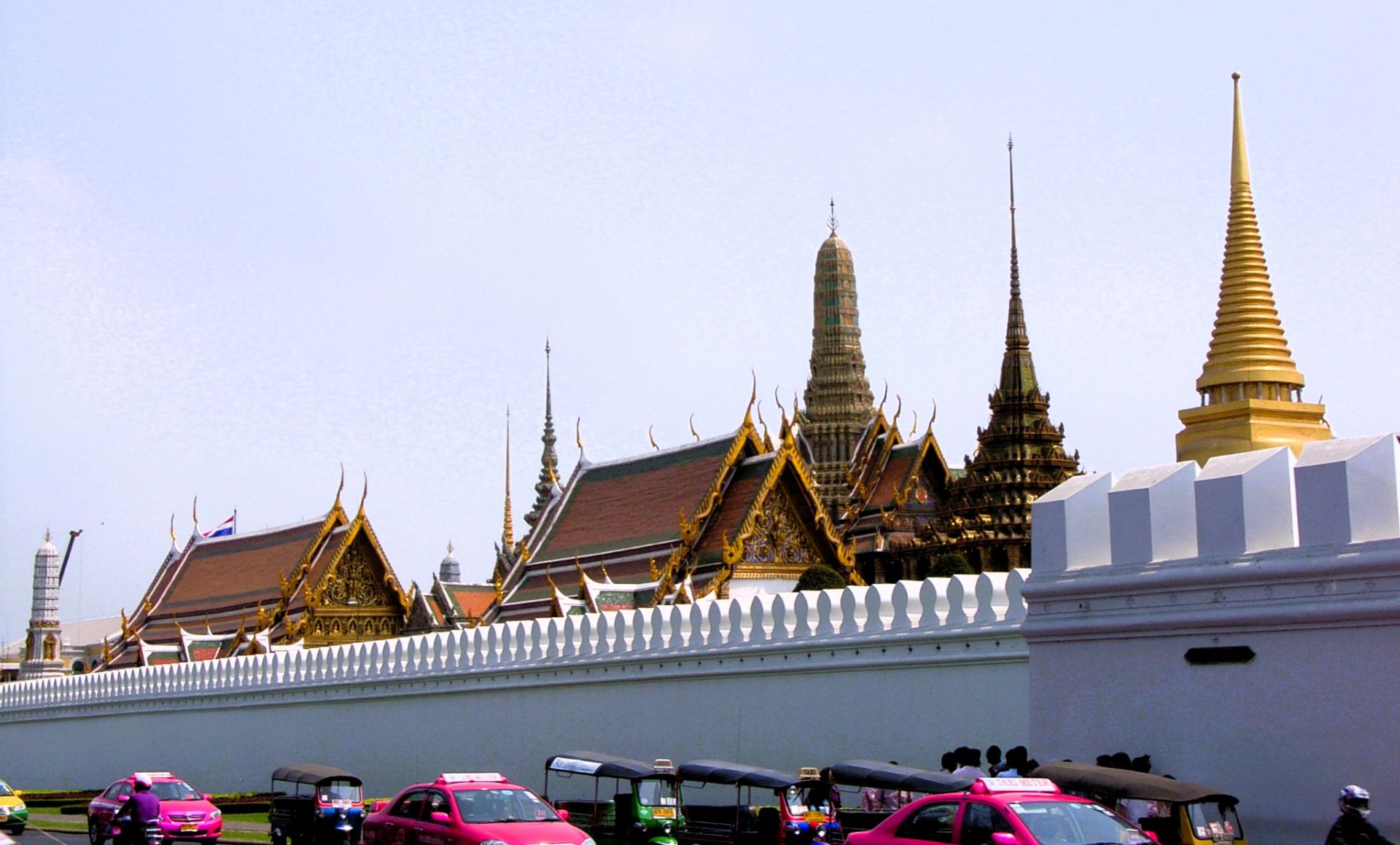
The Grand Palace in Bangkok, founded in 1782 by King Rama I, is a vast walled complex covering about 218,000 square meters with more than a hundred structures incorporating royal halls, ceremonial courts, pavilions, and the sacred Temple of the Emerald Buddha. For nearly 150 years it served as the official residence and administrative centre of the Thai monarchy, expanding under successive kings and blending Thai, Khmer, and European influences into a glittering architectural ensemble of gilded spires, mosaics, and multi tiered roofs. Although the royal family moved to other residences in the early 20th century, the Grand Palace remains the ceremonial heart of the nation, hosting major state rituals and drawing millions of visitors each year as Thailand’s most iconic cultural landmark.
The Grand Palace was started by King Rama I (1782 - 1809), the first king of the Chakri Dynasty. The palace then became the administrative capital of Thailand, as well as the residence of the King and the home of the Emerald Buddha. The Buddha was discovered in the 15th century in the northern town of Chiang Rai covered in plaster and was brought to Bangkok in the late 18th century by the future King Rama I, who was then serving as general under Tok Sin, the last ruler of the previous dynasty. After he became king, he moved the capital to Bangkok and in 1782 constructed Wat Phra Keow, commonly called the Temple of the Emerald Buddha to house the Emerald Buddha. This is one of the most venerated sites in Thailand. As each king ascended to the throne they made changes to the palace.
Significant renovations were carried out by King Rama III. He was the son of, not the queen but a concubine, and became king when the legitimate heir became a monk. During his reign, there was a series of wars with Laos, Cambodia, and Vietnam.
The Grand Palace is a vast, asymmetrical complex at the heart of Bangkok, established in 1782 by King Rama I as the seat of the newly founded Chakri dynasty. For more than a century, it functioned as royal residence and administrative centre. Although the Thai monarch no longer lives there, the palace remains the focus of major state ceremonies and a national symbol visited by millions each year.
The palace is not a single building but a layered ceremonial precinct in a rectangular enclosure of about 218,400 m², bounded by four walls.
The Palace consists of three courts, an Outer Court which consists of administrative offices, reception halls, and the Temple of the Emerald Buddha. The Middle Court includes the throne halls and spaces for royal audiences, while the Inner Court, historically incorporated the women’s quarters. These courts include gardens, pavilions, and courtyards.
The architecture of the structures, which were added by successive kings over a period of 200 years, consists of traditional Thai architecture, European neoclassical influences, and Chinese decorative elements, but also includes Hybrid halls that mirror Siam’s diplomatic and cultural exchanges. (Note: Siam was officially renamed Thailand on June 5, 1939).
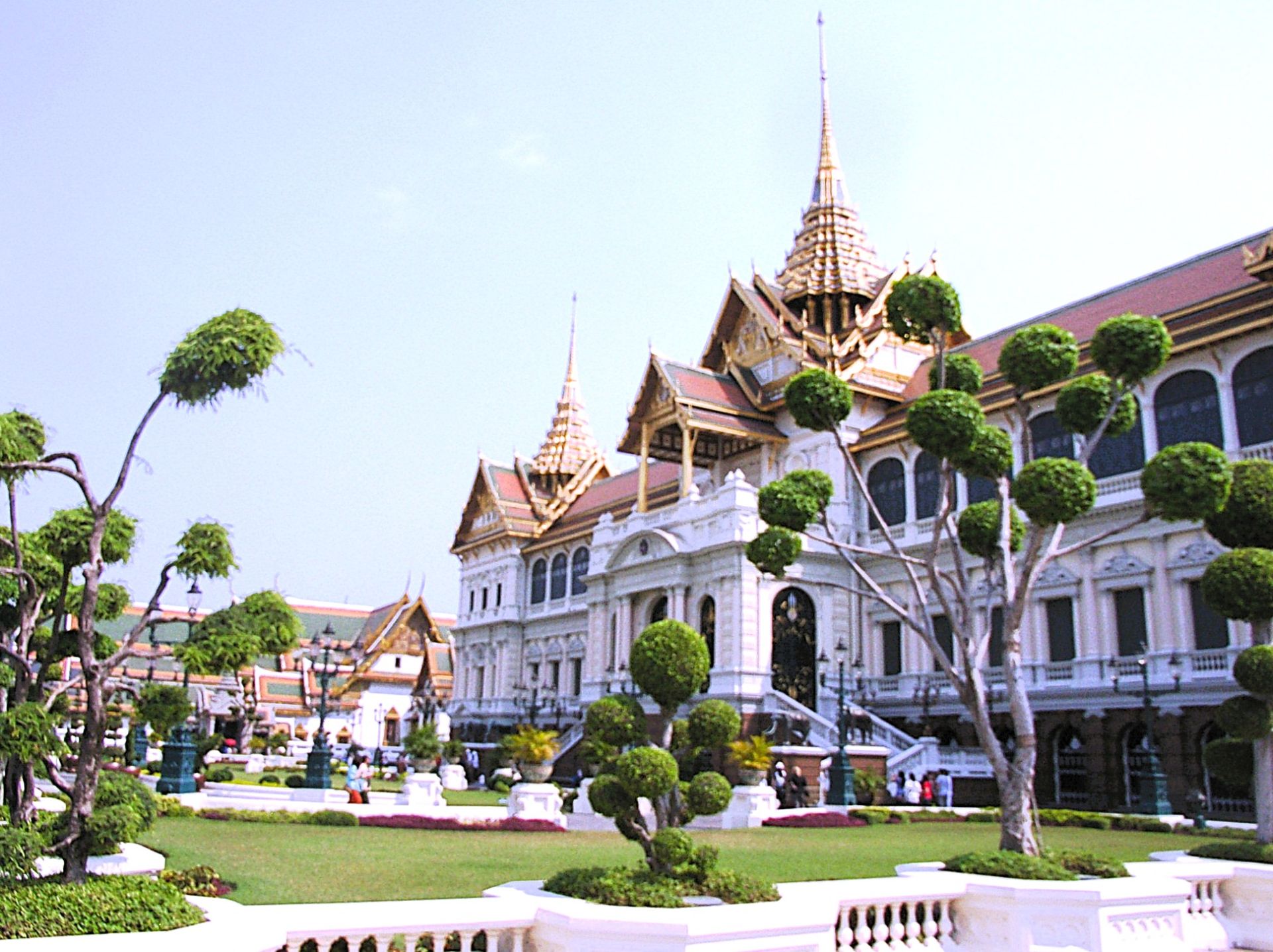
The complex incorporates the Royal residence, throne halls and government offices. There are four groups of palaces with the Chakri Maha Prasat being the largest and most famous. Erected by King Rama V as his own residence in 1882, it consists of 3 stories incorporating a mixture of Thai and Western architecture. The lower parts, designed by a British architect, are in the Imperial Victorian style while the top section is pure Thai with its tiered sloping roofs and tapering spires.
Adjacent to the palaces is the temple of Emerald Buddha and other buildings, monuments, and stupas.
The Temple of the Emerald Budha (Wat Phra Kaew) is at the heart of the Outer Court and is the large sacred precinct inside the Grand Palace that includes many structures: it is not a single building and is Thailand’s most sacred shrine.
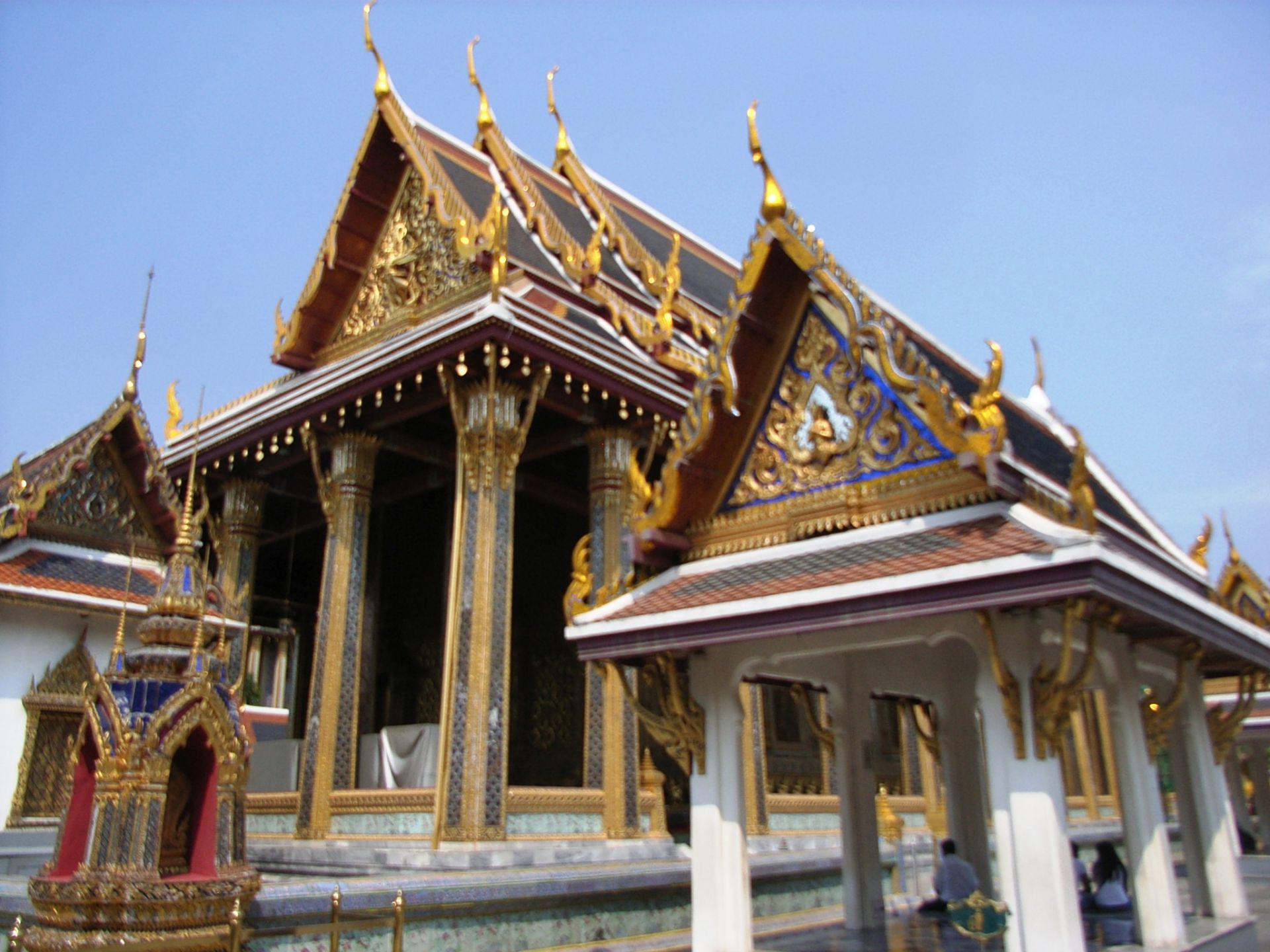
Within the Wat Phra Kaew, is the Ubosot, (the Ordination Hall) which is the most sacred single building in a Thai temple. The Ordination Hall, is used for Monk’s ordinations and major Buddhist rituals. It also houses the principal Buddha image the Emerald Buddha.
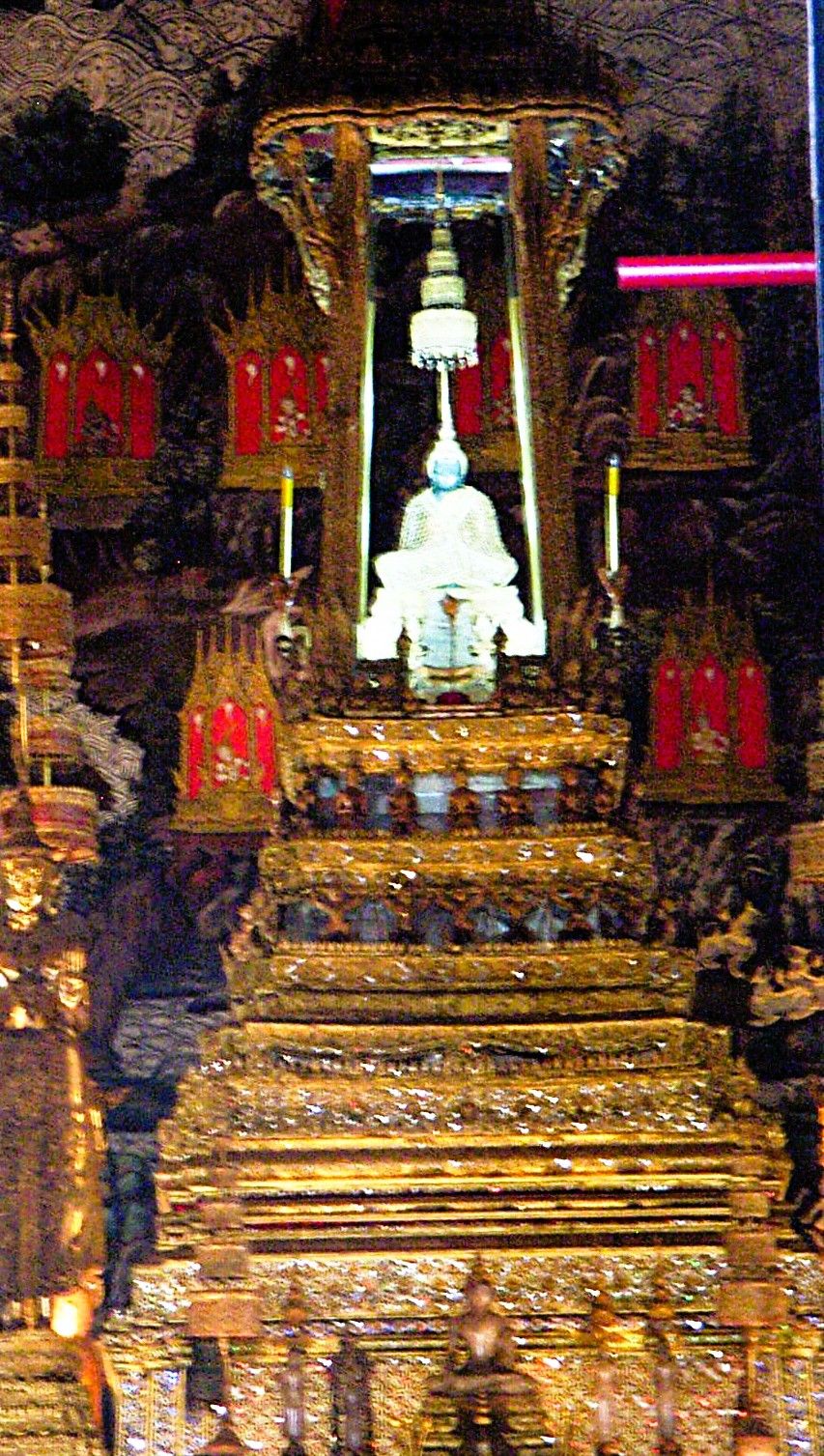
The Emerald Buddha is Thailand’s most sacred religious image and is believed to safeguard the kingdom’s prosperity and spiritual well‑being. The statue is 66 cm (26 inches) tall of the meditating Buddha, carved from a single piece of green semi‑precious stone, not emerald but most likely jasper or jadeite.
According to chronicles, it was created in 43 BCE in Pataliputra, India, by the sage Nagasena, with divine assistance from Vishnu and Indra. The earliest confirmed date of the Buddha is 1434, when lightning struck a stupa in Chiang Rai, revealing a stucco‑covered Buddha image; removing the plaster exposed the green statue beneath. Over the centuries, it travelled extensively finally reaching Bangkok, where in 1784, King Rama I installed it in the palace.
The Buddha sits in a meditative posture, clothed in gold robes, these are changed three times a year by the king, and mark the seasonal cycle of summer, rainy season, winter and affirms the monarch’s spiritual authority.
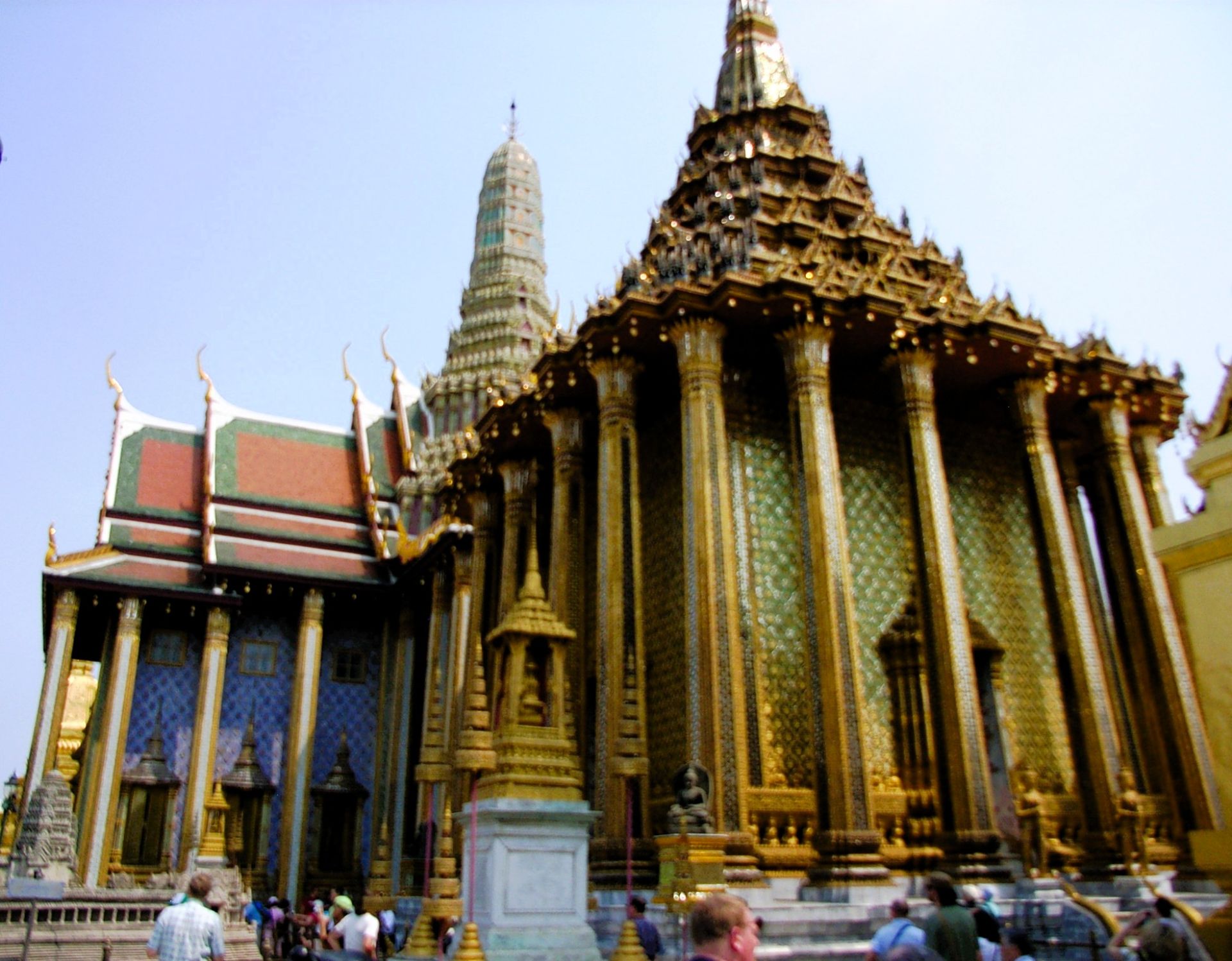
One of the other buildings of the Wat Phra Kaew is the Phra Mondop (Royal Library), with its multi‑tiered pyramidal roof with a tall, pointed spire; gilded and mirrored surfaces and highly ornate doors and pediments. It houses the Sacred Buddhist scriptures, Palm‑leaf manuscripts and Royal religious texts.
Four stone statues stand around the Phra Mondop. These are carved in the 9th‑century Javanese style and function as protective guardians of the sacred scriptures housed inside.
The base of the Phra Mondop is lined with gilded celestial beings from Thai Buddhist cosmology. These are depicted kneeling and although the pose of each is the same, each one slightly different with each figure having unique details.
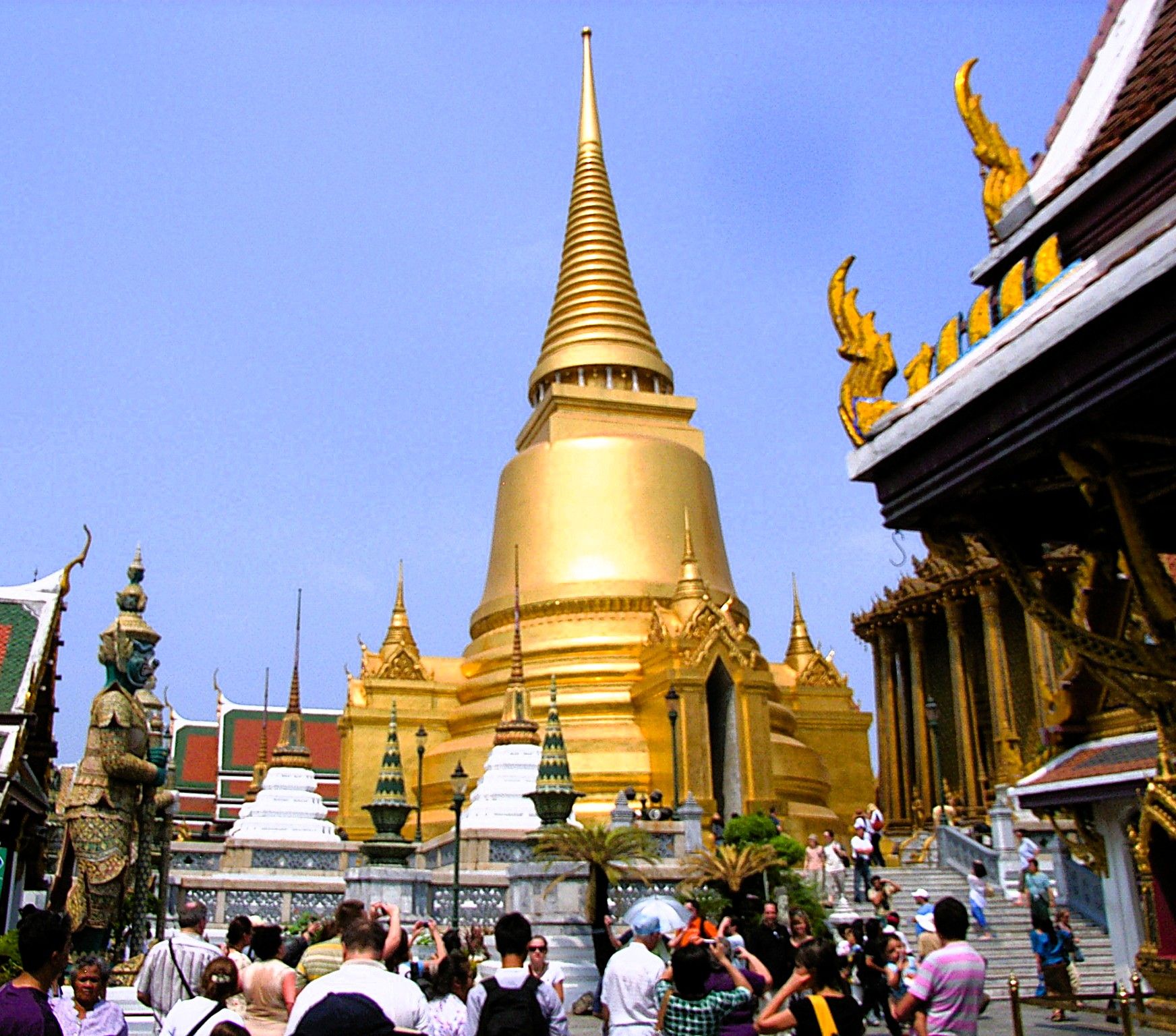
The Phra Si Rattana Chedi (golden stupa) is a reliquary mound, a structure that enshrines sacred Buddhist relics. The Phra Si Rattana Chedi specifically houses a relic of the Buddha, believed to be from Sri Lanka. With a circular base with multiple terraces, it has a smooth, bell‑shaped dome and tall, tapering spire covered entirely in gold mosaic tiles. The gold is not paint but is thousands of tiny reflective tiles, creating a jewel‑like effect.
Standing adjacent to the Phra Mondrop is the Prasat Phra Thep Bidon (Royal Pantheon). This is a shrine, originally intended to house the Emerald Buddha, however, the interior proved too small, so the Emerald Buddha was placed in the Ubosot instead. The Pantheon contains life‑size statues of the kings of the Chakri dynasty from Rama I to the present king.
The Pantheon is one of the most beautiful buildings in the Grand Palace although it is not open to the public except on Chakri Day (April 6), the national holiday honouring the dynasty. Sitting on a raised platform with ceremonial steps, it has a tall, multi‑tiered roof with gilded chofah finials; a central spire rising like a cosmic axis; Richly carved pediments; Gold and mirrored mosaics. It has Guardian figures and mythical motifs.
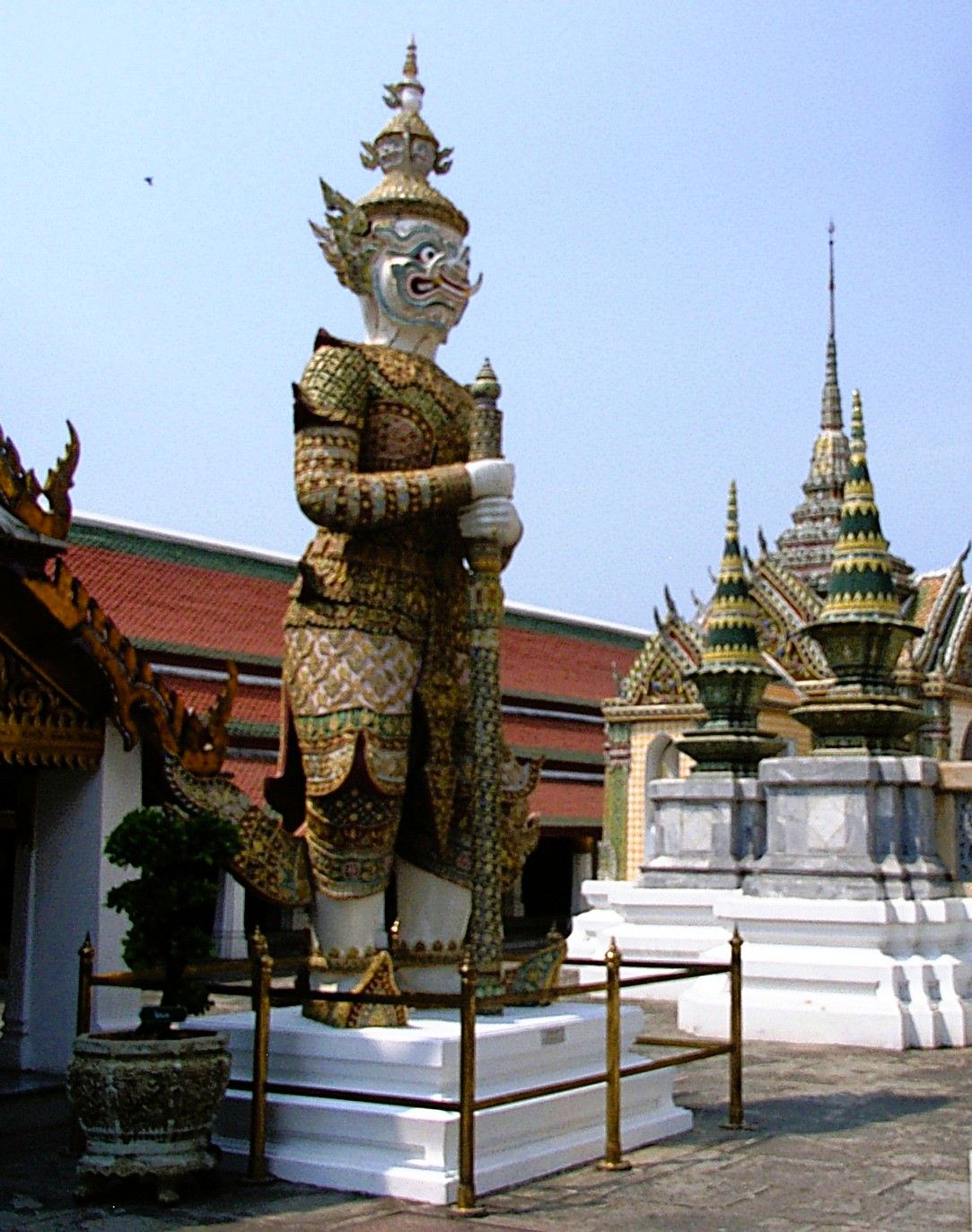
Other figures, who are at the gates of the Wat Phra Kaew, are the enormous demon giants standing approx. 16 feet tall (about 4.8 metres) who guard the threshold between the mundane world and the sacred precinct and protect the Emerald Buddha from spiritual threats.
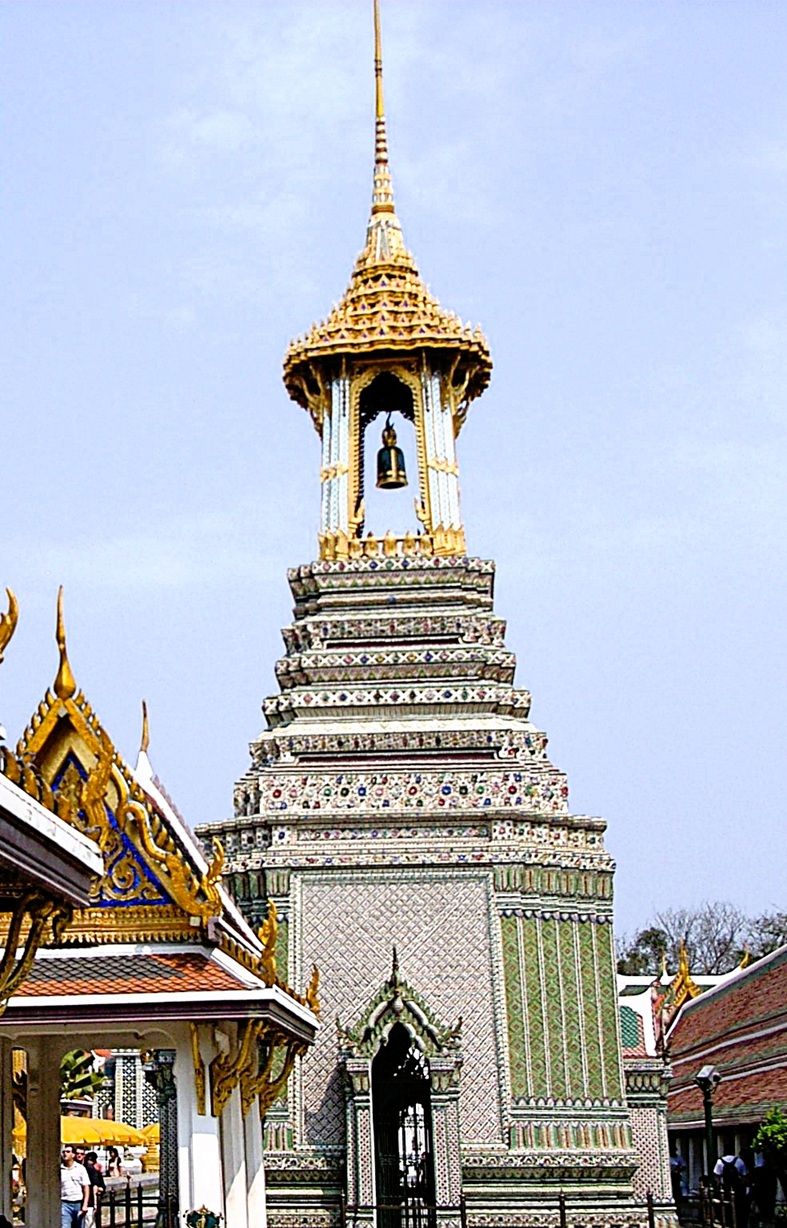
Near the Phra Mondop and the Royal Pantheon, forming part of the sacred architectural ensemble, is the Bell Tower which is a traditional Thai structure built to house a large bronze bell used in Buddhist ritual life. At Wat Phra Kaew, the bell tower marks ceremonial time; Signals the beginning of important rituals; and serves as a symbol of monastic authority, even though this temple has no resident monks.
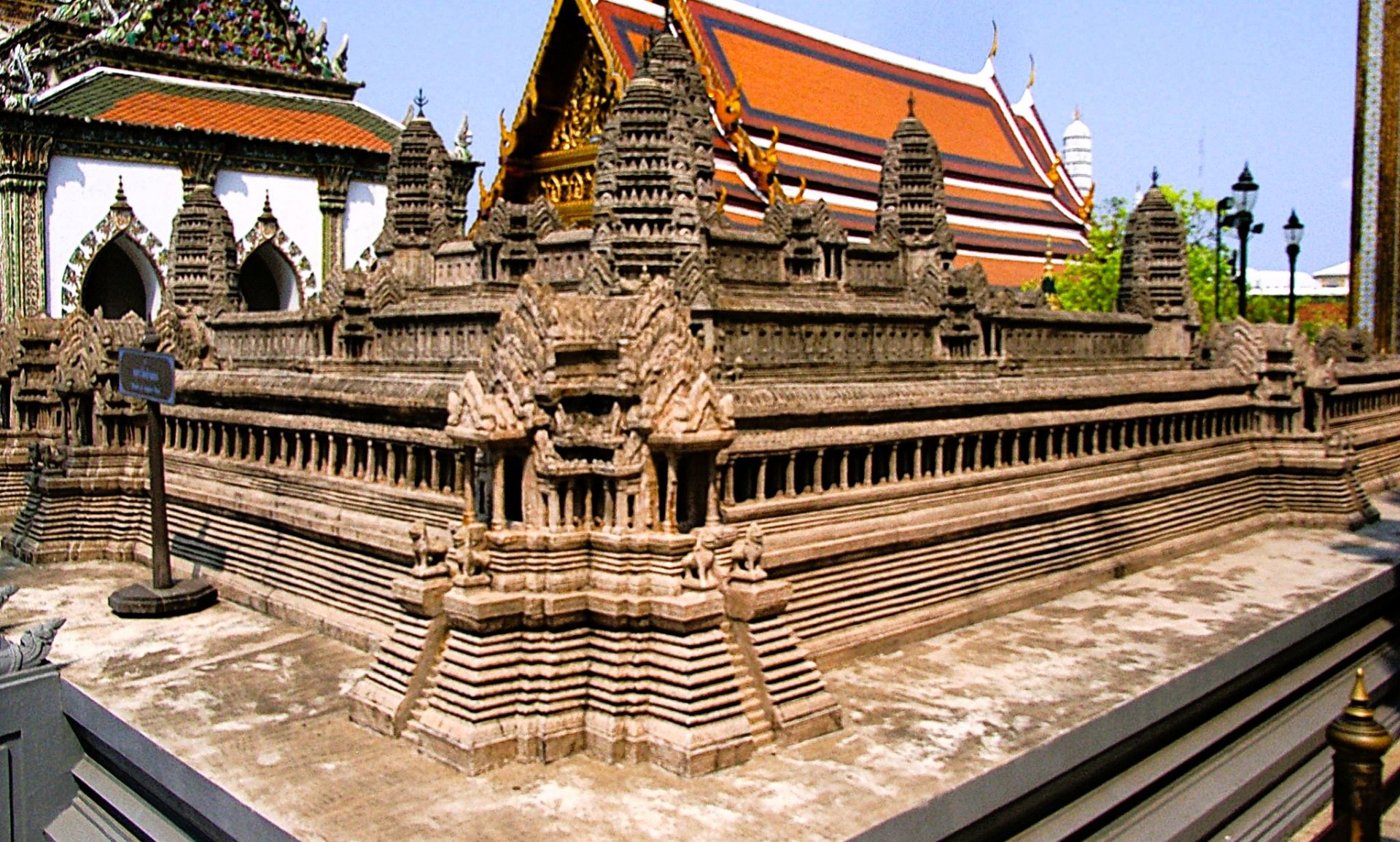
Sitting on the Upper Terrace, alongside Phra Si Rattana Chedi, Phra Mondop and the Royal Pantheon is a model of Angkor Wat was created in 1867, by King Rama IV who considered relocating the actual Angkor Wat to Bangkok. This was during a period when Siam (Thailand) exercised direct control over large parts of Cambodia, including Siem Reap: This was ultimately abandoned due to Cambodian resistance. The model became a symbolic assertion of cultural and political authority over Cambodia at a moment of geopolitical tension.
The model is made of stone and stucco, with careful attention to Angkor Wat’s towers and galleries. A small shrine beside it honours kings of the Chakri dynasty, surrounded by bronze elephants which are symbolic guardians of royal power.
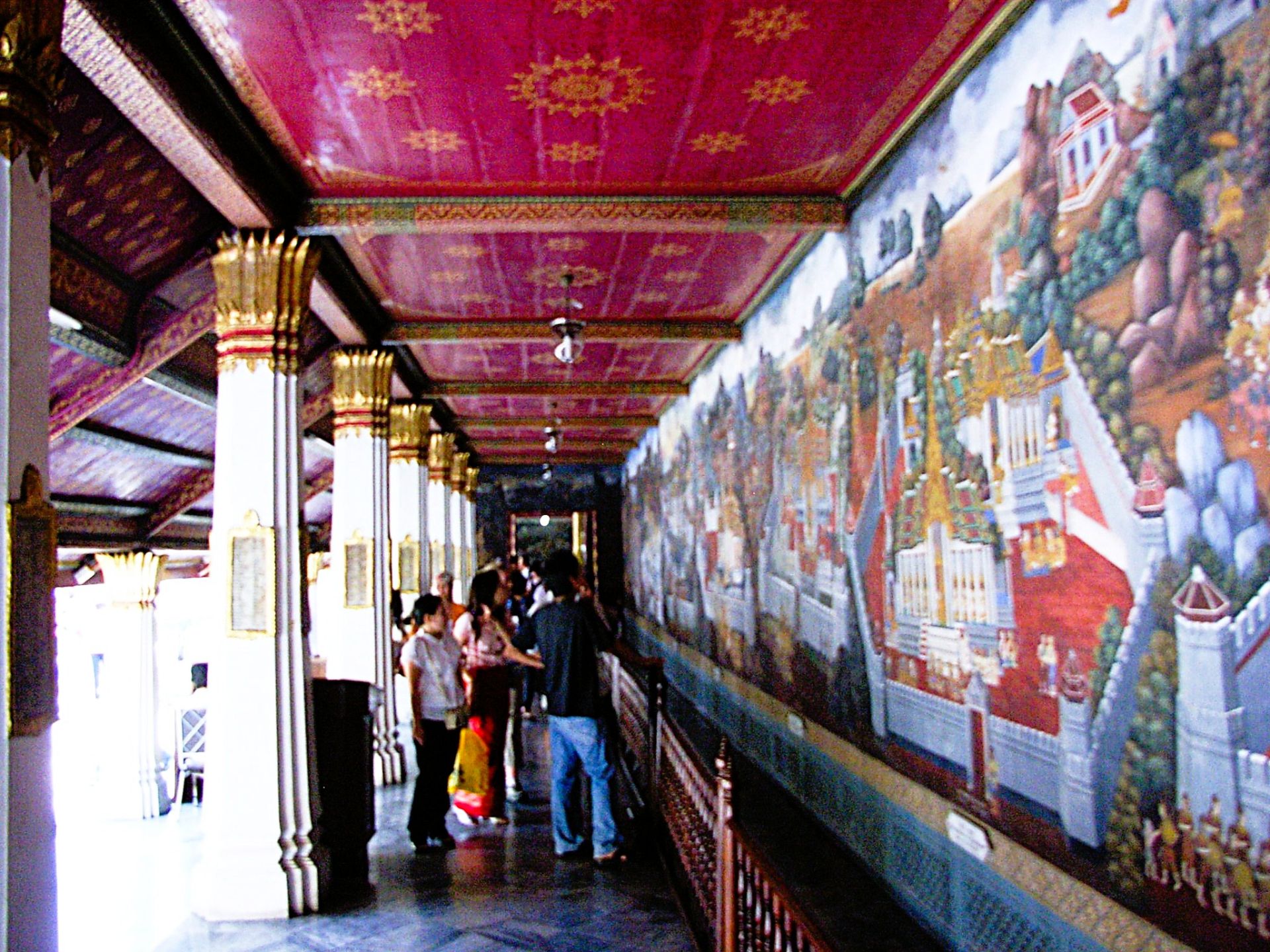
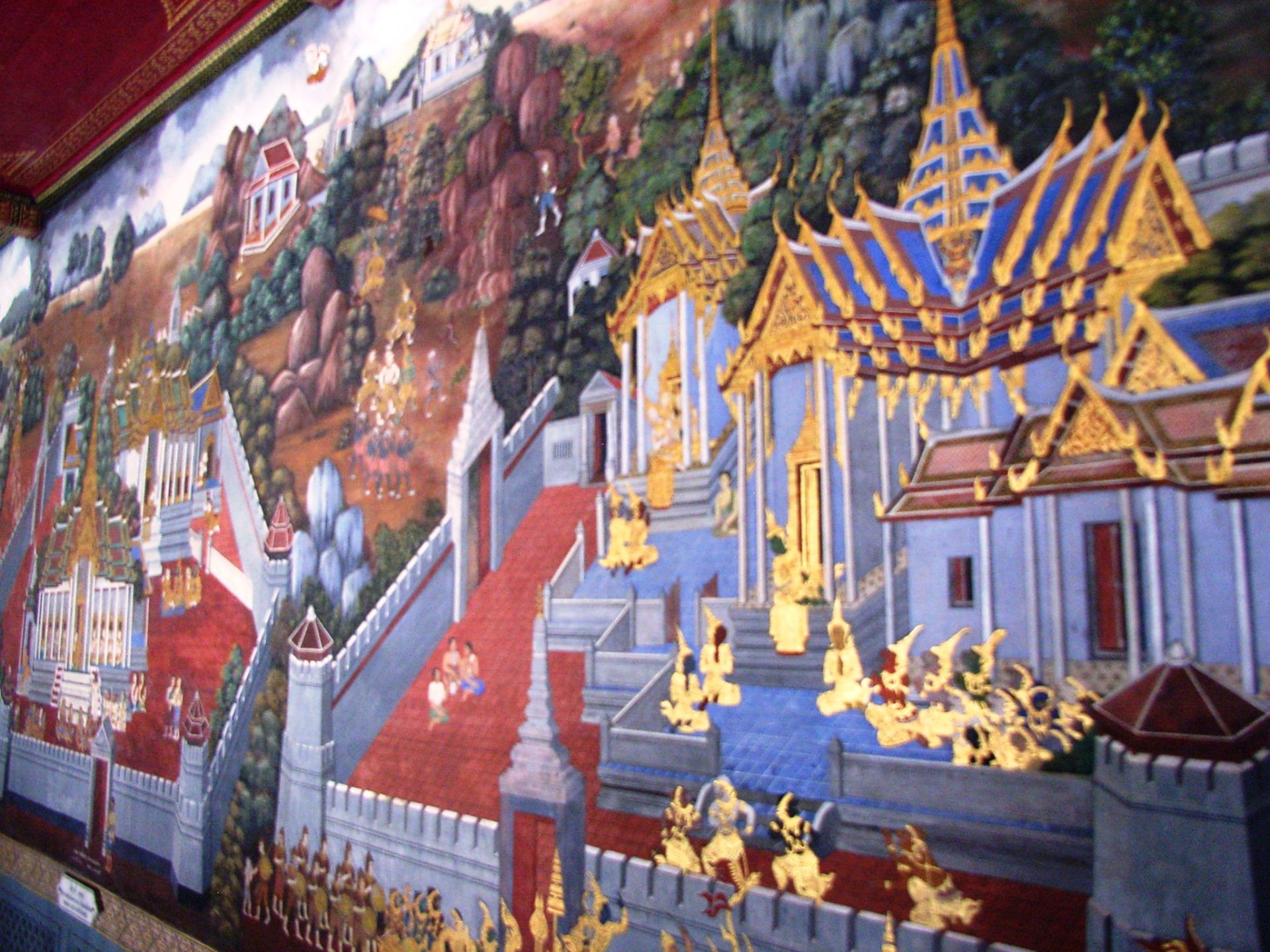
The Wat Phra Kaew is surrounded by the long cloister - The Ramakien Gallery.
Its walls are covered with 178 mural panels depicting the story of the Ramakien, Thailand's National epic from the Hindu epic the Ramayana. Stretching for over more than two kilometres in length the murals wrap around the precinct and is one of the most important artworks in Thailand. This is a national treasure displaying a visual story of Thai myth and depicts battle scenes, forest landscapes, palaces, demons, monkeys, and celestial beings. Many of the panels have been restored numerous times, most recently in a major project during the 20th century.
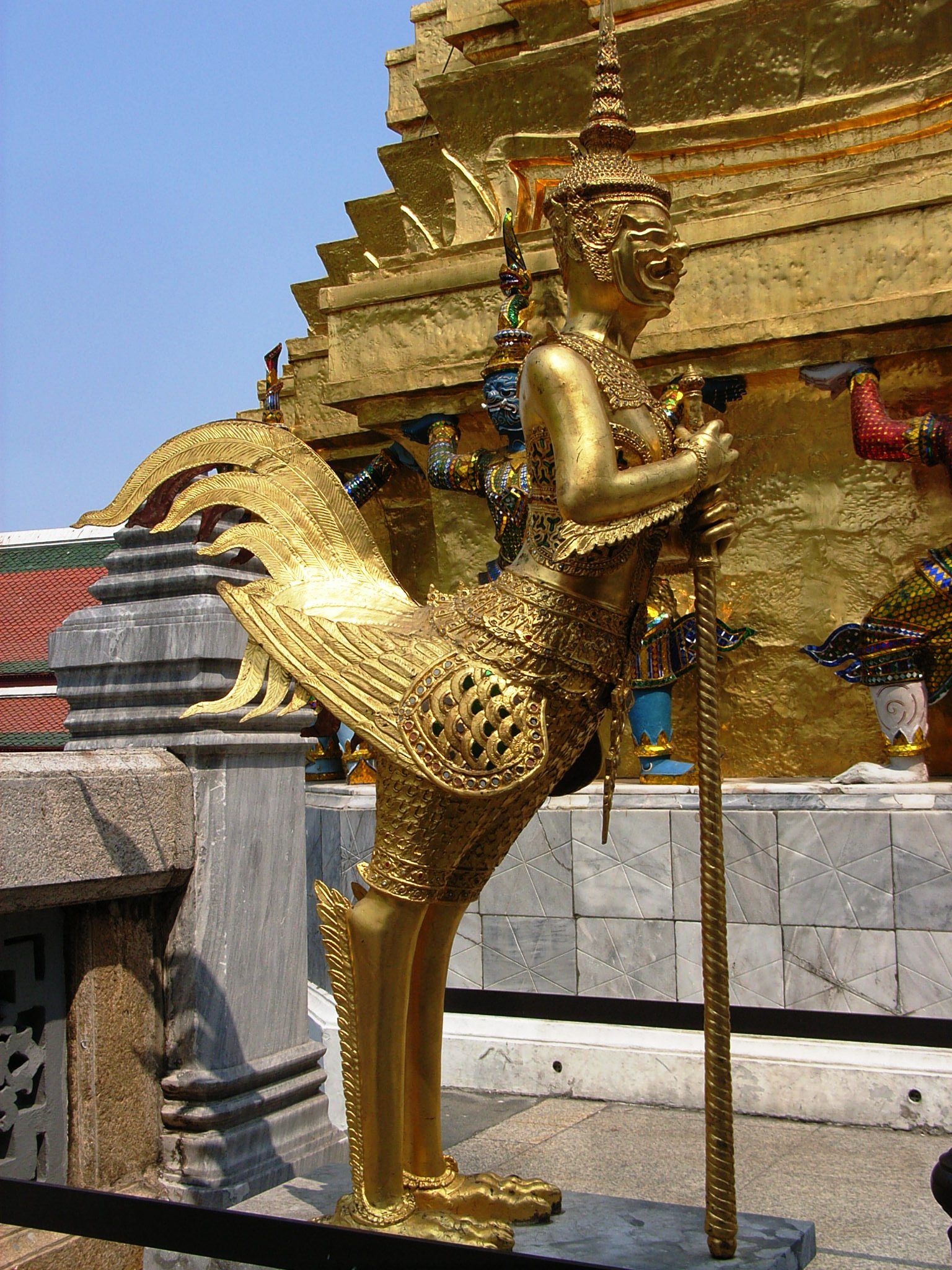
Around the complex are a number of Mythological beings, half-animal / half-celestial beings.
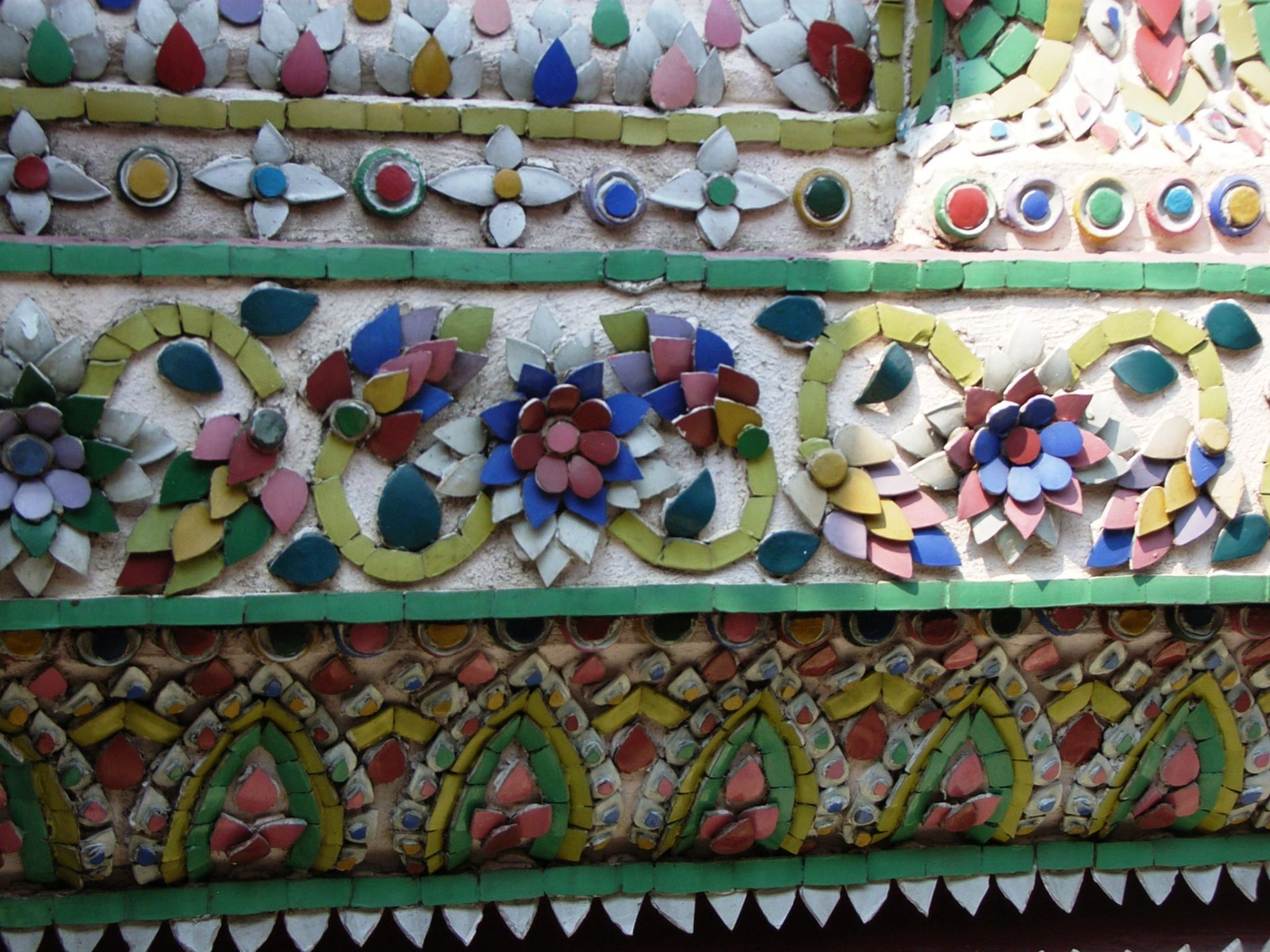
Also to be seen is a spire in the form of a Thai crown, made of Stucco and covered with Chinese porcelain. This came from crockery broken in transit and made into flowers.
Unlike most monasteries, there are no monks’ resident at Wat Phra Keow. The temple was for the exclusive use of the royal family who lived in the palace until the 1920s. It was opened to the public in 1959.
To see more photographs and take a virtual tour of the site click on the photoshow below.
All Photographs were taken by and are copyright of Ron Gatepain