






 |
|
|||||||||||||||
 |
||||||||||||||||











 |
|||
 |
Athens Holy Temple of Agia Irini – History, Architecture & Significance 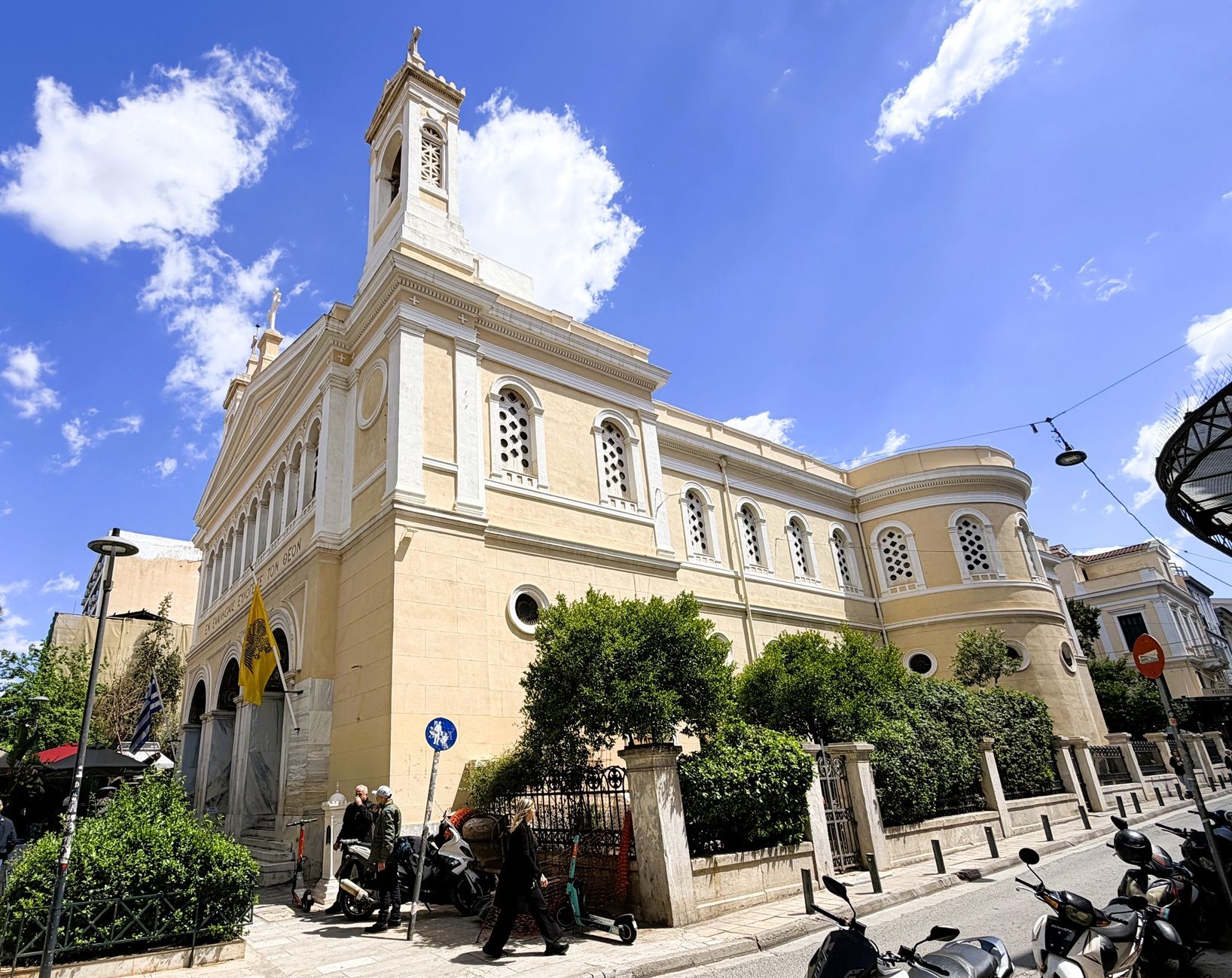
The Holy Temple of Agia Irini on Aiolou Street occupies a central place in the early history of modern Athens. The site originally held a small Byzantine chapel that later became a dependency of the Penteli Monastery, serving the surrounding commercial district long before the creation of the modern Greek state. This earlier church was destroyed during the Greek War of Independence of 1821 to 1829, leaving only fragments of the façade and parts of the masonry standing amid the ruins of the Ottoman era city. When Athens was declared the capital of the newly independent kingdom in 1832, the city lacked a suitable cathedral, and the damaged church of Agia Irini was hastily restored so that it could fulfil this role. Despite its modest size, it became the ceremonial heart of the new capital, hosting the first official celebration of Greek Independence Day in 1838 and the funeral of the revolutionary leader Theodoros Kolokotronis in 1843. These events established Agia Irini as a symbol of national rebirth at a time when Athens was still little more than a town of ruins and scattered houses. As the population of Athens grew and the city began to take shape, the restored church soon proved inadequate for the needs of the capital. In 1846 the government commissioned the distinguished architect Lysandros Kaftanzoglou to design a new and more imposing building on the same site. Kaftanzoglou, who had studied in Rome and was one of the leading figures of 19th century Greek architecture, created a design that blended Byzantine tradition with the neoclassical style that dominated the early decades of the modern city. The new church was completed and inaugurated in 1850, marking the transition from a provisional cathedral to a permanent architectural landmark that reflected the aspirations of the young Greek state. The façade of Agia Irini is framed by two neoclassical bell towers rising approximately 30 metres, giving the building a symmetrical and dignified appearance that aligns it with the civic architecture of the period. The entrance is formed by a three aisled narthex supported by columns, creating a transitional space between the lively square outside and the sacred interior, which is accessed via the front façade. 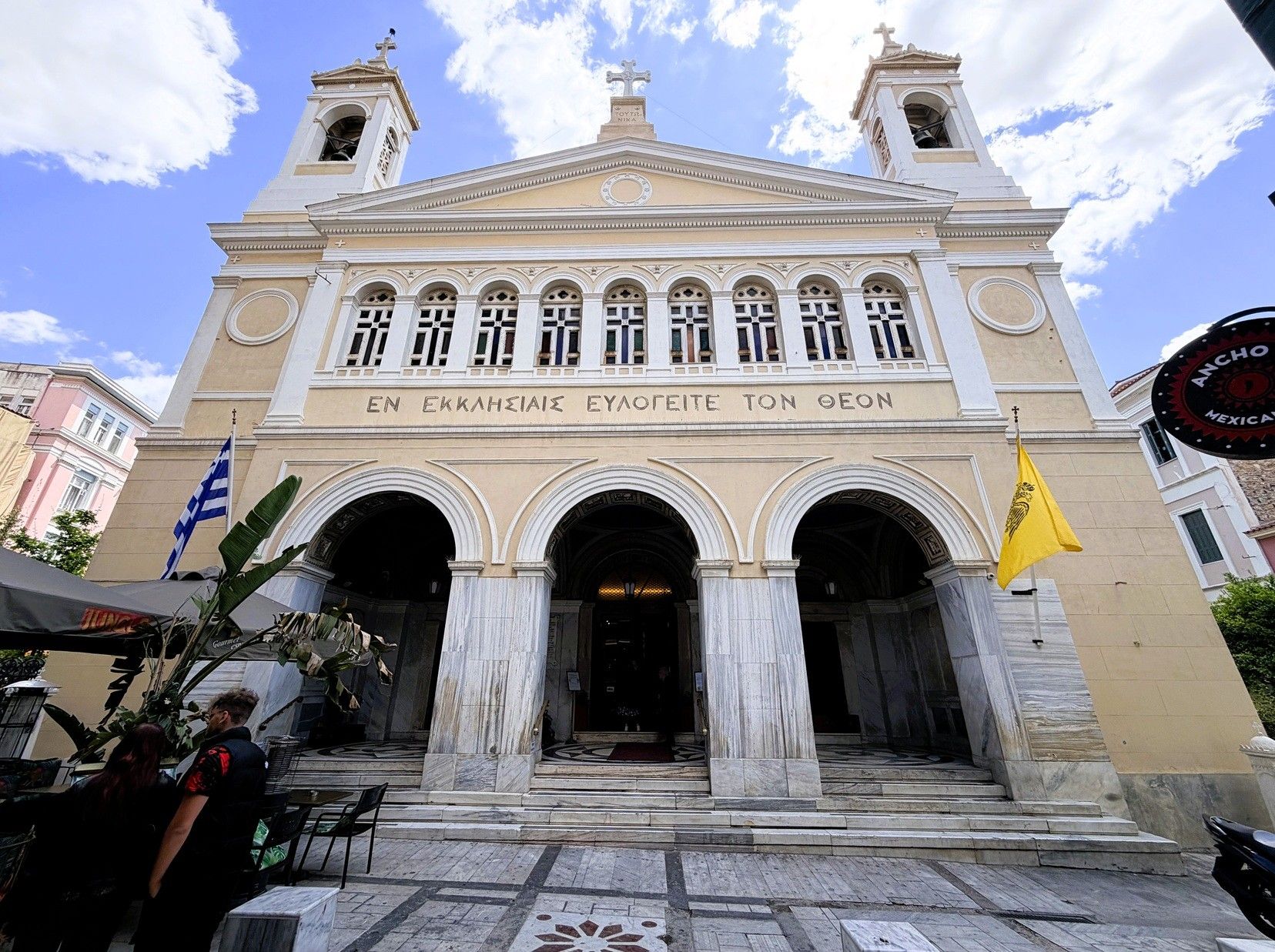 The narthex leads into a spacious three aisled basilica, with the central nave rising higher than the side aisles and drawing the eye directly toward the sanctuary. The arcades separating the aisles are supported by marble columns, some of which were reused from demolished Athenian churches and ancient ruins, reflecting the 19th century practice of incorporating historic materials into new public buildings as a way of linking the modern city with its ancient past. 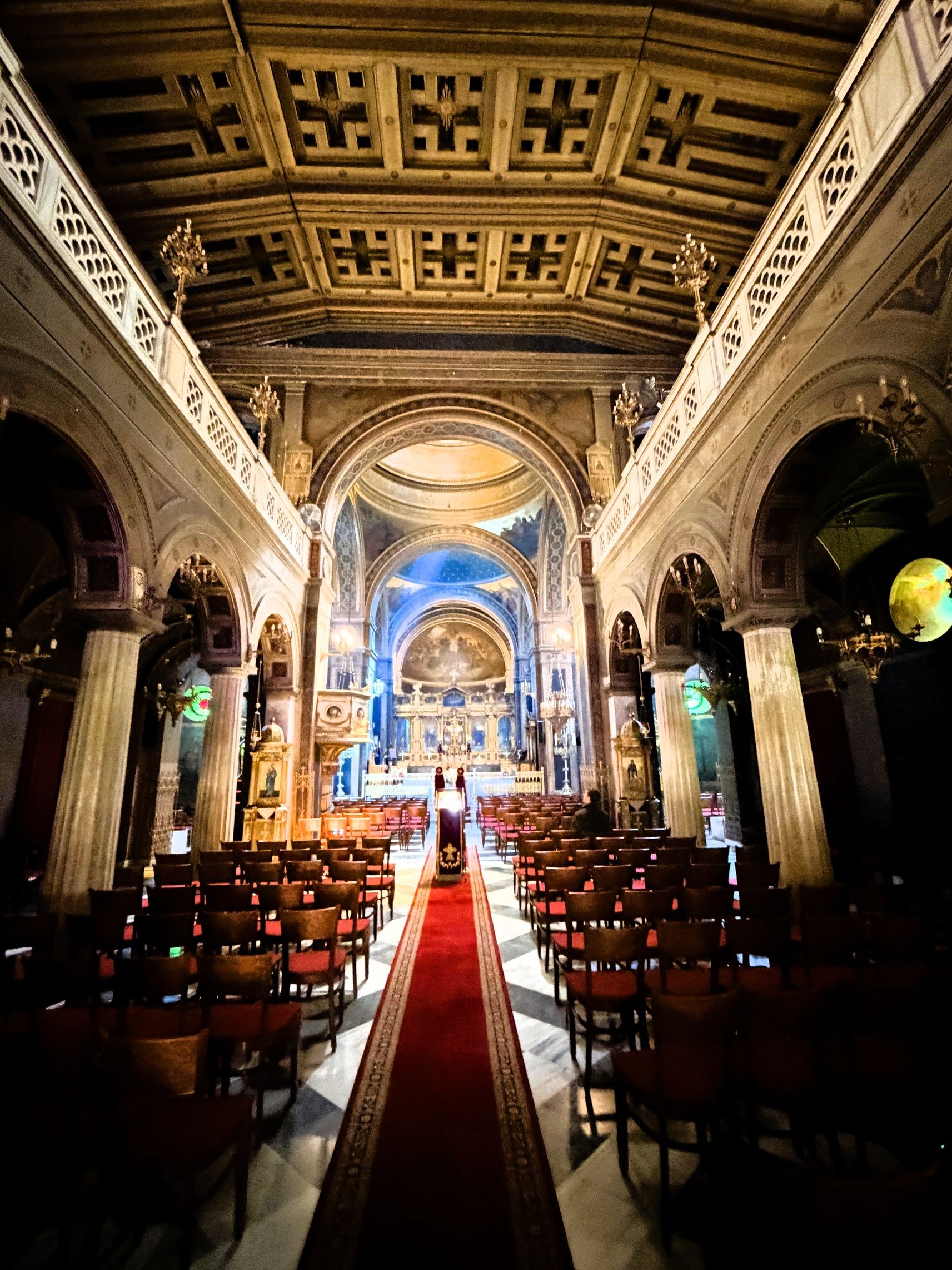 In the western domed bay located just inside the entrance, is a large semicircular mural and a ring of stained glass windows forming one of the church’s most striking interior compositions. The mural, painted by Spyridon Hatzigiannopoulos in the late 19th century, shows a crowd of figures arranged in a narrative scene, while above it five circular stained glass windows set in ornate gold frames fill the space with coloured light. The triangular panels between the windows contain stylised angelic figures, linking the earthly scene below with the heavenly light above. Positioned at the west end of the nave, this domed chamber acts as a transitional space between the narthex and the main body of the church. 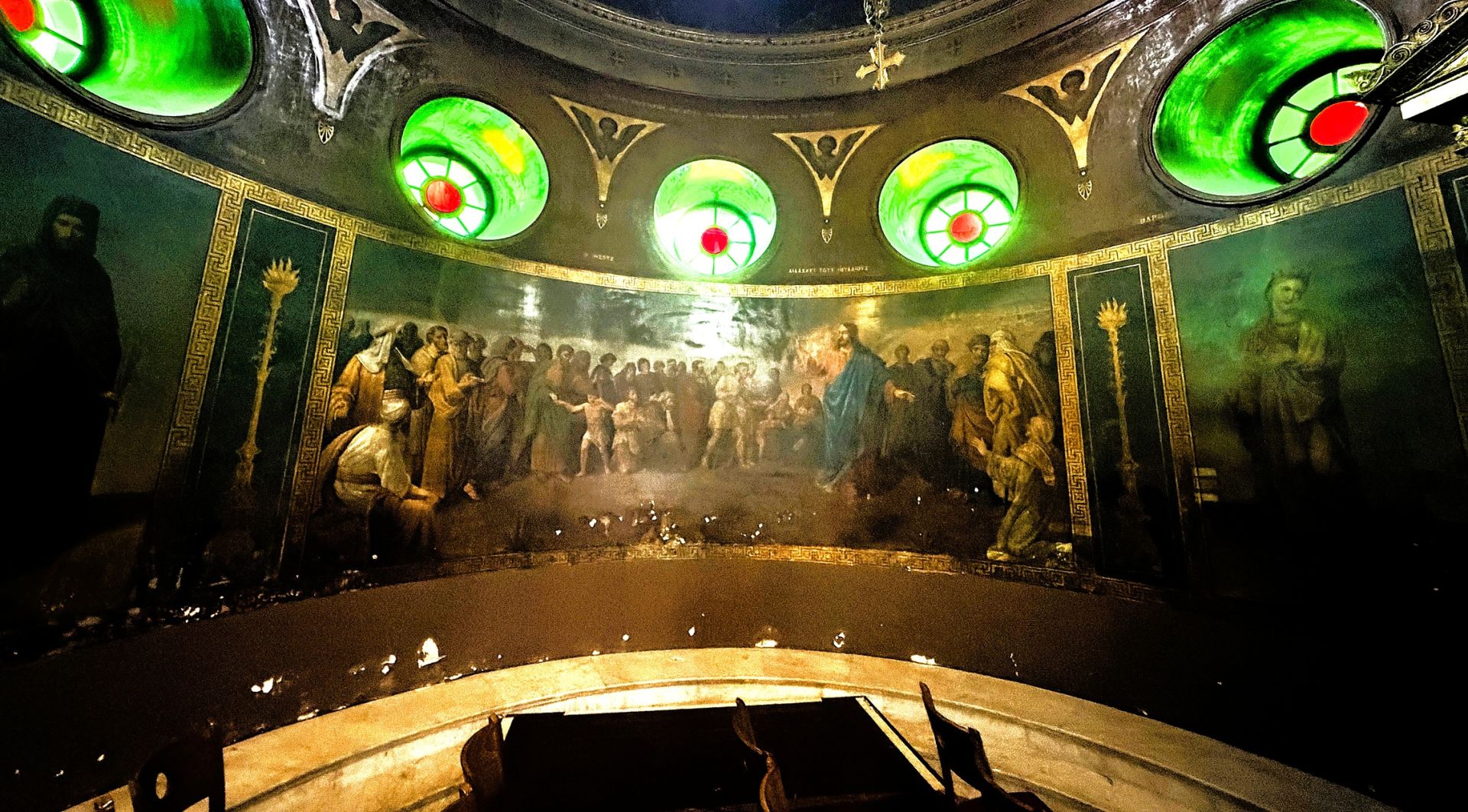 One of the most distinctive features of the church is the presence of two side conches—semicircular recesses projecting from the north and south sides of the nave. These give the interior a cruciform spatial impression, expanding the building laterally and providing additional surfaces for decoration. 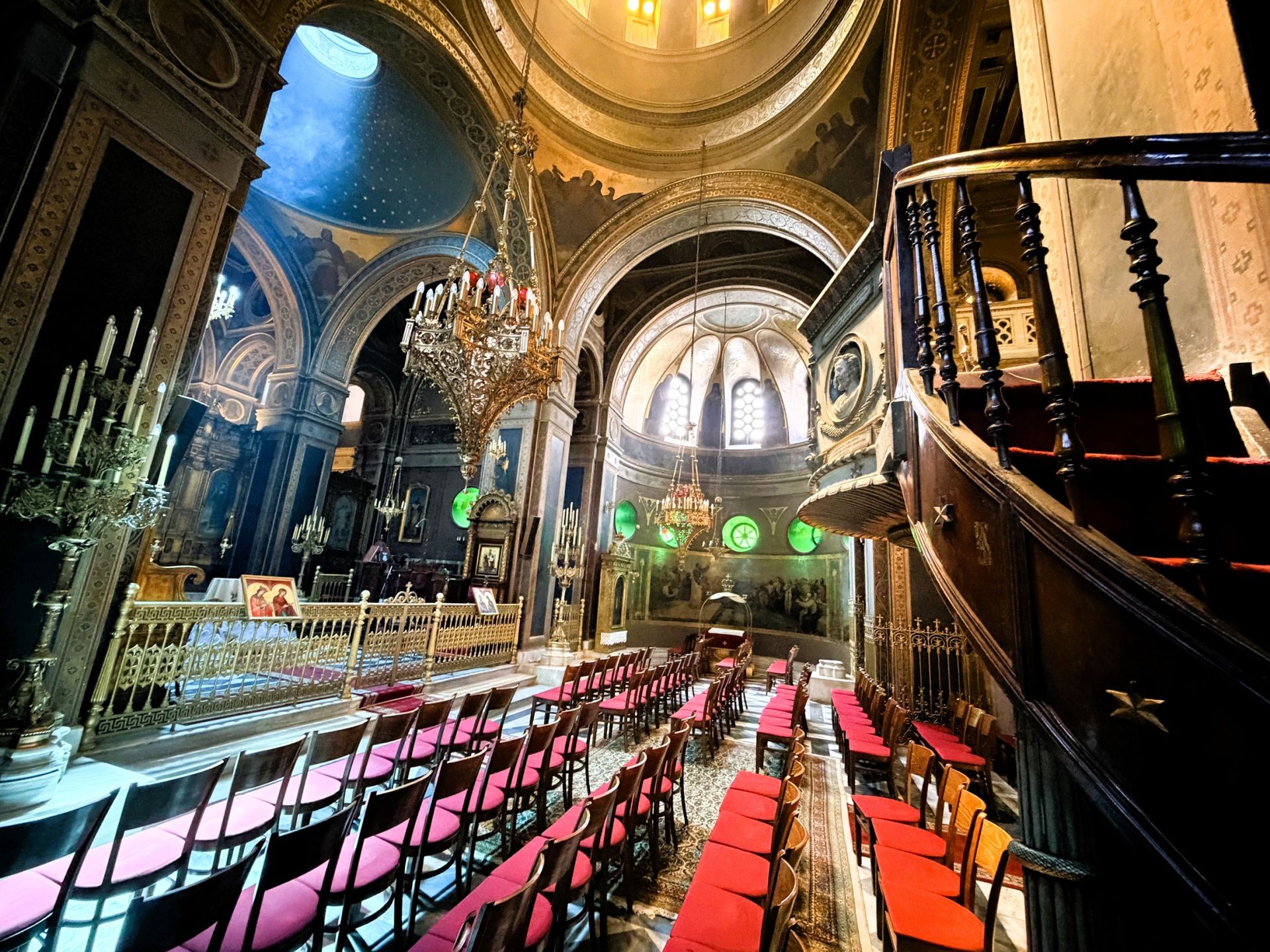 Above the aisles and narthex runs a continuous gallery, historically used for overflow seating and choirs, which also enhances the acoustics and architectural layering of the interior. 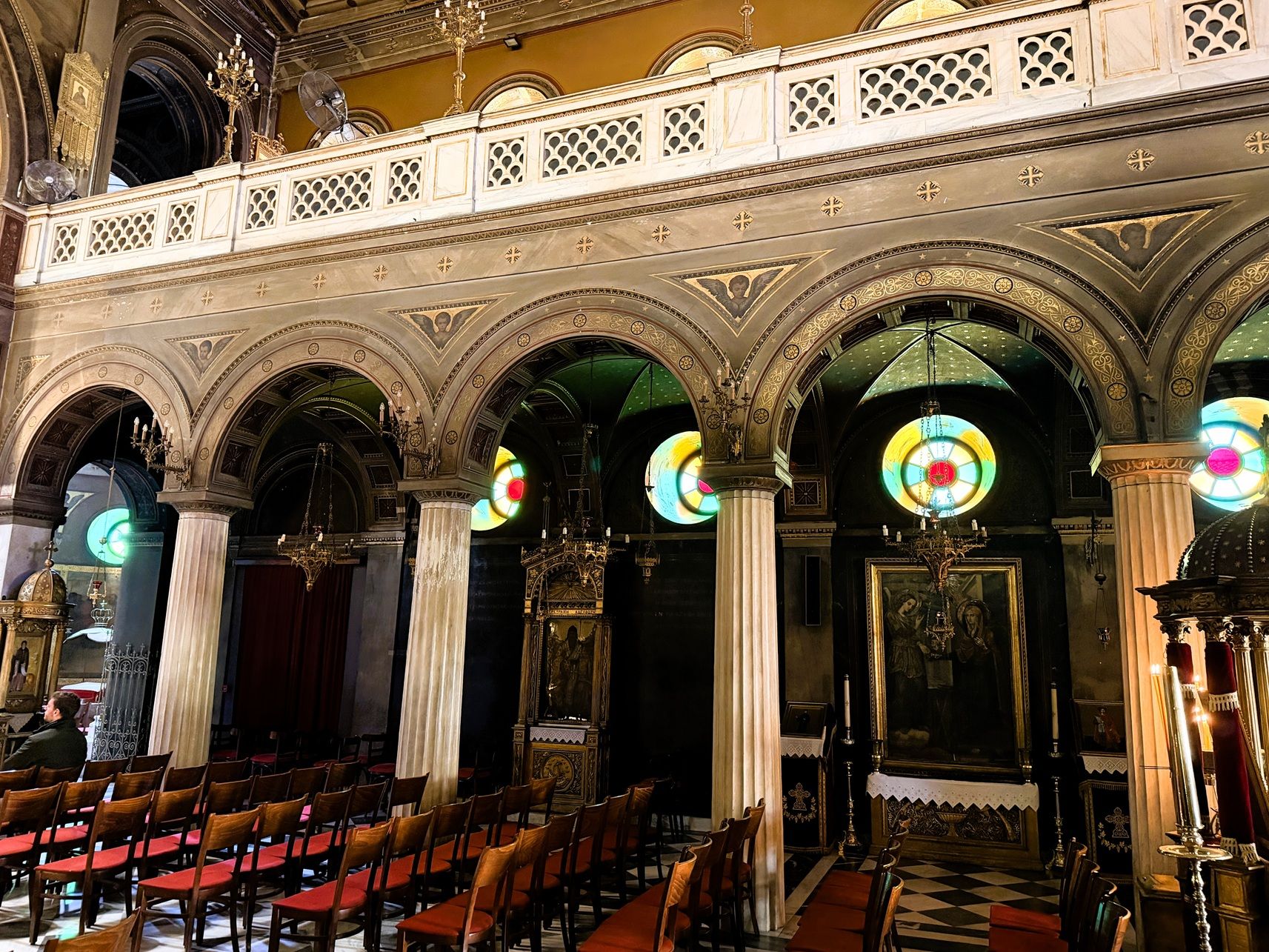 At the crossing of the nave rises the central dome, the symbolic heart of the church, which draws the eye upward and reinforces the vertical spiritual axis of the building. The dome, together with the conches and the basilican plan, creates a harmonious blend of Byzantine spatial tradition and 19th century architectural clarity. The sanctuary lies behind the iconostasis and contains the Holy Altar, the Prothesis where the Eucharist is prepared, and the Diakonikon used as a sacristy. Access to this area is restricted to clergy, and its arrangement follows traditional Orthodox liturgical requirements. Separating the sanctuary from the nave is the church’s most important interior feature: the gold plated iconostasis, a gift from Tsar Nicholas I of Russia in 1850. Richly carved and covered in gold leaf, it displays large icons of Christ, the Virgin, St John the Baptist, and St Irene, while the Royal Doors depict the Annunciation. This iconostasis forms both a liturgical boundary and a visual masterpiece, dominating the eastern end of the church and reflecting the close cultural ties between Greece and Russia during the 19th century. 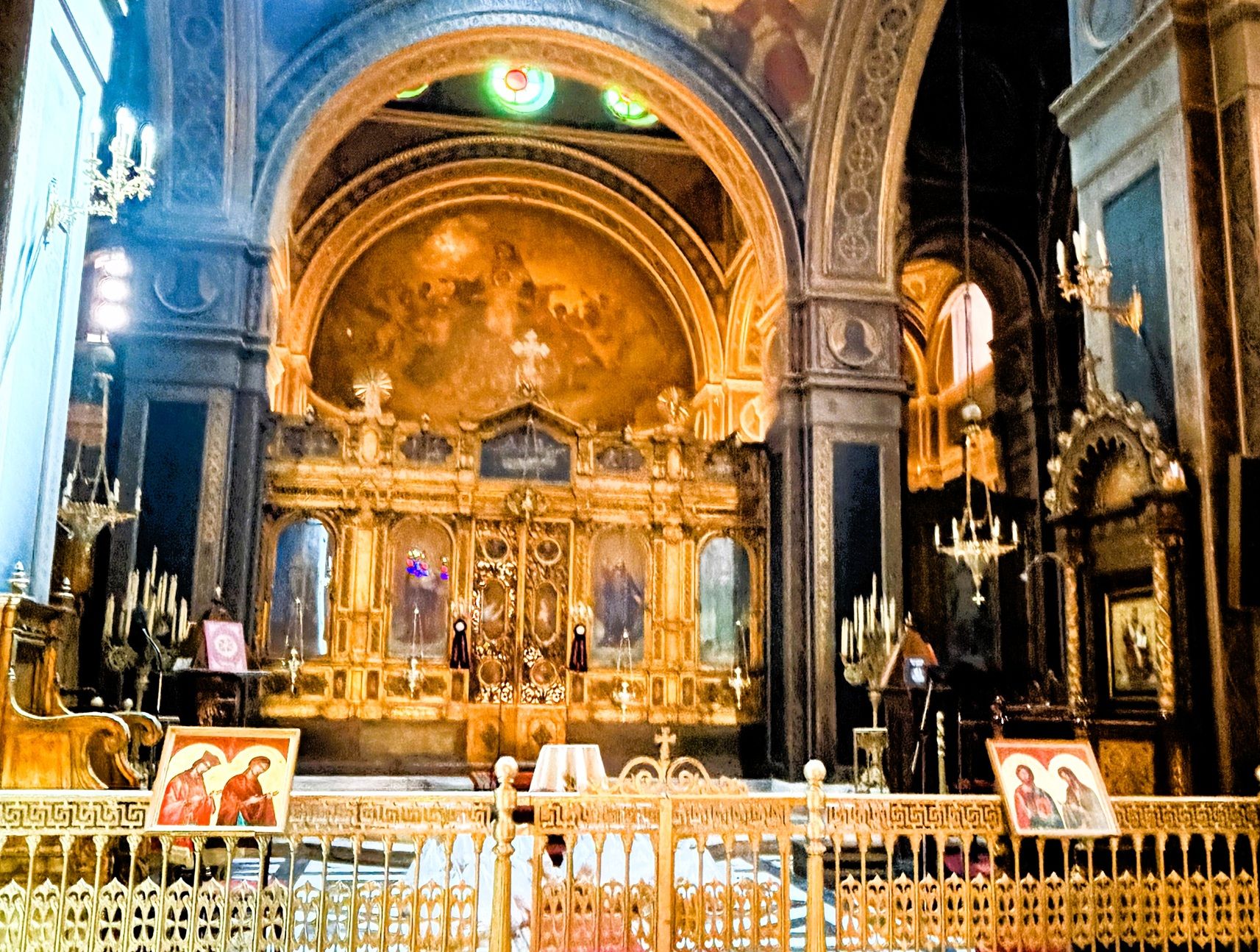 Positioned in the main nave directly in front of the iconostasis, is a richly embroidered velvet covered stand holding a framed icon, flanked by two tall candle stands draped in matching cloths bearing gold stitched crosses and floral motifs. This arrangement is used during feast days and liturgical seasons to highlight a particular icon for public veneration. Behind it, the gold plated iconostasis—donated in the mid 19th century—forms a brilliant backdrop with its carved panels, chandeliers, and rows of icons, while the wooden seating of the nave surrounds the space. Altogether, this area represents one of the church’s most active devotional points, where worshippers approach to kiss the icon, light candles, and participate in the liturgical life of Agia Irini. 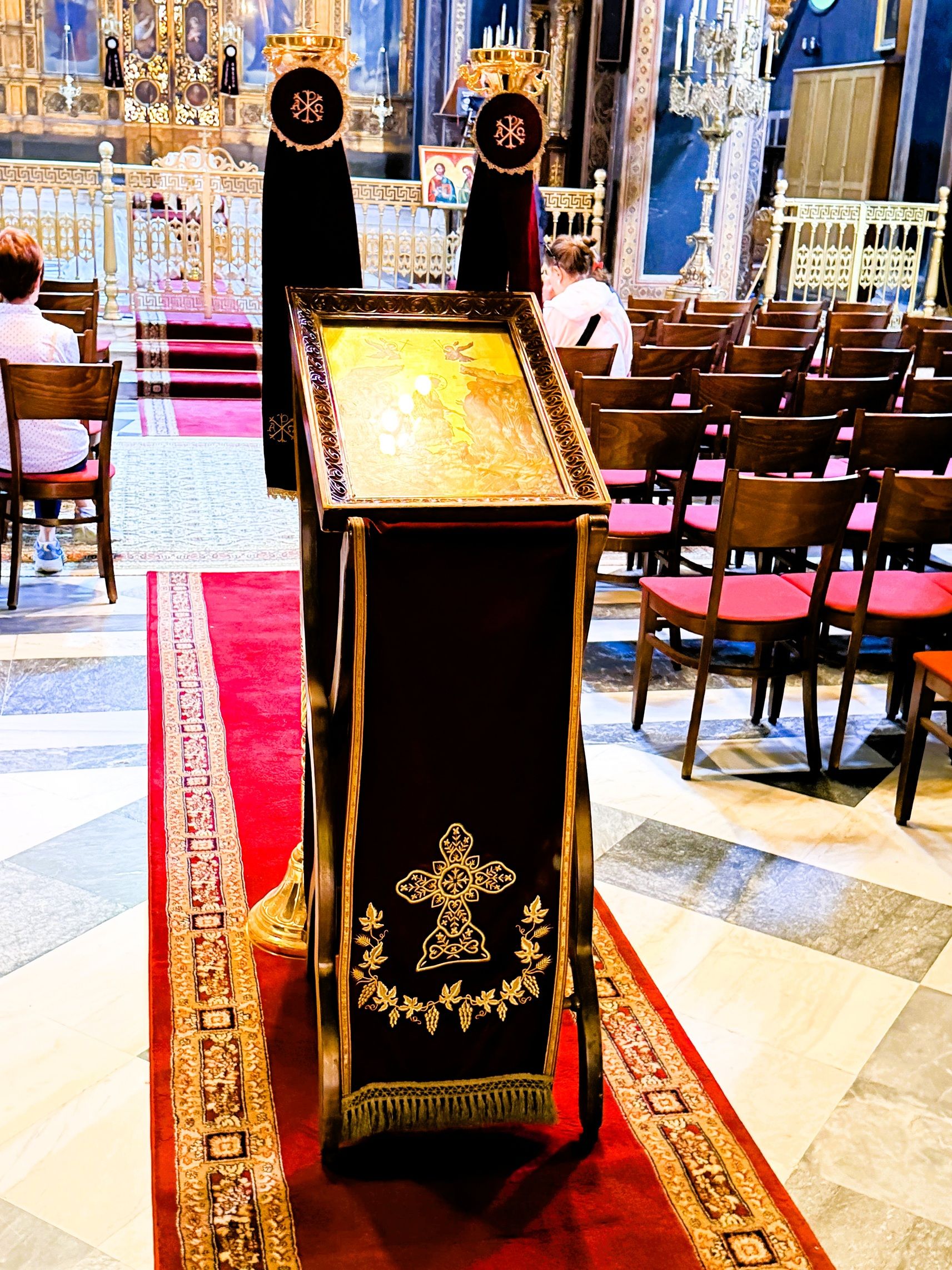 The church also contains several side shrines, one of the most notable being the beautifully carved wooden proskynitarion dedicated to the Panagia Galaktotrophousa, the Virgin Mary as the Milk Giver. This icon, set within an ornate wooden frame of deep floral and geometric carving, depicts the Virgin nursing the Christ Child, an image that emphasises both the humanity of Christ and the tender, nurturing role of Mary. A small vigil lamp hangs above the icon, while a carved panel with a cross and Greek inscription sits below it, forming a devotional focus for personal prayer. The shrine stands against a wall illuminated by stained glass windows whose green and yellow tones cast coloured light across the woodwork, enhancing the sense of warmth and intimacy. The striped marble floor and red cushioned chairs surrounding the shrine reflect the careful attention given to even the secondary spaces of the church, where craftsmanship and devotion combine to create a rich spiritual atmosphere. This side altar icon is one of several within Agia Irini that demonstrate the depth of its 19th century ecclesiastical artistry and the continued importance of Marian devotion in Greek Orthodox worship. 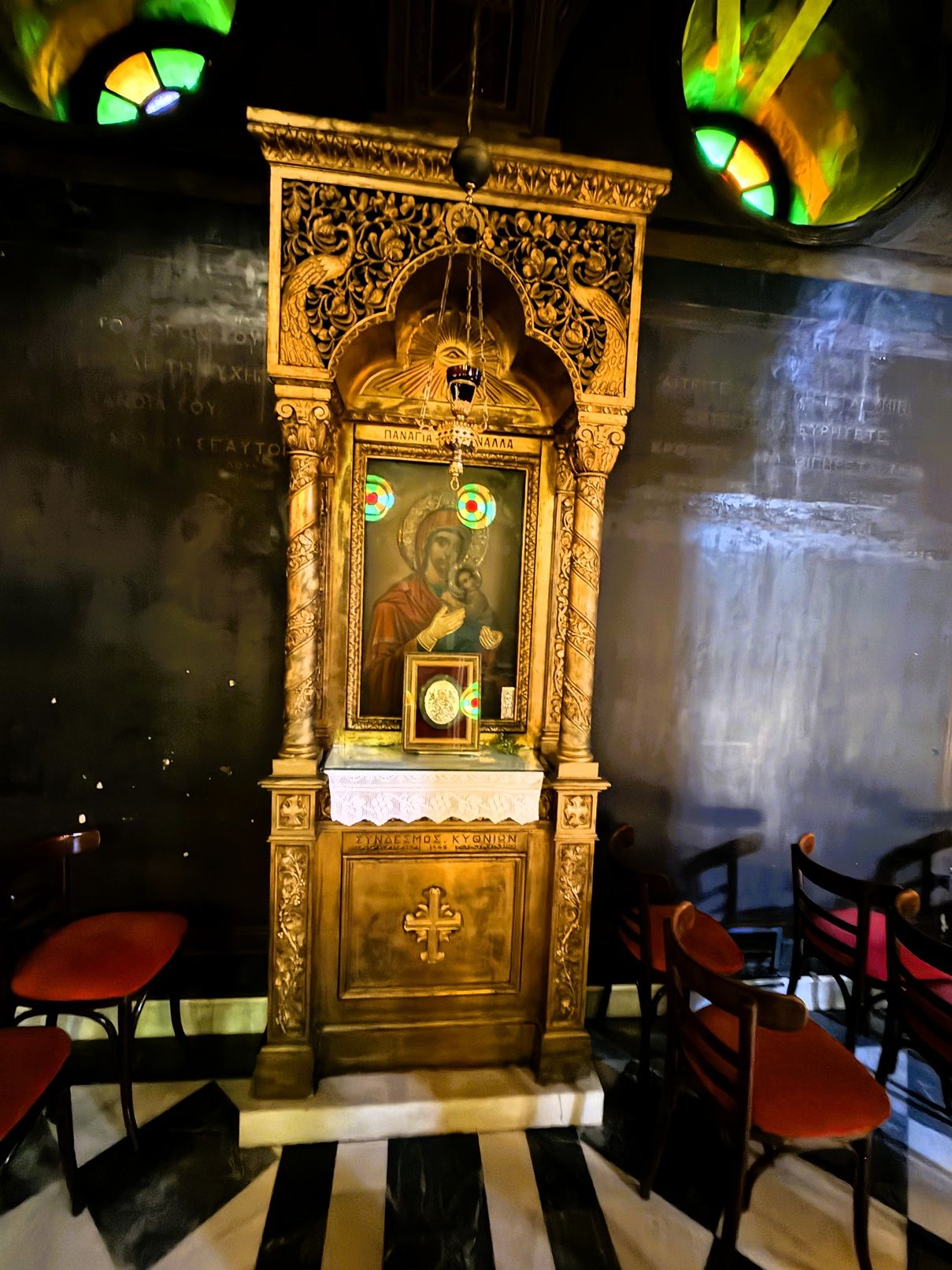 The interior decoration was completed between 1879 and 1892 by the painter Spyridon Hatzigiannopoulos, whose work blends Byzantine iconographic tradition with the academic realism of his time. His murals cover the vaults, arches, and dome, depicting scenes from the life of Christ and the Apostles. Two large narrative compositions stand out in the naves: Paul preaching at the Areopagus and Christ preaching in Jerusalem. The ceilings, which form a continuous decorative surface throughout the church, were also painted during this period. Above the nave, the ceiling is divided into framed panels filled with geometric motifs, floral ornamentation, and stylised Byzantine patterns, all executed in deep reds, blues, and golds typical of late 19th century ecclesiastical art. The ceilings of the side aisles continue this decorative pattern in a more restrained form, helping to unify the three aisles visually. The arches are enriched with painted bands and small symbolic motifs, while the transitional ceiling around the dome features radiating patterns and ornamental borders that draw the eye upward toward the dome’s central image. This elaborate ceiling scheme not only enhances the church’s visual richness but also contributes to its acoustics and reinforces the upward movement of the interior. 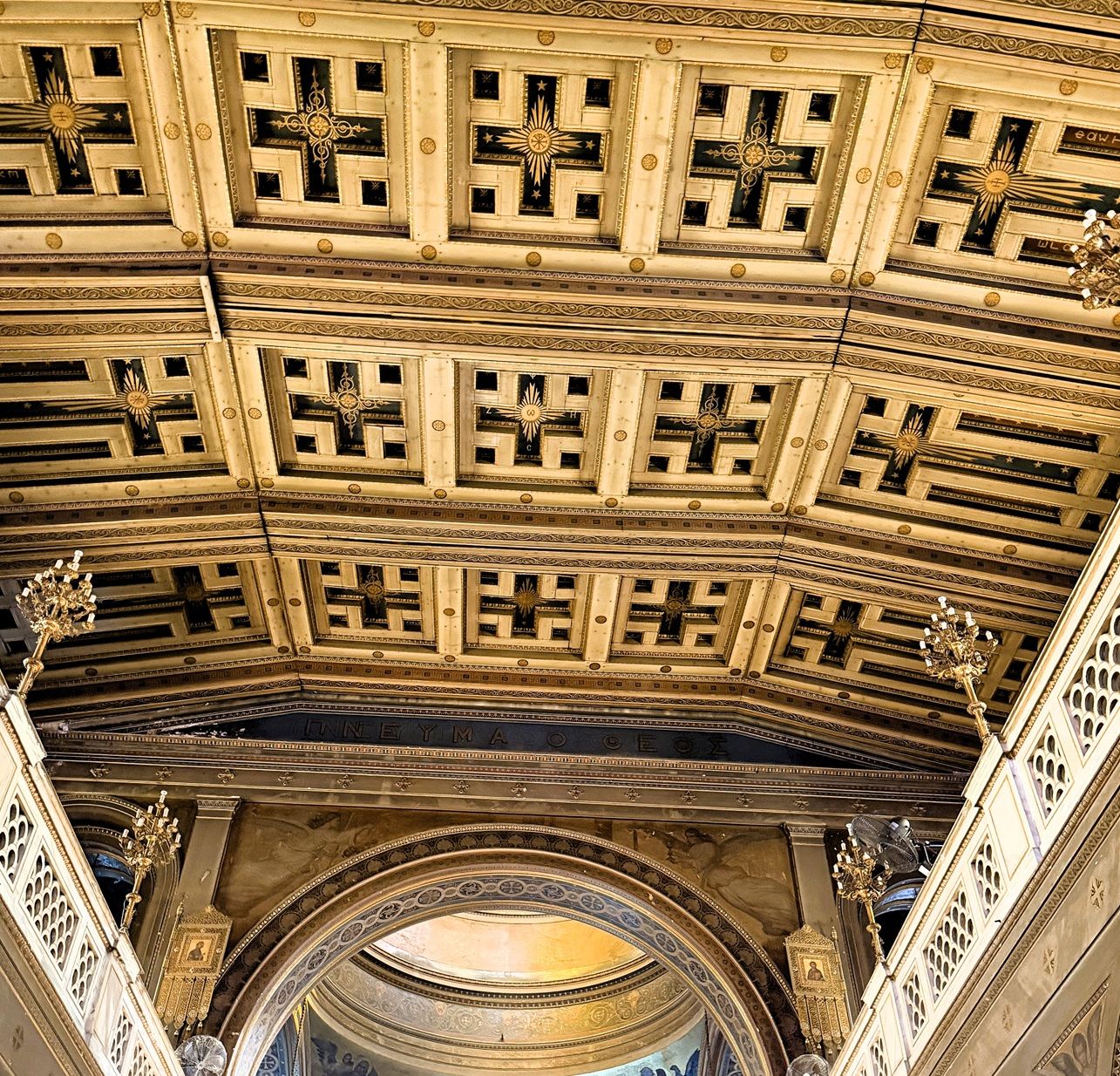 Another major focal point of the interior is the apse and sanctuary, which form the liturgical and visual culmination of the church. The curved apse is dominated by a large fresco of the Platytera ton Ouranon, depicting the Virgin Mary enthroned with the Christ Child and surrounded by angels. Painted in warm golden tones that evoke the radiance of the heavenly realm, this image occupies the highest and most sacred position in the church, directly above the altar. It reflects the long Orthodox tradition of placing the Theotokos in the apse as the intercessor between heaven and earth, watching over the liturgy performed below. Beneath the fresco rises the upper section of the gold plated iconostasis, with its intricate carved ornamentation and central icon of the Last Supper, framed by smaller devotional panels and crowned by a cross. This richly decorated ensemble marks the threshold between the nave and the sanctuary, emphasising both the theological importance of the space and the craftsmanship of the 19th century artists who completed it. Together, the apse fresco and the gilded iconostasis create one of the most striking and spiritually resonant vistas in Agia Irini, drawing the visitor’s gaze toward the heart of the church’s worship. A stained glass depiction of Saint Irene, identified by the Greek inscription “Η ΑΓΙΑ ΕΙΡΗΝΗ” shows her with a halo and holding a palm branch, a symbol of victory and martyrdom. The window uses rich jewel tone colours and geometric patterns typical of 19th century Greek Orthodox stained glass. Set within an ornate carved arch above a doorway, it marks the threshold as sacred and honours the church’s patron saint while adding colour and light to the interior. 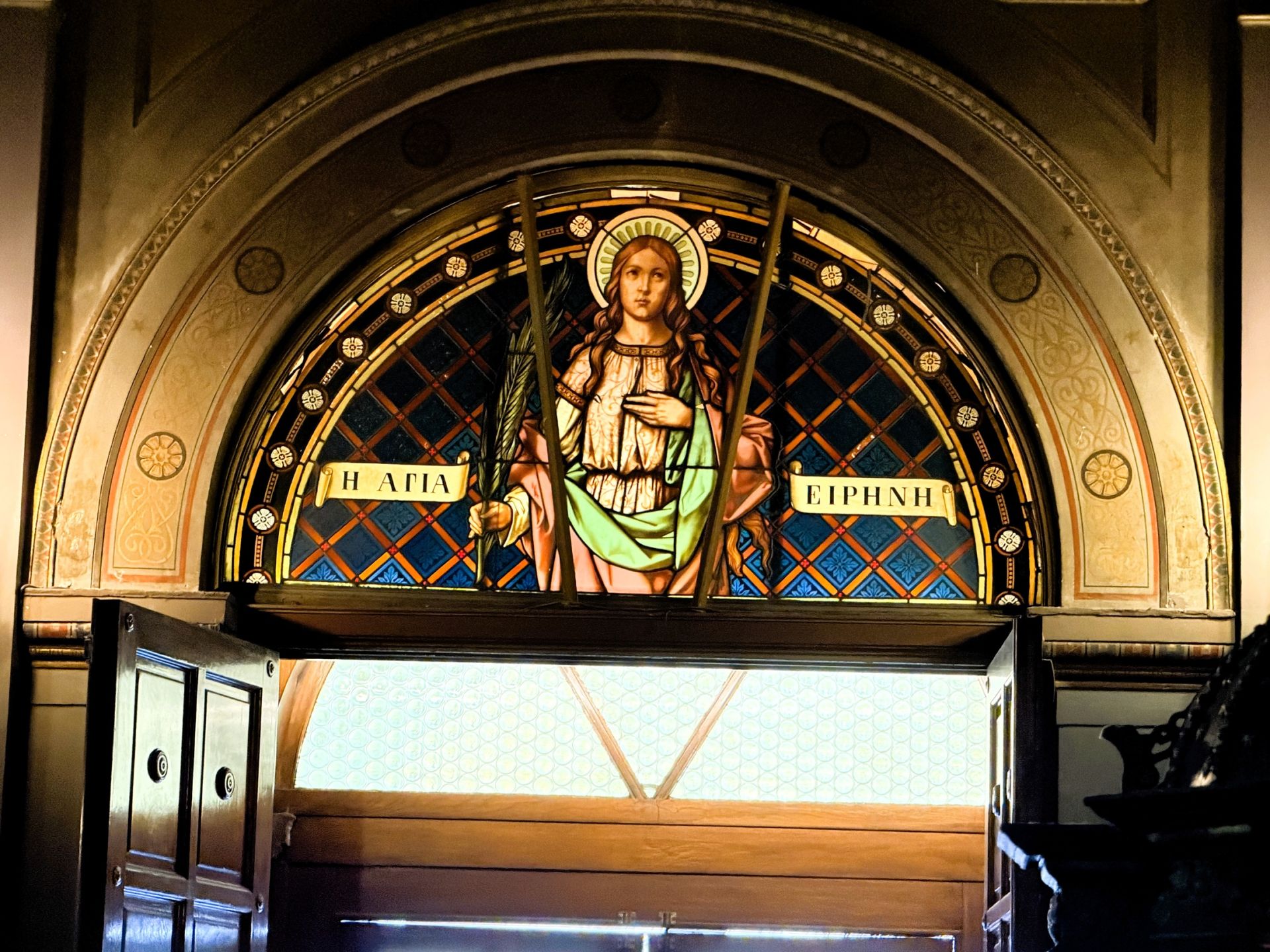 The pulpit, positioned along one of the aisles, is a finely carved wooden structure used for preaching, while the bishop’s throne, the chandeliers suspended from the dome, and the various icon stands contribute to the church’s rich 19th century ecclesiastical furnishings. Together with the murals, scriptural panels, and decorative ceilings, these elements create an interior that is both visually impressive and historically significant, reflecting the artistic tastes and religious sensibilities of the period in which the church was completed. 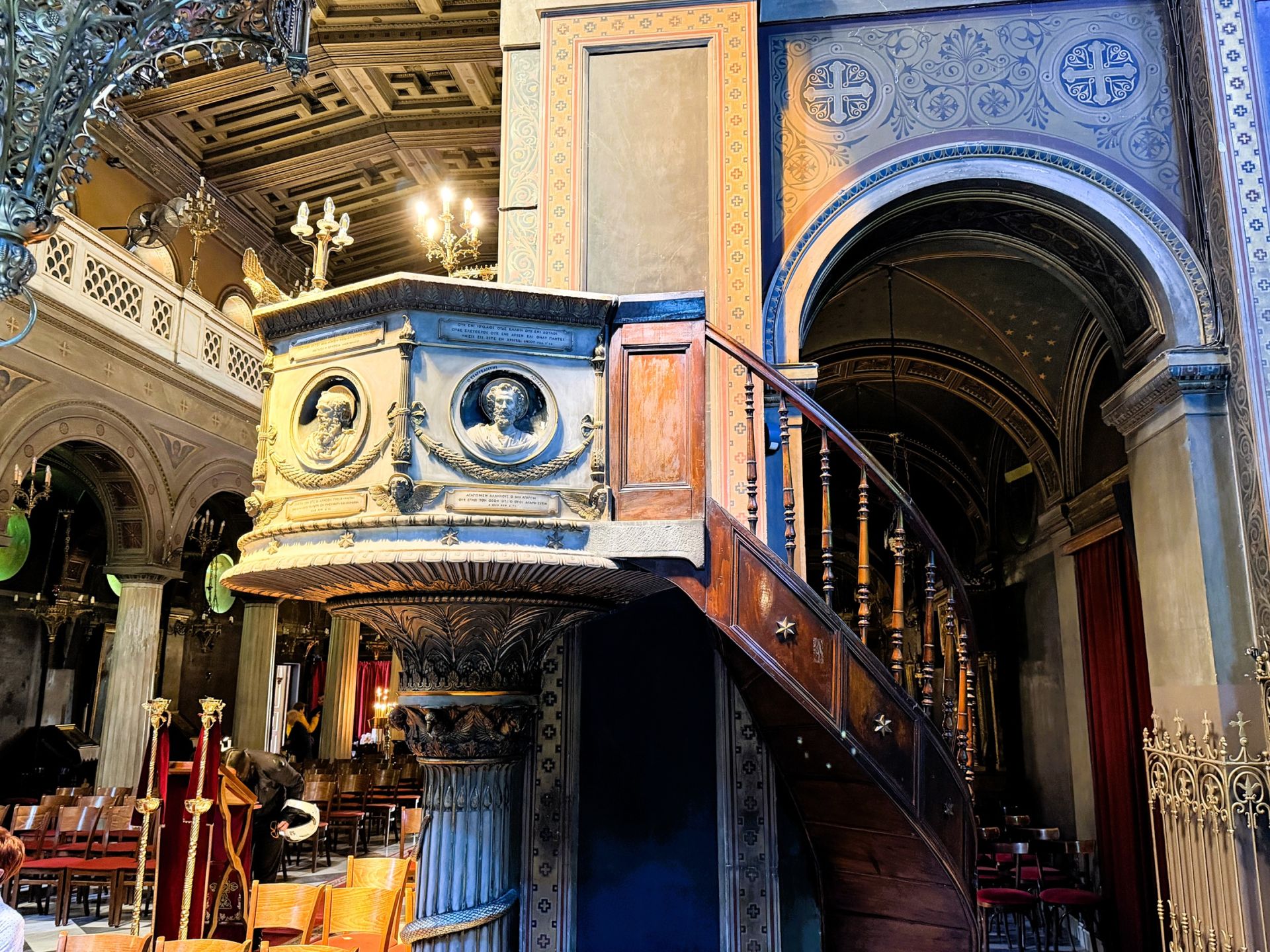 Today Agia Irini remains an active parish church and a prominent landmark in the historic commercial district of Athens. Standing on the lively square that bears its name, it continues to attract visitors for both its architectural interest and its historical importance as the first cathedral of the modern Greek state. Its combination of Byzantine forms, neoclassical elements, and 19th century academic painting makes it a key example of the ecclesiastical architecture of its period, while its richly decorated interior offers a vivid impression of the artistic tastes that shaped the early decades of the new capital. The church’s layered history—from Byzantine chapel to provisional cathedral to 19th century architectural statement—makes it one of the most significant religious buildings in Athens and an essential stop for anyone interested in the city’s cultural and historical development. References and Additional Information https://athina.guide/en/Attraction-Agia_Irini_Church-p1309-r189400-Athens https://www.thisisathens.org/attractions/agia-irini-church https://www.greeka.com/attica/athens/sightseeing/church-agia-irini/ https://en.wikipedia.org/wiki/Saint_Irene_church,_Athens https://www.athenskey.com/agia-eirini.html
|
 |
|
 |
|||


All Photographs were taken by and are copyright of Ron Gatepain


| Site Map |