








 |
|
|||||||||||||||
 |
||||||||||||||||











 |
|||
 |
Louisiana Baton Rouge USS Kidd Veterans Museum – History, Architecture & Significance 
On entry to the museum visitors come to a gift shop enabling them to obtain relevant souvenirs of their visit and to walk around an array of artifacts donated by veterans and their families. 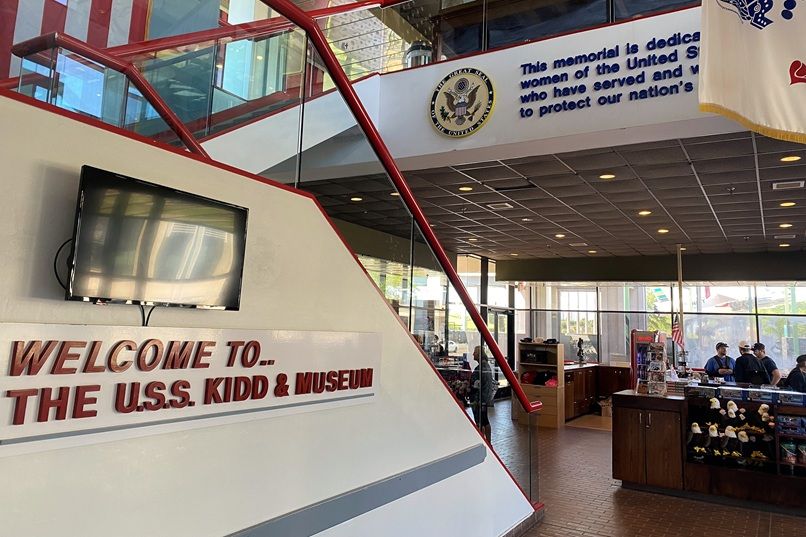 The displays include personal effects, carried into combat, to uniforms, medals, and letters that reveal the human dimension of war. 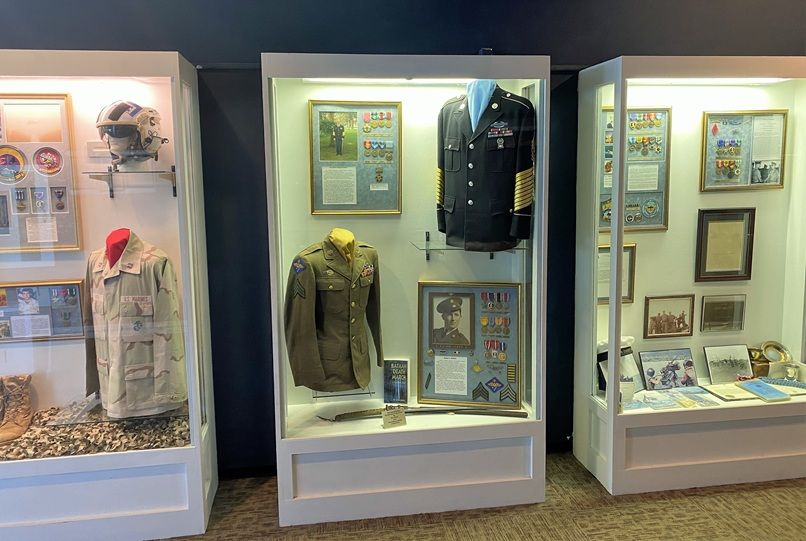 It also contains larger items such as a restored Curtiss P‑40 aircraft and an A‑7E Corsair II jet that serves as a memorial to Vietnam‑era aviators. These help bridge the gap between the naval story of USS Kidd and the wider history of American military aviation. The museum also includes Ship models and a full‑scale replica of the gun deck of USS Constitution - “Old Ironsides” - this connects Louisiana’s veterans to the earliest traditions of the United States Navy. 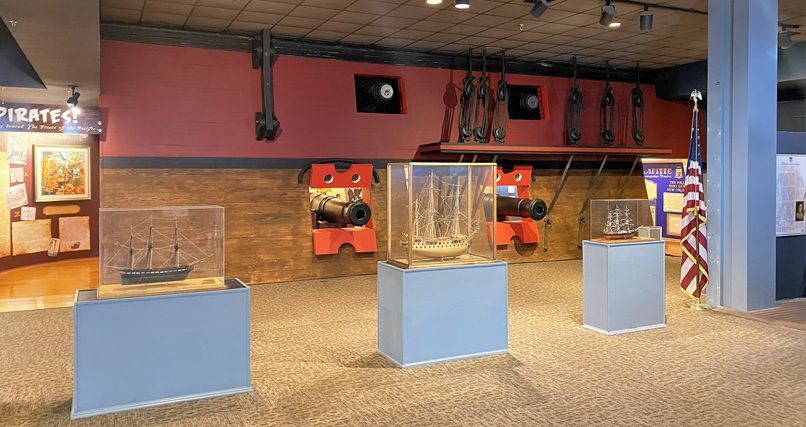 Within the complex is the Louisiana Memorial Plaza, which contains the names of Louisiana service members who lost their lives in combat engraved in stone. The plaza reinforces the museum’s dual purpose as a historical institution and a memorial site, dedicated not only to preserving artifacts but also to honouring the individuals behind them. The highlight of the museum is the Fletcher‑class destroyer USS Kidd (DD‑661). The DD-661 is the hull classification number of USS Kidd, identifying her as a destroyer (DD) and the 661st destroyer built for the U.S. Navy. Launched in 1943, today it as one of the most authentically preserved American warships of the Second World War. Constructed at the Federal Shipbuilding & Drydock Company in Kearny, New Jersey, between October 1942 and 23 April 1943 when she was completed and commissioned. She was named in honour of Rear Admiral Isaac C. Kidd, the first U.S. flag officer killed in World War II who died on the bridge of USS Arizona during the attack on Pearl Harbor. The ship’s identity became inseparable from the admiral’s Naval Academy nickname, “Cap,” which evoked the legendary pirate, Captain Kidd. With the blessing of the admiral’s widow, the crew embraced the pirate motif, flying a full Jolly Roger from the foremast as they steamed down New York Harbor on their maiden voyage. The Navy granted official permission for the destroyer to carry the emblem, making USS Kidd the only U.S. Navy vessel ever formally authorized to fly a pirate flag. Kidd was first engaged in the Atlantic and Caribbean, escorting major combat vessels and performing anti‑submarine patrols. By August 1943 she had moved to the Pacific, where she became part of the carrier task forces engaged in the naval war against Japan. She took part in the air attacks on Wake Island in October 1943, supported operations around Bougainville and Rabaul in November, and repeatedly rescued downed aviators. Her service in World War II also included anti‑aircraft operations as well as carrying out shore bombardment. Her service in the Pacific earned her a reputation for resilience and precision, and she accumulated multiple battle stars before the war ended. As a Fletcher‑class destroyer, Kidd embodied the most advanced American destroyer design of the era. With a length of 376 feet, she displaced just over 2,000 tons and with her four oil‑fired boilers feeding two steam turbines producing 60,000 shaft horsepower she could reach speeds of 35 knots. During the course of the war her crew numbered around 329 officers and enlisted men. Their living conditions were compact, basic, and deeply hierarchical. This is one of the most revealing parts of naval architecture because it shows how a warship balanced combat readiness, habitability, and strict social order. Officers and Enlisted lived in Completely Different conditions with space very limited. Accommodation was allocated by rank, responsibility, and proximity to duty stations. The Enlisted slept in large berthing compartments with rows of stacked bunks (“racks”) The racks were three high, often above machinery, ammo, or storage. Storage for personal effects was minimal, usually a small locker and space under the mattress. 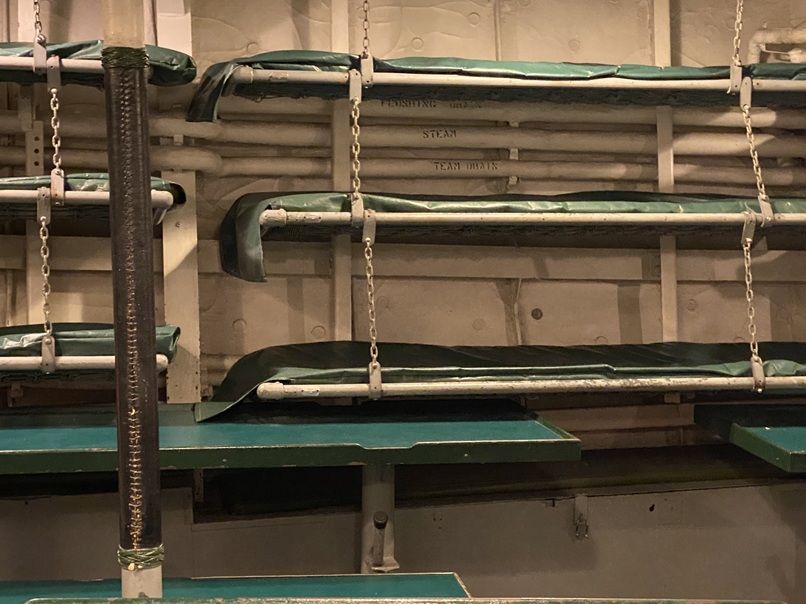 They would eat in the mess deck, which doubled as workspace, recreation, and sleeping overflow. The accommodation would be located near their place of duty in that gunners were near the gun mounts; Engineers near the engine rooms and signalmen and radiomen near the bridge; this arrangement meant a reduced response time during battle stations. Officers had small, shared staterooms accommodating 2–4 officers per cabin. They would eat in the wardroom, a formal dining space. 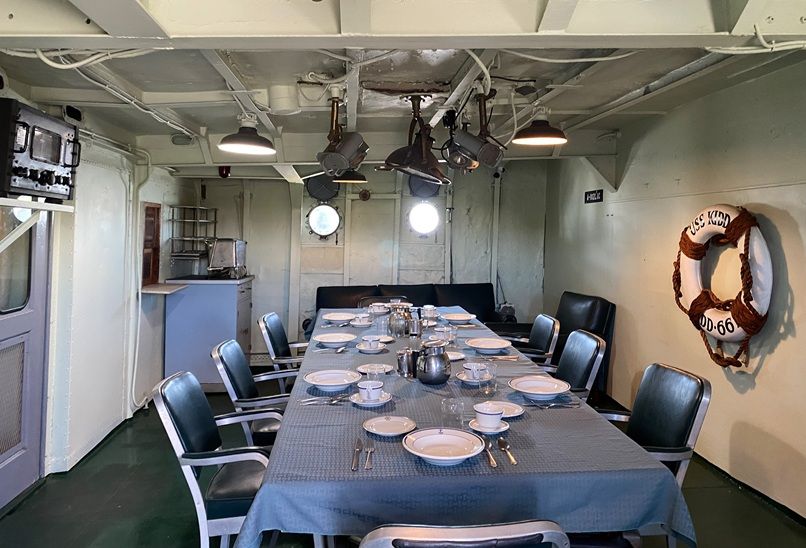 The captain had a private cabin located directly behind the bridge. Initially, when the ship was first launched, Kidd had five 5‑inch/38 guns, able to fire a 55‑pound shell at aircraft, ships, or shore targets with remarkable accuracy. 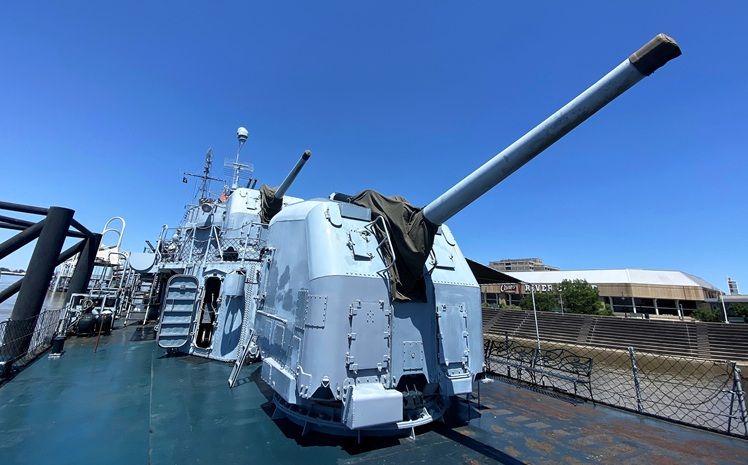 It also had ten 21‑inch torpedo tubes, and 20 mm anti‑aircraft gun. These were fast‑firing, single‑barrel automatic cannons designed to defend the ship against low‑flying aircraft, strafing runs, and small, fast surface threats. 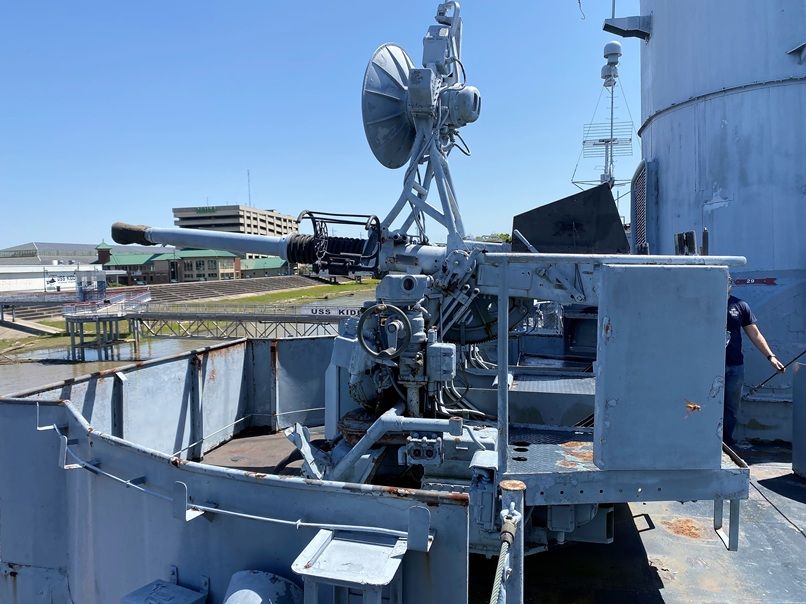 At the side of the deck are 20 mm Bofors anti‑aircraft gun, one of the most important weapons on the ship. The Bofors is instantly recognizable because, unlike the single‑barrel 20 mm Oerlikons, it has two long barrels side‑by‑side and sits in a powered mount with a distinctive shielded front. On USS Kidd, these guns formed the ship’s medium‑range anti‑aircraft defence 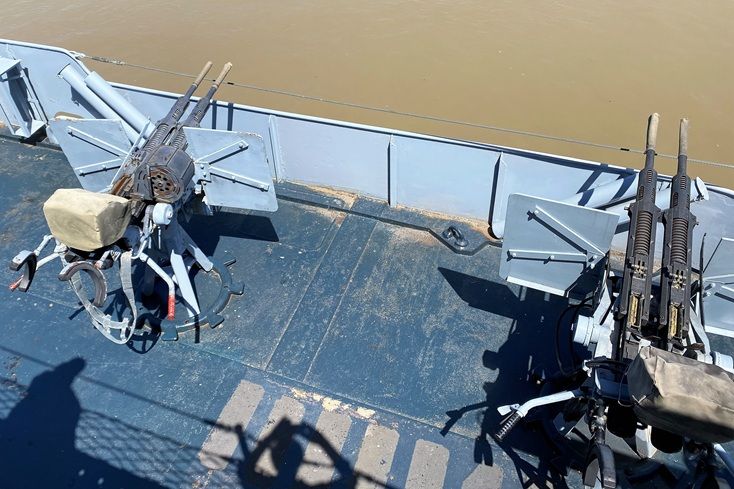 As the war progressed her armament evolved and by 1945 her configuration had shifted toward heavier anti‑aircraft defences, with fourteen 40 mm In December 1946, following the war, Kidd was decommissioned, but was brought back into service in March 1951 during the Korean War era. She served through the early Cold War before being decommissioned for the final time in June 1964 and removed from the Naval Vessel Register in 1974. Only a handful of Fletcher‑class destroyers remain today as most were scrapped. Kidd is one of only two preserved in their authentic World War II configuration, a fact that makes her an invaluable artifact of naval history. In 1986 she was designated a National Historic Landmark and became the centrepiece of the USS Kidd Veterans Museum. Visitors can explore her decks, compartments, and combat systems exactly as they appeared in 1945, gaining a rare, immersive understanding of life aboard a wartime destroyer. USS Kidd’s legacy is that of solemn remembrance and spirited tradition. She honours the memory of Admiral Kidd and the thousands of sailors who fought in the Pacific, while also preserving the unique culture that made her the “Pirate of the Pacific”, with her pirate flag still flying on ceremonial occasions, a reminder of the morale, identity, and spirit that defined her crew. As a museum ship, she continues to educate, commemorate, and inspire, standing as one of the most complete and compelling naval time capsules in the United States. |
 |
|
 |
|||


All Photographs were taken by and are copyright of Ron Gatepain


| Site Map |