





 |
|
|||||||||||||||
 |
||||||||||||||||











 |
|||
 |
Virginia Colonial Williamsburg Bruton Parish Church 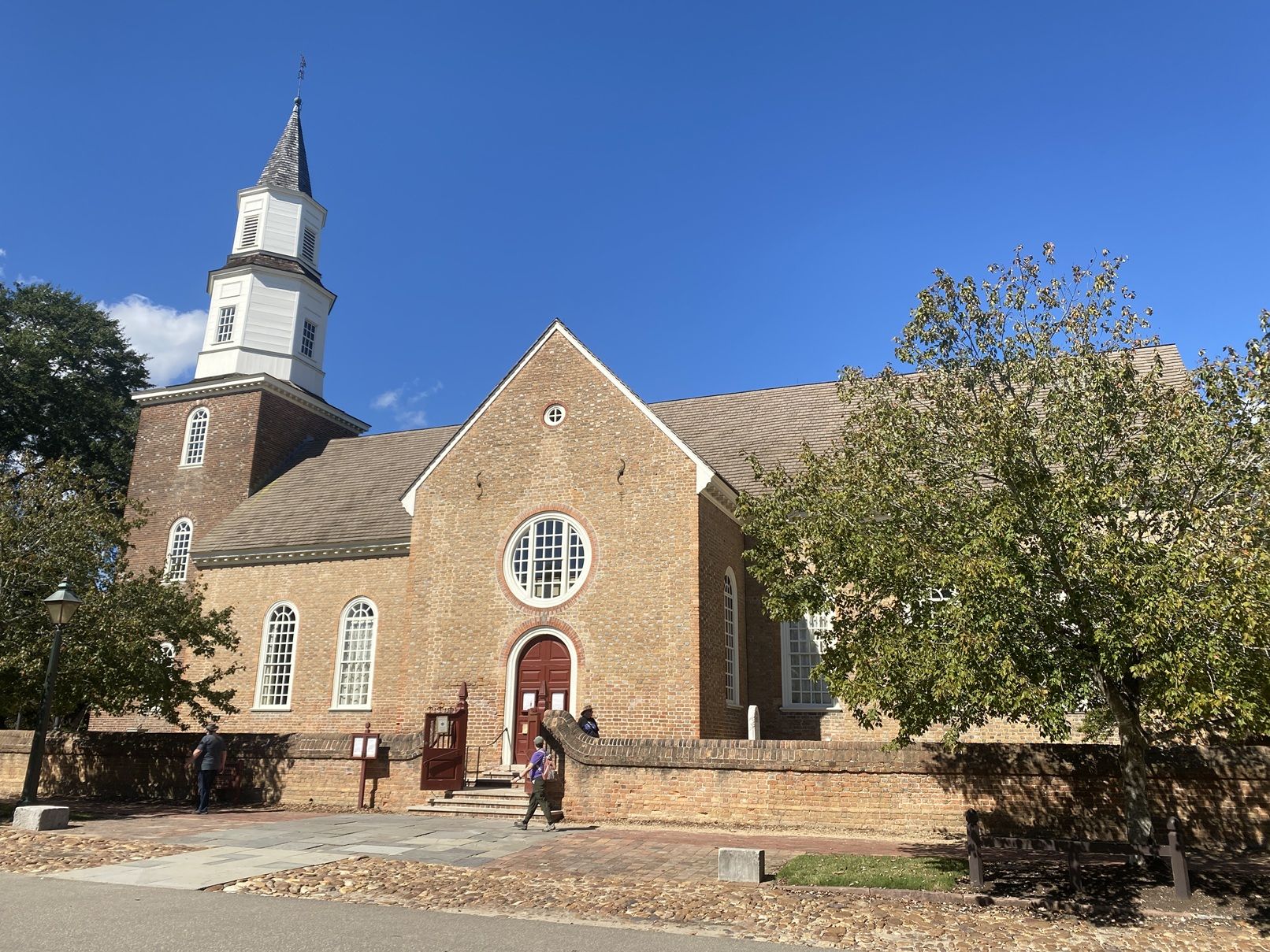
Located towards the west end of the Duke of Gloucester Street, the Bruton Parish Church was founded in 1674 when two earlier Virginia parishes were consolidated, and the church became the official church of Virginia’s capital. The current building was constructed between 1711 and 1715 replacing an earlier wooden structure and is a Georgian-style Episcopal church that served as the spiritual and civic heart of colonial Williamsburg. Still active today, it is renowned as one of the best-preserved examples of colonial religious architecture in America and in 1970 it was designated a National Historic Landmark due to its architectural and historical significance. Bruton Parish Church is a classic example of early 18th‑century Georgian ecclesiastical architecture, simple yet dignified, and built to endure. Built of red brick laid in Flemish bond, the church has a cross‑shaped floor plan (nave with transepts), which was unusual for parish churches in Virginia at the time and gave it a more formal, cathedral‑like presence. A square tower rises above the west entrance, capped with a spire. This made the church a visible landmark in Williamsburg and ensured it remained a focal point of the town’s skyline. The tower and steeple were built following the donation of an English‑cast bell to the Church by Williamsburg merchant James Tarpley in 1761. The tower rises 46 feet, with the steeple and spire adding a further 51 feet to its height. Completed in 1769–1771 it rises above the west façade of the church. The bell, hung in the upper part of the steeple, is audible across Williamsburg. 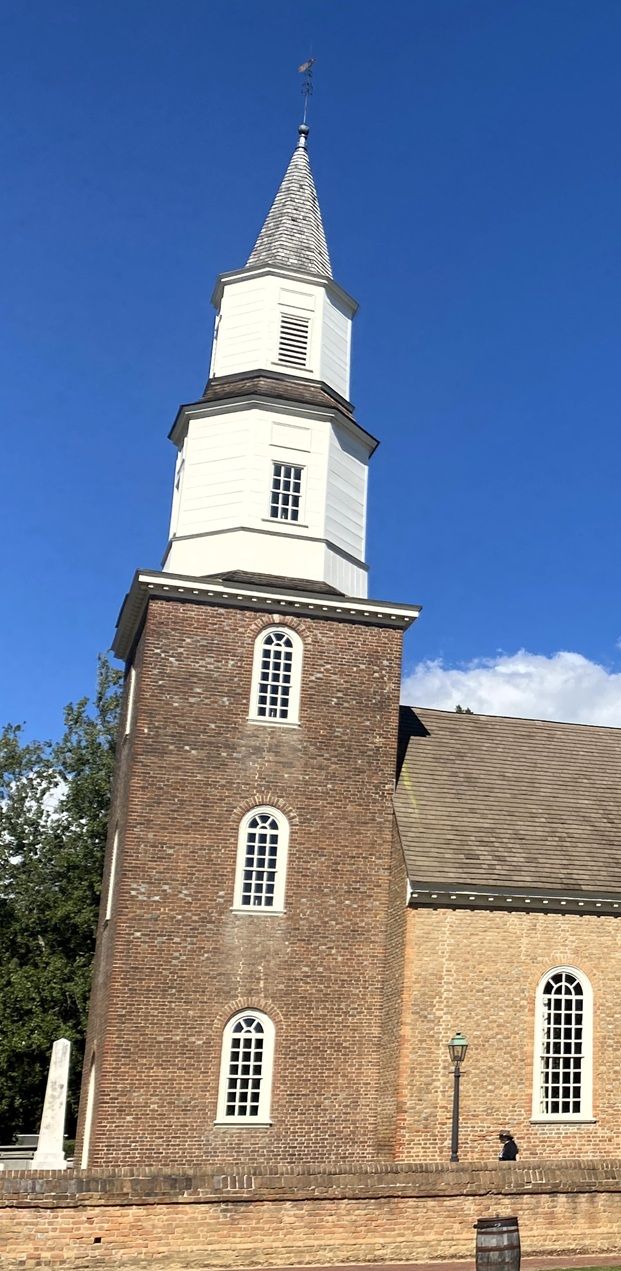 The church has heavy wooden doors which open onto Duke of Gloucester Street, and tall, arched windows which line the exterior walls, allowing natural light into the nave. With their symmetry reflecting Georgian ideals of balance and proportion. The surrounding landscape of brick paths, trees, and colonial buildings, frame the church as part of Williamsburg’s preserved historic core. Its churchyard is enclosed by a low brick wall, and the graveyard reflects three centuries of Virginia’s history, and contains the graves of governors, patriots, and parishioners. 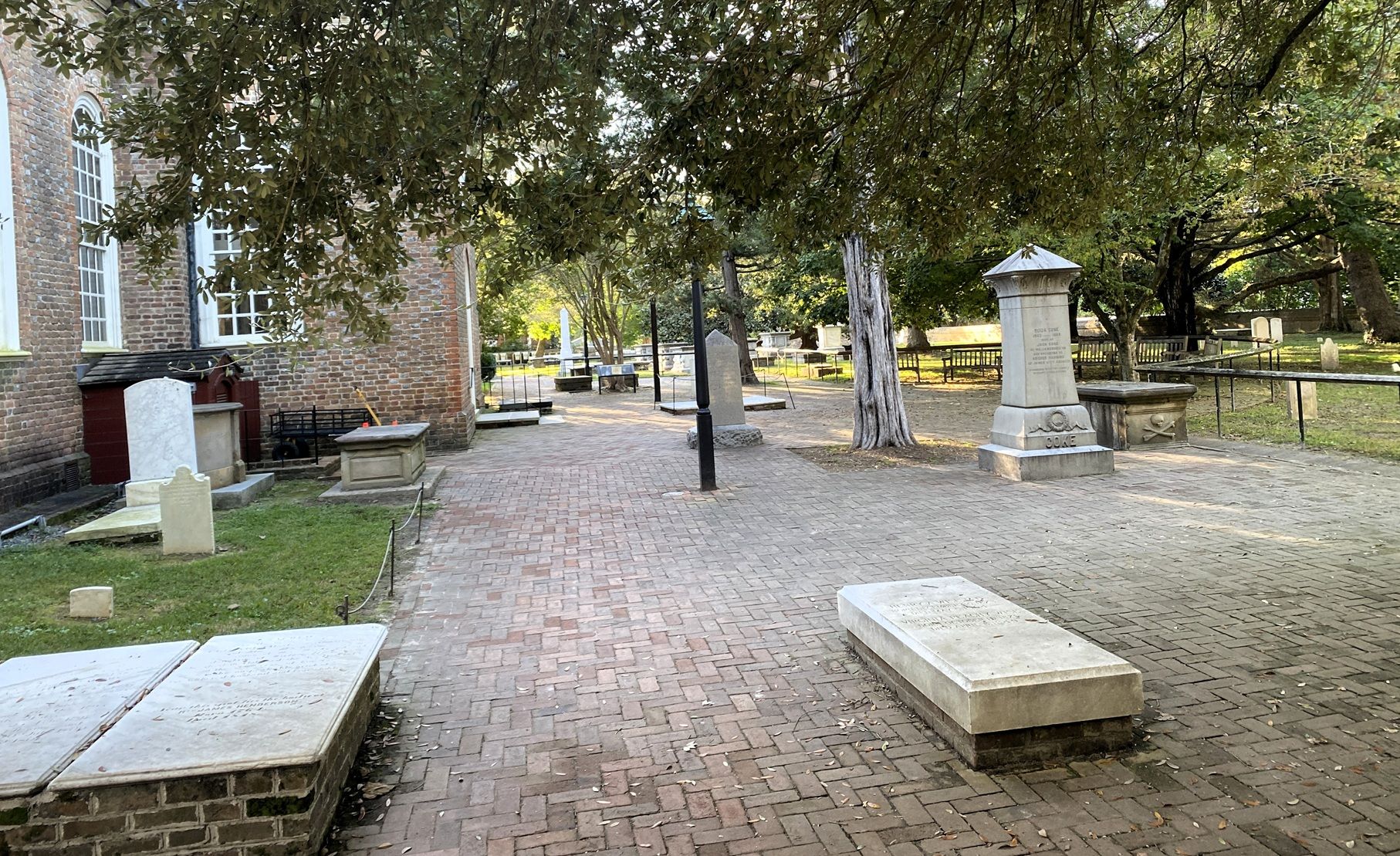 One interesting grave (seen on the right of this photograph) is that of Colonel Edward Nott the Royal Governor of Virginia (1705–1706). He died in office suddenly on August 23, 1706, at the age of 49, only a year after his appointment. Contemporary accounts do not specify a particular illness or cause, only that his death was unexpected and cut short his brief administration. His gravestone has a skull-and-crossbones motif which was not meant as a pirate emblem but as a memento mori (“remember you must die”), something that was common in the 17th–18th century, reminding viewers of mortality and the inevitability of death. Internally, the church follows a cross‑shaped design, with a central nave, side transepts, and the chancel at the east end. This layout was unusual for Virginia parish churches, giving Bruton Parish a more formal, cathedral‑like feel. The nave of the Church is the long central hall where the congregation gathers, and it has been the heart of worship for over 300 years. It stretches from the entrance to the chancel and altar. The interior features box pews, which were common in colonial Virginia. Families sat together in enclosed wooden pews, some of which were reserved for prominent citizens. The nave hosted worshippers such as George Washington, Thomas Jefferson, Patrick Henry, and other patriots, who attended services here during the colonial period. In 1862, a memorial plaque was installed in the nave to honour Confederate soldiers from the Battle of Williamsburg. This plaque has since been contextualized with an additional marker acknowledging the horrors of slavery and the broader history of the parish. The nave thus embodies both spiritual devotion and the complex social history of Virginia across centuries. Today, visitors entering the Church step into the nave, where the historic pews, pulpit, and altar create an authentic colonial atmosphere. It remains an active worship space, hosting Episcopal services, concerts, and community events. The box pews dominate the nave and transepts; these are enclosed wooden benches with high sides. Families sat together in enclosed wooden pews, which reflected both privacy and social hierarchy and also provided warmth in winter. Wealthier or more prominent families often had reserved pews, marked with plaques or records of ownership. The pews were not just for worship - they reflected social status. Where a person sat in church was a visible marker of their place in Williamsburg society.  The Governor’s Pew, with its chair and canopy, near the front of the nave, was built larger and more ornate than the others and stands out as a symbol of colonial authority. The pew faces the altar directly, emphasising the governor’s ceremonial presence at worship. It is enclosed with high panelling, providing both visibility and distinction, marking the governor’s elevated civic role. 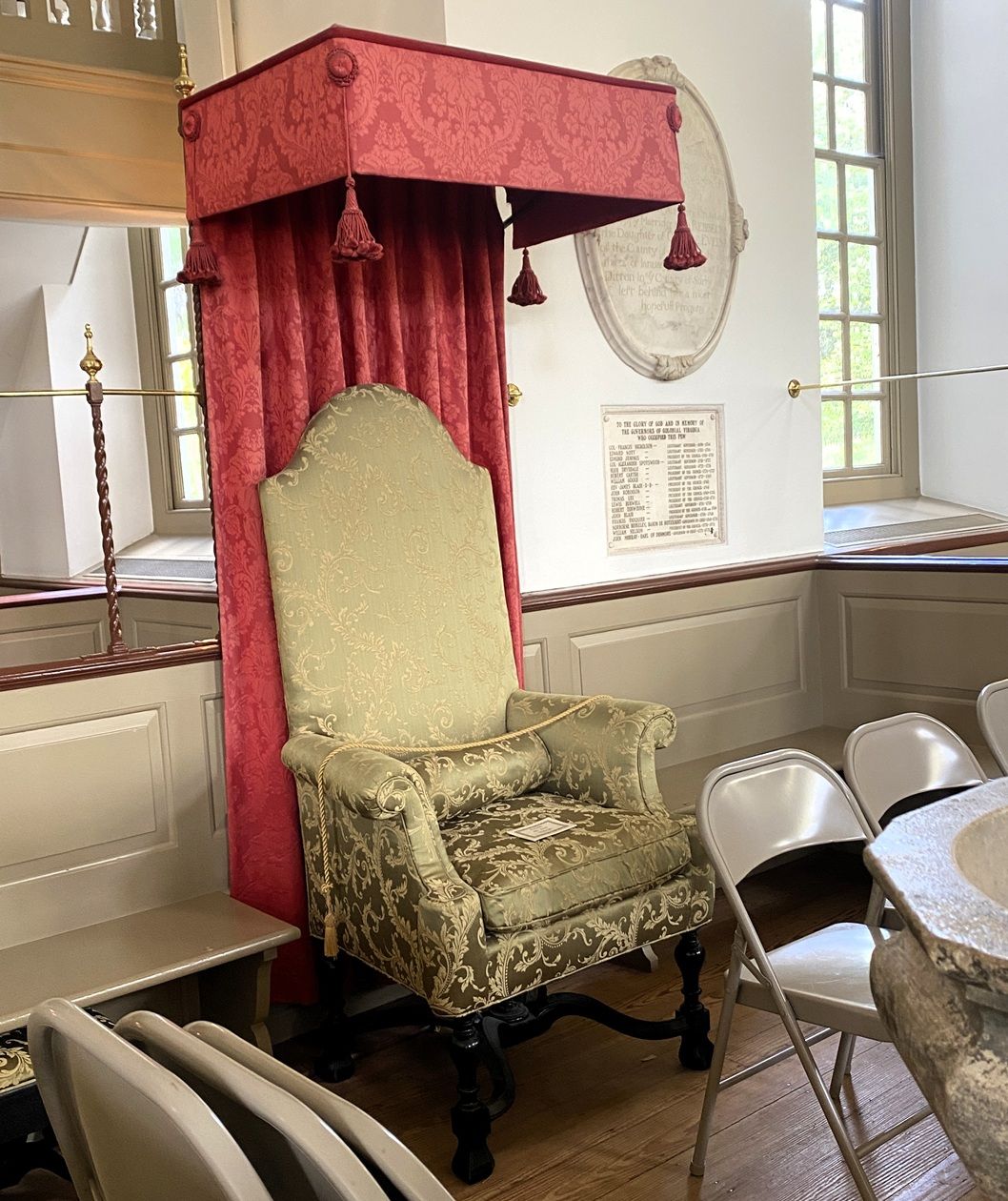 By the 19th century, many of the original pews had been altered or removed and during the Colonial Williamsburg restoration in the 1930s, the pews were reconstructed to match their 18th‑century appearance. The altar is the central feature and the focal point of the interior and was part of the original 1715 construction. Positioned at the east end of the church, aligning with traditional Christian orientation. The altar is a simple communion table, consistent with Anglican practice after the Reformation. Candlesticks, altar railings, and a brass cross add layers of ceremonial symbolism. 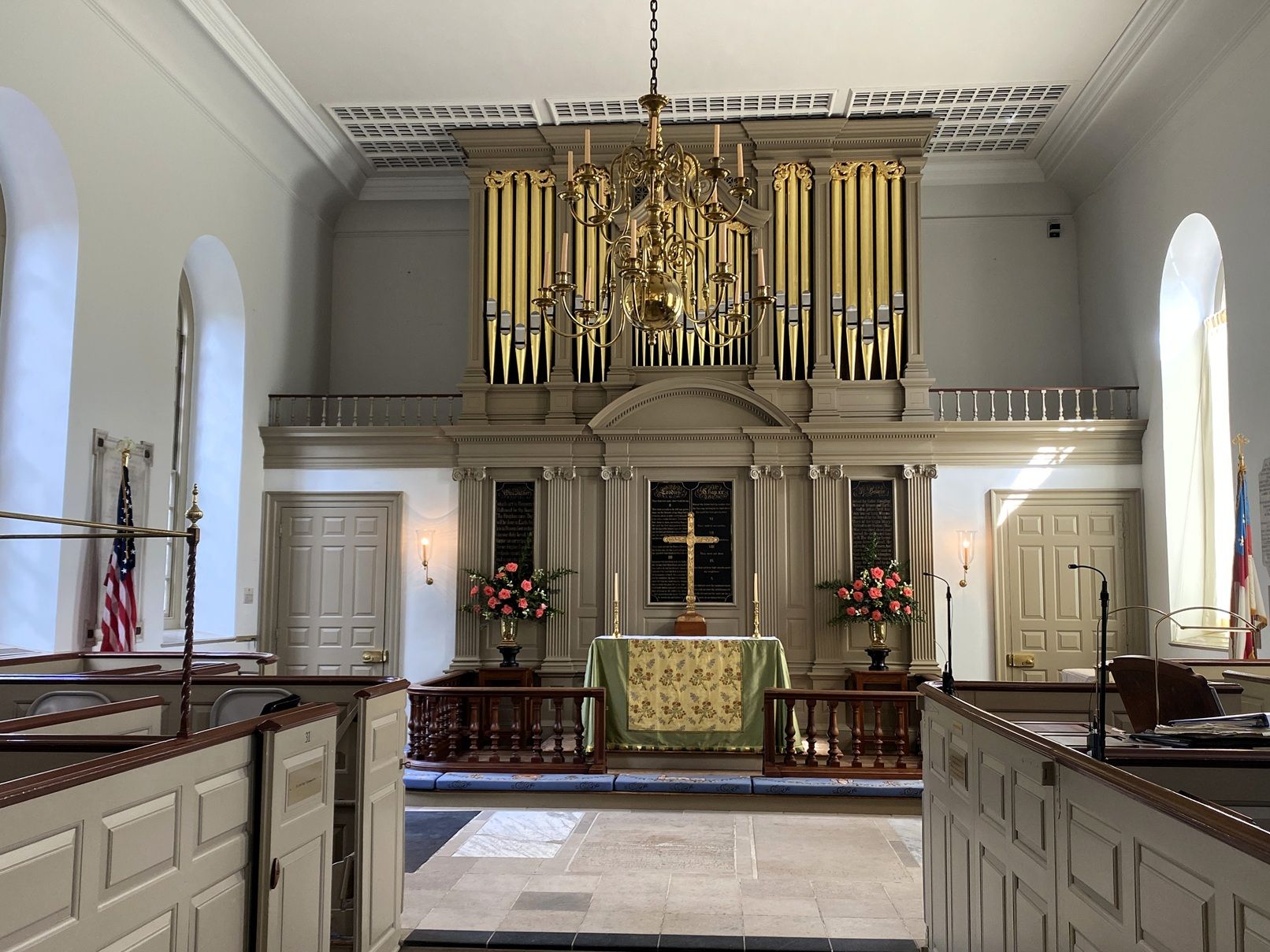 Behind the altar is the reredos, which is a gilded wooden screen that displays the central texts of Anglican worship. This arrangement highlights the three fundamentals of faith, law, and prayer that includes the Apostles’ Creed, the Ten Commandments, and the Lord’s Prayer in gilded wood panels. This reflects the Georgian style of the church and was installed during the church’s 1711–1715 construction. During the 1938–1939 Colonial Williamsburg preservation works the altar and reredos were carefully restored, ensuring the church retained its 18th‑century character and that they remained a centrepiece of the church’s interior. The original pulpit was part of the church’s Georgian design (1711–1715). Elevated pulpits were common in Anglican churches, symbolizing the authority of scripture and preaching. From this pulpit, clergy addressed congregations. In 1891, the pulpit was taken away after the vestry redesigned the chancel into an open platform. The pulpit had been donated in memory of Catharine Brooke Coleman, a young girl who died in 1883. Her mother, Cynthia Beverley Tucker Coleman, organized the gift through the Catharine Memorial Society. Reverend Thomas Carter Page disliked the bulky six‑foot pulpit, preferring to walk while preaching, so it was removed. When Colonial Williamsburg began its restoration in the 1920s under Reverend W.A.R. Goodwin, the pulpit was reinstated to reflect the church’s colonial appearance. Today, the pulpit stands as a symbol of continuity, blending its colonial origins with the memory of later parishioners. 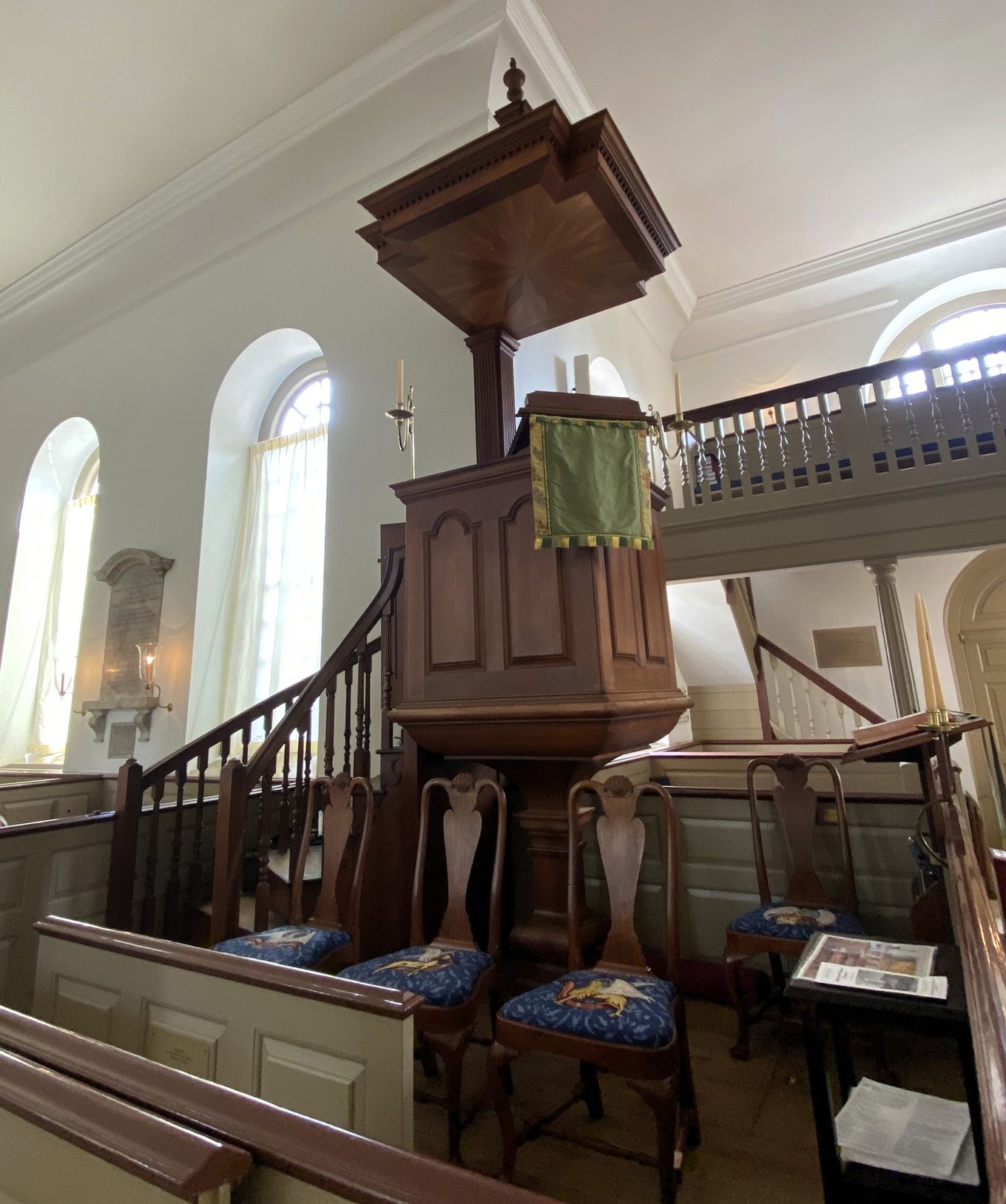 The Bible stand or lectern is located prominently within the nave and chancel area, emphasising the centrality of scripture in Anglican worship. Its design reflects both functionality and symbolism - a sturdy support for the sacred text. The bronze lectern was donated by President Theodore Roosevelt in the early 20th century to hold a gold-covered ceremonial Bible presented by King Edward VII of England, a gesture symbolizing the deep historical ties between England and Virginia. 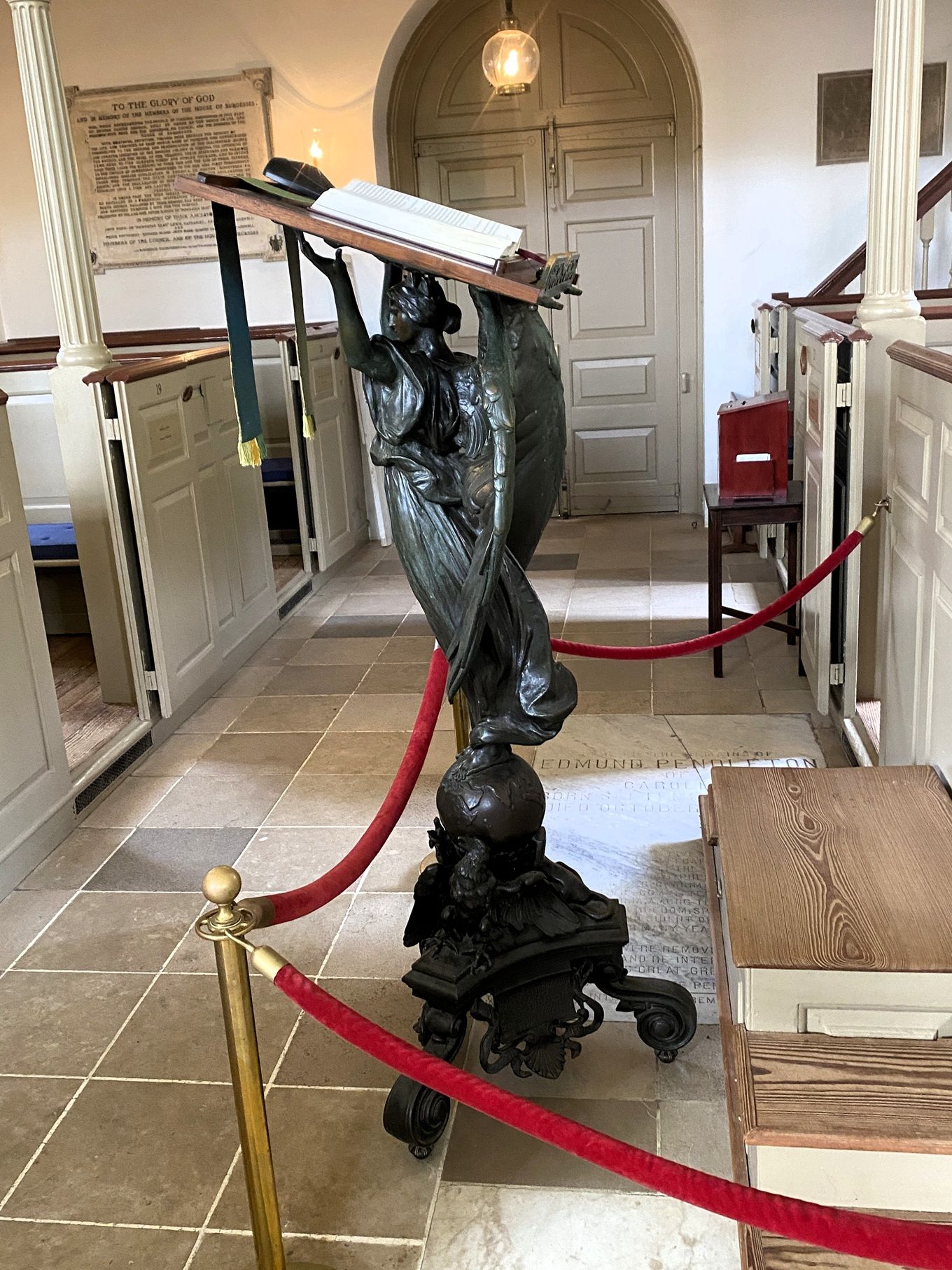 Bruton Parish Church’s first organ was ordered from London in 1752 and that was replaced by a Henry Erben organ, installed in a new gallery in 1835. In 1856 that was replaced by an organ built by Pomplitz & Rodewald of Baltimore. In the 1950s /60s an organ by Aeolian-Skinner Organ Co. was installed, this was a large 4-manual, 72-stop instrument with over 4,700 pipes. In 2019 the current organ, a Dobson pipe organ, featuring 3 manuals and 45 ranks, was installed. This is a powerful and versatile instrument for worship and concerts, which continues a long tradition of music at the heart of Colonial Williamsburg. The 1920s restoration of Bruton Parish Church was a pivotal moment in both the preservation of the building and the birth of Colonial Williamsburg as a historic site. Reverend W.A.R. Goodwin, rector of Bruton Parish Church, was deeply committed to preserving Williamsburg’s colonial heritage. He spearheaded the restoration of the church, recognising its architectural and symbolic importance. His efforts extended beyond the church, laying the groundwork for the broader restoration of Williamsburg itself. Goodwin’s vision attracted the support of philanthropist John D. Rockefeller Jr., who became the chief benefactor of the Williamsburg restoration. The church’s restoration was one of the first major projects, serving as a model for the preservation of other colonial buildings. |
 |
|
 |
|||


All Photographs were taken by and are copyright of Ron Gatepain


| Site Map |